The Weight of a Single Clamp
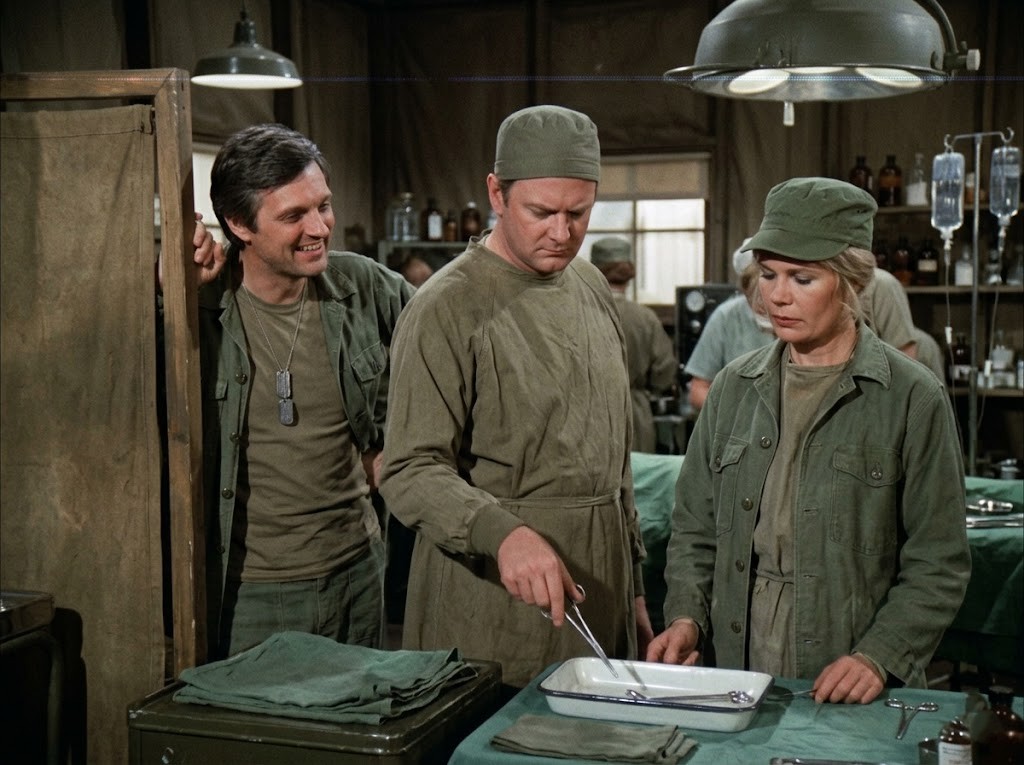
The overhead lamps in the operating tent always hummed a fraction out of tune with the generators. It was a low, vibrating drone that settled deep into your teeth after twelve hours of meatball surgery, a sound that meant you were still moving, still breathing, and still fighting the mud.
The final patient of the night had just been wheeled out to post-op, leaving behind the heavy scent of antiseptic, sweat, and old copper. The frantic rush of shouting nurses and clattering metal had evaporated, replaced by the profound, exhausting silence that only a M*A*S*H unit could produce.
Charles Emerson Winchester III stood frozen over an enamel instrument tray, his gloved hand trembling slightly as he held up a pair of surgical forceps. His eyes were fixed on the metal, his aristocratic brow furrowed in a mixture of disbelief and quiet contemplation.
Margaret Houlihan stood right beside him, her cap pulled low, her face etched with the deep, unmistakable lines of a thirty-hour shift. She didn’t look at Charles; she looked only at the tray, her hands resting flat against her green fatigues as if she were trying to anchor herself to the earth.
Leaning against the wooden frame of a privacy screen just a few feet away, Hawkeye Pierce watched them both with a tired, knowing smile. His dog tags hung loose over his chest, catching the dull glare of the remaining lamp, and his jacket was thrown open in absolute surrender to the humidity.
“You know, Charles,” Hawkeye said, his voice a gravelly whisper that barely carried across the tent, “if you stare at it any harder, you’re going to burn a hole right through the enamel. And Radar just cataloged that tray last week.”
Charles didn’t snap back with his usual venom, which was the first sign that something was truly amiss. He merely shifted his grip on the instrument, his thumb tracing the hinge of the clamp.
“This is a vintage piece, Pierce,” Charles murmured, his voice stripped of its usual booming Boston theatricality. “Crafted in Boston. A personal gift from my uncle, a man who believed that a surgeon’s tools are an extension of his very soul.”
Margaret finally shifted her gaze, her eyes tracking the movement of Charles’s fingers on the metal. “It’s bent, Charles,” she said softly, her voice lacking its usual commanding edge. “The alignment is completely gone.”
“Precisely,” Charles said, his voice tightening. “During the influx, when the boy from the 8th Cavalry started to bleed out on my table… I didn’t have time for elegance. I forced it. I clamped blindly into the dark, ignoring every tenet of proper surgical form.”
He held the instrument up a little higher, the light catching the distinct, irregular curve in the stainless steel. It was ruined by any traditional medical standard—a piece of precision Boston engineering warped by the raw, unyielding chaos of a Korean hillside.
Hawkeye straightened up slightly from the wooden partition, his smile fading into something much softer, much more grounded. He knew exactly which boy Charles was talking about, and he knew exactly what that bend in the metal represented.
Margaret looked from the bent forceps up to Charles’s face, her expression a mix of professional sorrow and deep, unspoken empathy. “Charles…” she began, her voice cracking just a bit under the weight of the endless day.
Charles let out a long, ragged breath, his shoulders sagging beneath his surgical gown as he stared at the ruined piece of home. “I have broken the first rule of the Winchester line, Major. I allowed this place to change the tool.”
The silence returned, heavier this time, stretching between the three of them like a taut wire as the reality of their exhaustion finally caught up.
Hawkeye stepped forward, his boots clicking softly against the floorboards as he crossed the small distance between the partition and the instrument table. He didn’t mock, and he didn’t offer a grand philosophical speech; he simply reached out and gently tapped the edge of the enamel tray.
“The tool didn’t change, Charles,” Hawkeye said quietly, looking Winchester straight in the eye. “It just adapted to the neighborhood. Around here, elegance doesn’t keep a heartbeat going.”
Charles looked down at the forceps again, his jaw tightening as he fought against the overwhelming fatigue that always threatened to break a person after the sewing was done. “It was perfect, Pierce. Before I arrived in this godforsaken swamp, it was perfect.”
“Perfect for a well-lit theater in Massachusetts,” Margaret countered, her voice firming up as her natural strength took over. She reached out, her hand hovering over the tray, not quite touching Charles but offering a steady presence that he sorely needed. “But out here, perfect is whatever keeps a nineteen-year-old kid from going home in a box.”
She looked at Charles with a tenderness that she rarely allowed the rest of the camp to see—the look of a chief nurse who carried the weight of every wounded boy right alongside her surgeons. “That kid is in post-op right now, breathing on his own, because you forgot about Boston for five seconds and remembered how to fight.”
Charles looked at Margaret, his eyes searching hers for a moment before he looked back at the instrument in his hand. The haughty defense mechanism that usually protected his ego seemed to dissolve in the warm, dim light of the tent.
Hawkeye let out a dry, gentle chuckle, leaning his hip against the table. “Look at it this way, Charles. You’ve officially been initiated. You can’t truly call yourself a 4077th surgeon until you’ve ruined at least one piece of expensive personal property in the name of saving a life.”
“I hardly think a bent clamp qualifies as a badge of honor, Pierce,” Charles muttered, though the sharpness had completely left his tone, replaced by a weary, reluctant acceptance.
“It’s the best kind of badge,” Hawkeye said, his voice dropping to that warm, familiar register that kept the dark at bay. “It doesn’t go on a uniform, and you don’t get a speech from a general. But every time you look at it, you’ll remember that a kid from Iowa is going to see his mother again because this little piece of steel gave up its shape.”
Charles stood in silence for a long time, the hum of the lamps filling the void between them. Slowly, deliberately, he lowered his hand and placed the forceps back into the white enamel tray with a soft, metallic click.
He didn’t throw it away. He didn’t cast it aside in disgust. He simply laid it down next to the other tools, a permanent part of the collection now.
Margaret watched the instrument settle, a faint, tired smile finally touching the corners of her lips. She looked up at Hawkeye, a brief spark of shared understanding passing between them, before she turned her attention back to the orderly cleanup of her domain.
“Alright, gentlemen,” Margaret said, her voice returning to its familiar, grounding rhythm. “Let’s get this place wiped down before the morning shift arrives. Colonel Potter wants a full inventory by 0800, and I don’t want to be doing it in my sleep.”
“Spoken like a true romantic, Major,” Hawkeye said, his wry smile returning as he stepped back toward the exit of the tent, lifting a hand in a lazy salute. “I’m going to go see if BJ left any swamp gin in the bottom of the still. Charles, if you need me, I’ll be practicing my imperfect form.”
Charles didn’t look up as Hawkeye walked away, but the ghost of a smile appeared on his face, quickly hidden by a polite clearing of his throat. He reached for a towel, wiping his hands with the meticulous care of a Boston aristocrat who had finally found his place in the mud.
The swamp was still loud in the distance, the frogs croaking in the compound and the distant rumble of artillery reminding them where they were. But inside the tent, under the humming lights, three tired people had found a small, quiet victory to carry them through to the dawn.
Sometimes the things we break out here are the only things that keep us whole.