The Last Round at Rosie’s
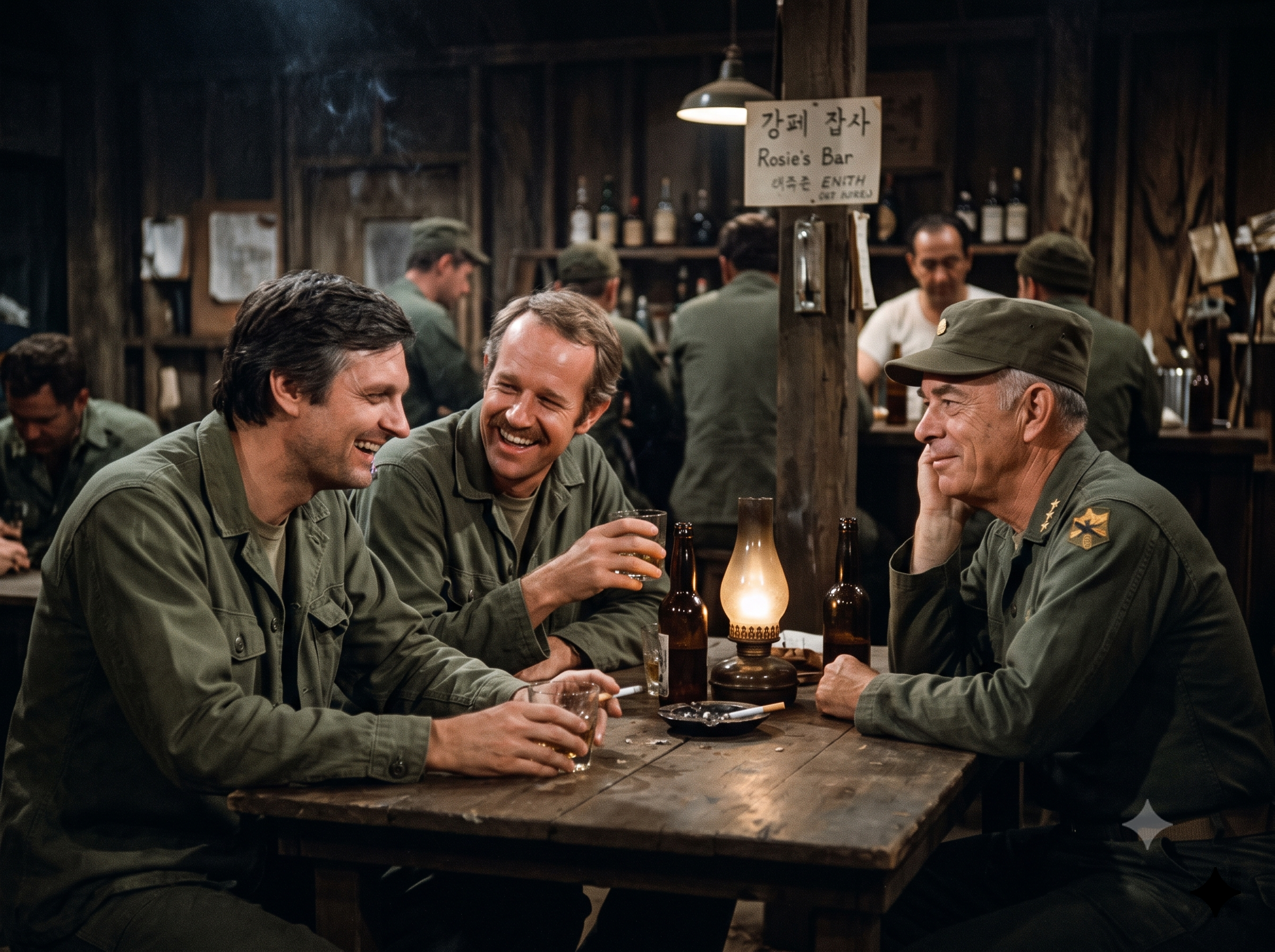
The air in Rosie’s Bar was thick—a familiar cocktail of stale cigarette smoke, damp earth, and the faint, lingering scent of pine cleaner that never quite did the job. Outside, the Korean night was a vast, unblinking eye, but in here, time had decided to take a permanent holiday.
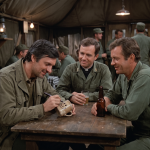
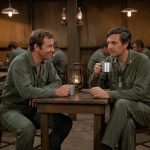
Hawkeye Pierce leaned back, his green fatigues rumpled from a shift that felt like it had lasted three days instead of twelve hours. Beside him, B.J. Hunnicutt was nursing a drink that looked suspiciously like watered-down bourbon, a small, genuine smile plastered across his face.
Across the scarred wooden table sat Colonel Potter, his cap pulled low, his eyes reflecting the soft, flickering amber of the oil lamp burning between them. It was a quiet moment, the kind that was rare in the 4077th, where every heartbeat felt measured against the backdrop of a war that had no end in sight.
“I’m just saying, Colonel,” Hawkeye said, his voice dropping into that familiar, raspy cadence of exhaustion laced with humor, “if you let Klinger run the supply tent for one more week, we’ll be eating nothing but dehydrated apricots and wearing dresses made of parachute silk.”
B.J. chuckled, a low, grounding sound. “And I think you’d look lovely in pink, Hawk. It’d really bring out the dark circles under your eyes.”
Potter’s mustache twitched—the only outward sign of the grin he was suppressing. He leaned forward, his hands wrapping around his glass as if it were a tactical map.
“Gentlemen,” Potter began, his voice gravelly but warm, “if I had any intention of listening to your advice on logistics, I’d have asked for a consultation with the camp’s resident geniuses years ago.”
He looked at them, really looked at them, and for a split second, the humor drained from the room. The exhaustion wasn’t just physical; it was a weight that settled into the joints, the kind that made you wonder if you’d ever feel light again.
Then, Hawkeye’s expression shifted. He reached out, his hand hovering over the table, and his voice dropped to a whisper that cut through the low roar of the bar.
“Colonel, we heard about the incoming chopper pilot. The one you flew with back in the Big War. We know it’s been a long night.”
The silence that followed was absolute. The clinking of glasses at the bar stopped. The shadows seemed to stretch, pulling the three of them into a singular, fragile circle of truth. Potter didn’t flinch, but his grip on the glass tightened until his knuckles went white.
Potter looked down at the table, his eyes tracing the grain of the wood as if reading a story etched there long before they’d arrived. The bravado he carried—the stoic, iron-willed commander—softened, revealing the tired, old man who had seen too many boys go home in pieces.
“He was a good kid,” Potter said, his voice barely audible. “We played cards in a foxhole in the Ardennes. He told me he was going to open a bakery when he got back. He had a picture of a girl with a ribbon in her hair tucked into his helmet liner.”
He looked up then, and the pain in his eyes was so raw, so unadorned, that Hawkeye and B.J. felt the breath catch in their throats.
“He didn’t make it to the bakery,” Potter finished. “And tonight, hearing that call sign over the radio… it brought it all back. The cold. The noise. The silence that follows.”
Hawkeye looked at B.J. There was no quip to be made here. No smart-aleck remark could bridge the chasm between the war they were fighting and the ghosts the Colonel was carrying. Hawkeye reached out, placing a firm, steady hand on the table near the Colonel’s.
B.J. nodded, his own smile fading into an expression of profound, quiet empathy. “We’re here, Colonel,” he said simply. “You’re not sitting in that foxhole alone.”
Potter looked at their hands—three men who had no business being friends, forged by a chaos they hadn’t invited, held together by the thin thread of their shared humanity. He took a long, steadying breath, and the tension in his shoulders seemed to bleed away, replaced by a weary, grateful acceptance.
He picked up his glass, holding it up in a silent, jagged toast. “To bakeries,” he murmured. “And to the ones who keep us anchored when the wind tries to blow us away.”
Hawkeye and B.J. raised their glasses, the glass clinking softly against the Colonel’s—a tiny, fragile sound that seemed to ring out against the backdrop of the war outside. For that moment, the exhaustion didn’t matter. The mud didn’t matter. The uncertainty of tomorrow evaporated in the golden, flickering light of the lamp.
They sat there for a long time, not saying much, just existing in the space between the memories of the past and the demands of the next morning. They were tired, they were frayed, and they were far from home—but they were together.
And in the 4077th, sometimes, that was the only miracle you were allowed.
They were just men in the dark, keeping the light on for each other.