The Distance to the Porch
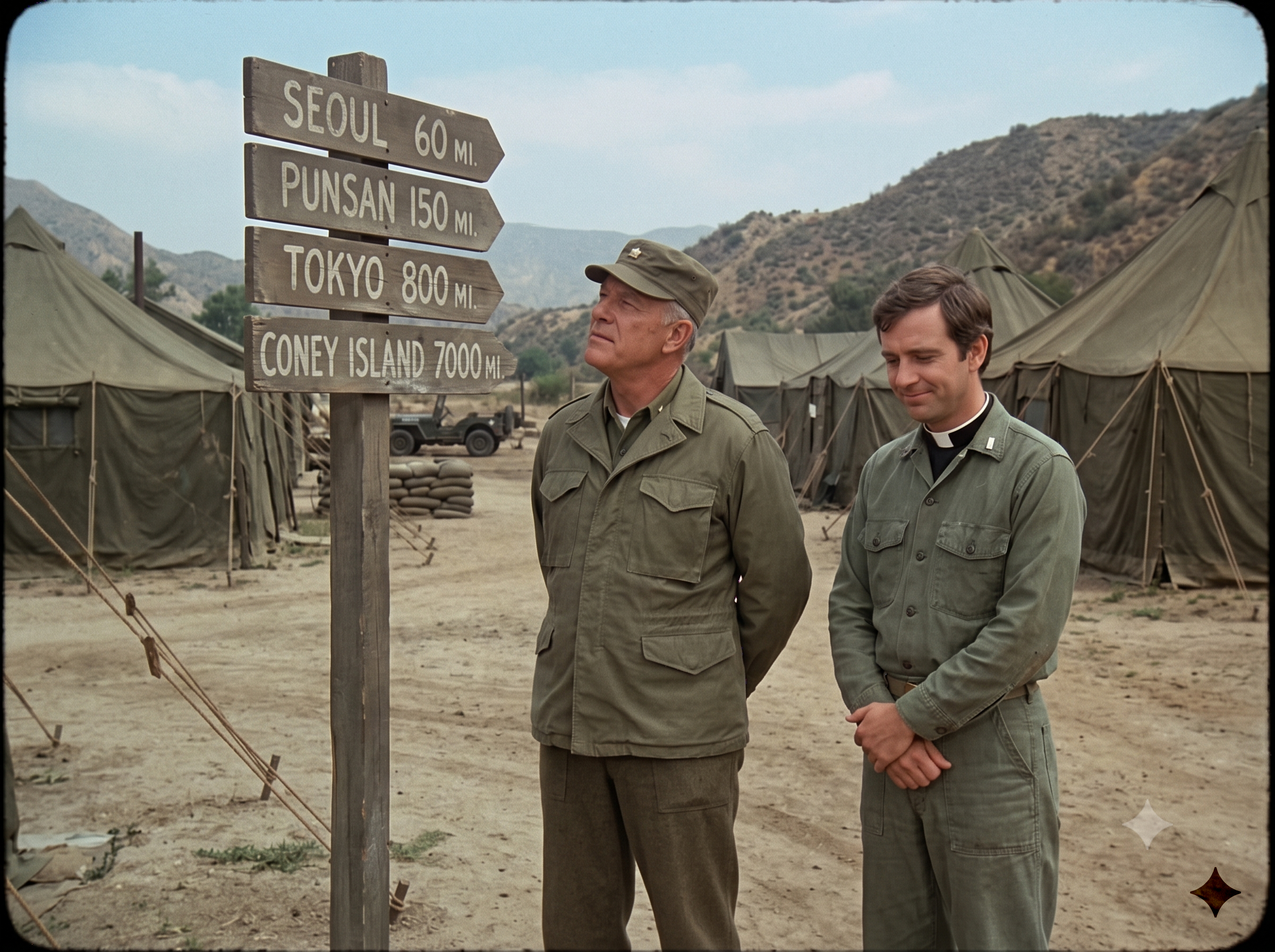
The war was always loudest in the quiet moments. It was early morning at the 4077th Mobile Army Surgical Hospital, in that fragile, fleeting hour before the choppers arrived. The sky was a soft, muted blue, hanging delicately over the dusty beige canvas of the sleeping tents.
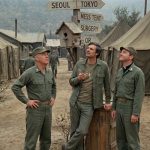
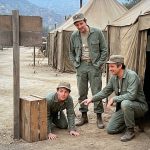
In the center of the outdoor compound, Colonel Sherman T. Potter stood perfectly still. His posture was compact and stable, grounded in the South Korean dirt as if he had been planted there. He wore his faded green fatigues and his standard-issue cap, his hands clasped firmly behind his back.
He was staring up at the wooden signpost. It was a crooked, weathered monument to homesickness, standing sentry in the middle of a war zone.
Father Francis Mulcahy stepped softly onto the dirt path, his boots making only a gentle crunching sound. He paused when he saw the Colonel.
Mulcahy knew better than to interrupt a man in the middle of a heavy thought. But he also knew that out here, a man left alone with his heavy thoughts for too long could easily drown in them.
He moved to stand quietly beside the Colonel, offering his presence rather than his words.
For a long time, neither man spoke. The morning air was cool, carrying the faint, metallic scent of the motor pool and the lingering, ghostly smell of antiseptic from the night before.
“Seoul, sixty miles,” Potter said finally, his gravelly voice keeping its volume low, as if not wanting to wake the surrounding tents.
“Punsan, one hundred and fifty miles,” the Colonel continued, his eyes tracing the jagged painted letters on the wood. “Tokyo, eight hundred. Coney Island… seven thousand.”
Mulcahy looked slightly off to the side, his hands folded neatly in front of his waist. “It is a rather staggering piece of geography, isn’t it, Colonel?”
“It’s a cruel joke, is what it is, Padre,” Potter replied, though there was no real anger in his tone. Just a deep, bone-weary fatigue. “You look up at this post, and it tells you exactly how far away you are from everything that makes sense.”
Potter shifted his weight, his eyes still fixed on the topmost arrows. “I sat down to write to Mildred last night. Just a regular letter. The weather, the food, the usual complaints about Pierce and Hunnicutt turning the Swamp into a still.”
Mulcahy offered a small, knowing smile. “A familiar litany.”
“But then I wanted to tell her about a dream I had,” Potter said, his voice dropping a fraction of an inch. The gentle pride in his posture seemed to carry a sudden, unseen weight.
“I dreamed I was sitting on our front porch back in Hannibal. I could feel the breeze. I could hear the rocking chair creaking. But Padre…” Potter turned his head, looking at Mulcahy with a sudden, startling vulnerability.
“For the life of me, I couldn’t remember the color of the porch railing. I sat there with my pen hovering over the paper, and my mind was entirely blank. Was it white? Was it a dark green? I’ve painted that railing three times myself, and this war just wiped it clean out of my head.”
Potter turned back to the signpost, his jaw tightening under the pressure of the revelation.
“If a man starts forgetting the very home he’s trying to survive for… what exactly is keeping him tethered to the earth?”
Mulcahy absorbed the Colonel’s words in silence. He stood slightly to the side, a calm and grounding presence amid the dusty beige surroundings.
A quiet sadness settled into the corners of the priest’s eyes. It was the sorrow of a man who spent his days trying to bandage up the souls of people who were stretched far too thin.
Yet, beneath that sadness was a profound, hopeful warmth. He gently adjusted his hands, his fingers intertwining as he gathered his thoughts.
“I don’t believe the war has wiped it from your mind, Colonel,” Mulcahy said softly, his voice a soothing balm in the morning chill. “I believe the mind simply runs out of room.”
Potter gave a small, skeptical grunt, but he didn’t pull his gaze away from the signs.
“Consider what you are asked to hold in your head every single day,” Mulcahy continued, looking up at the fading painted letters for Tokyo. “You hold the lives of every doctor, nurse, and corpsman in this camp. You hold the logistics of a hospital that is constantly running out of supplies.”
Mulcahy turned his head slightly, his expression earnest and incredibly kind. “You hold the names of the boys who come through our doors. The ones who go home, and the ones who do not. That is a tremendous amount of weight, Colonel. It takes up a great deal of space.”
Potter sighed, his shoulders dropping a fraction of an inch. “So you’re saying my porch railing got evicted to make room for a shipment of plasma?”
“In a manner of speaking, yes,” Mulcahy smiled gently. “The human heart is resilient, but it is not infinite. It prioritizes what is immediately necessary for survival.”
The priest took a small step closer to the wooden post. He looked at the crude, hand-painted letters pointing all the way toward Coney Island.
“But forgetting the color of the paint does not mean you have forgotten the porch,” Mulcahy said quietly, bringing absolute moral clarity to the dusty air. “You remember the breeze. You remember the creak of the rocking chair. You remember Mildred.”
Potter’s eyes softened. The rigid, military line of his jaw finally relaxed.
“The essence of your home is still perfectly intact, Colonel,” Mulcahy assured him. “The details may blur because you are giving so much of your spirit to the people in this compound. But the foundation remains.”
A soft breeze drifted through the camp, causing the canvas of the nearby tents to ripple. The sound was like the breathing of some large, tired animal finally waking up for the day.
Potter slowly lowered his head. He let out a long, slow breath, a sound that carried months of exhaustion followed by a sudden, profound relief.
“White,” Potter said suddenly, a spark of life returning to his eyes.
Mulcahy looked at him, his eyebrows raised in gentle inquiry. “Sir?”
“It’s white. Peeling a little on the bottom rung because the neighbor’s hound keeps scratching at it,” Potter said, a genuine, warm smile breaking across his weathered face. “Mildred’s been after me to scrape it and put on a fresh coat for two years.”
“Well,” Mulcahy beamed, his hands unclasping as a wave of pure joy washed over him. “It sounds like you have a very important task waiting for you when this is all over.”
“That I do, Father. That I do,” Potter said, straightening his posture. The compact, stable command presence returned, but this time it was fueled not just by duty, but by a renewed sense of hope.
From across the compound, the sharp bang of a screen door echoed.
“Morning, Colonel! Morning, Father!” came the distant, unmistakable voice of Hawkeye Pierce, followed immediately by the sound of him stumbling over a tent rope.
“Watch your step, Hawk, the war is still going on down there,” B.J. Hunnicutt’s voice trailed closely behind, dry and steady.
Potter chuckled softly, shaking his head. The quiet sanctuary of the morning was officially over. The daily madness of the 4077th was winding up its clock.
“Well, Padre,” Potter said, turning to face the direction of the Swamp. “It sounds like the local livestock is awake.”
“Indeed it does, Colonel,” Mulcahy smiled, readying his own heart for whatever chaos the day would bring.
Potter reached out and patted the rough wood of the signpost. He didn’t look at the distances anymore. He didn’t need to.
“Let’s get to work,” Potter said, clapping his hands together once. “We’ve got a lot of miles to cover today.”
The two men walked side-by-side down the dirt path, leaving the signpost behind them, standing tall and pointing the way home under a soft, blue Korean sky.
No matter how far the miles stretched, home was always just a heartbeat away at the 4077th.