A Splash of Color in a Khaki World
Korea had a reliable, ruthless way of bleeding the color out of everything it touched.
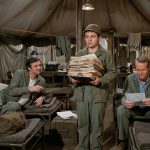
By the time you had been stationed at the 4077th for more than a month, your eyes simply adjusted to a world composed entirely of three shades: olive drab, canvas tan, and dusty beige.
The sky above the camp on this particular Tuesday was a muted, heavy gray. The dirt paths running between the tents were dry and powder-fine.
It was a quiet morning, the kind of rare, fragile morning that only arrived after a brutal, unending night in the operating room.
Colonel Sherman T. Potter stepped out of his office, hoping for nothing more complicated than a decent cup of coffee and a moment of peace. He wore his standard fatigues and his soft cap, his shoulders carrying the heavy, invisible weight of command.
He took two steps into the compound, stopped, and planted his hands firmly on his hips.
The universal stance of a military commander who has seen it all, yet is somehow, miraculously, seeing something entirely new.
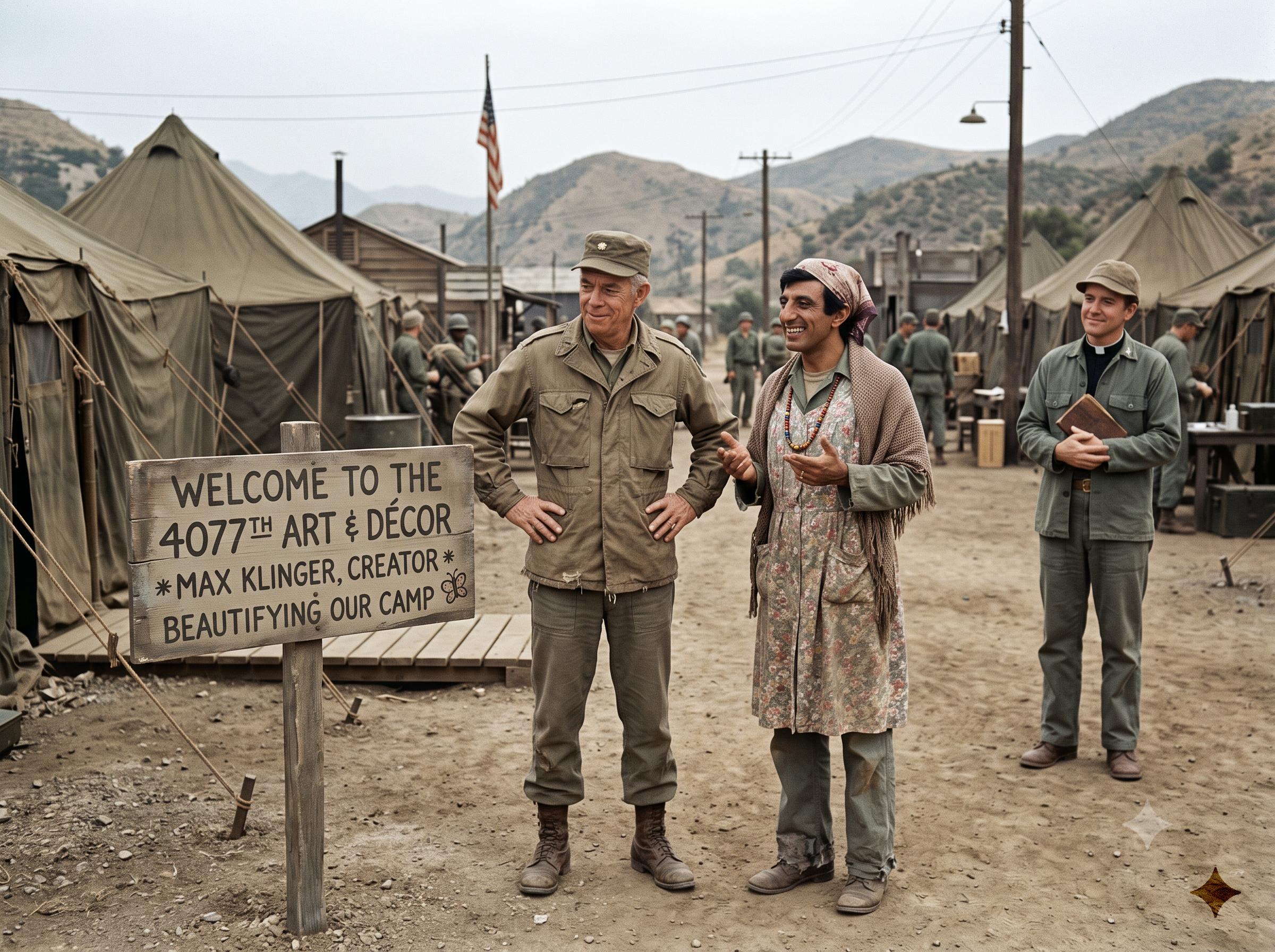
Planted squarely in the middle of the walkway, catching the soft, diffused daylight, was a brand-new wooden sign.
It was large, sturdy, and painted with an alarming level of care.
“WELCOME TO THE 4077TH ART & DÉCOR,” the bold black letters proclaimed.
Beneath that, flanked by little decorative asterisks: “* MAX KLINGER, CREATOR *”
And finally, at the bottom, right next to a delicately painted little butterfly: “BEAUTIFYING OUR CAMP.”
Standing right beside this masterpiece was Corporal Max Klinger.
He was not wearing fatigues. He was not wearing anything approaching standard issue.
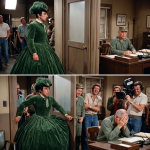
Klinger was dressed in a long, faded floral dress that looked like it had been repurposed from a Toledo grandmother’s sitting room curtains.
Wrapped around his shoulders was a thick, brown knitted shawl. A colorful beaded necklace rested against his chest, and his hair was neatly tied back in a patterned headscarf.
He didn’t look crazy. He looked incredibly, undeniably proud.
His face was split into a wide, beaming smile, his eyes shining with absolute sincerity. His hands were raised in a gentle, theatrical gesture of presentation, as if he were unveiling a masterpiece at the Louvre rather than a piece of scrap wood in a Korean dirt patch.
A few steps away, standing near the edge of the tents, Father Mulcahy watched the scene unfold.
The chaplain held a thick, worn book pressed gently to his chest. He wasn’t interrupting. He was just observing, a soft, innocent smile playing on his lips, recognizing the perfect, ridiculous timing of the moment.
Potter stared at the sign. He stared at the butterfly. Then, slowly, he shifted his gaze to his company clerk.
“Klinger,” Potter said, his voice a low, gravelly rumble that carried across the quiet compound.
“Good morning, Colonel!” Klinger practically sang, his energy vibrating with resilient pride. “Notice anything different? Anything… aesthetically pleasing?”
Potter sighed, a long, weary exhalation that seemed to originate from the soles of his boots. He had spent the last fourteen hours up to his elbows in the grim realities of war.
He didn’t have the energy for a Section 8 scam. He didn’t have the patience for theatrical nonsense.
He had to maintain order. He was a regular army man, and this was an army camp, not a Greenwich Village art collective.
Potter narrowed his eyes, his face setting into a stern, unreadable mask.
He took a slow, deliberate step forward, looking Klinger up and down, preparing to deliver a verdict that could crush the vibrant, eccentric spirit right out of the man.
Klinger’s bright smile faltered, just for a fraction of a second, as the heavy silence stretched out beneath the muted Korean sky.
“A butterfly, Klinger?” Potter finally asked, his tone dry as the dirt beneath their boots. “Is that what we’re doing now? Entomology?”
Klinger instantly bounced back, leaning in with eager, earnest enthusiasm.
“It’s a symbol, Colonel! Metamorphosis! A caterpillar goes into a dark, ugly cocoon, and comes out a beautiful, soaring creature. I felt it was highly thematic for our current living conditions.”
Potter’s mustache twitched. “Your current living condition, Corporal, is the United States Army. Which, to my knowledge, has never authorized the deployment of decorative butterflies.”
Klinger clutched his shawl a little tighter, his voice dropping its theatrical pitch, becoming surprisingly grounded.
“Colonel, with all due respect, look around us,” Klinger said softly. “It’s all dirt. It’s all mud. It’s khaki and canvas and… and blood.”
Klinger gestured broadly to the camp behind him.
“People need to see something else. The doctors stumble out of that O.R. looking like ghosts. Major Houlihan is stressed to the gills. I just thought… if I could add a little art. A little décor. Maybe a centerpiece for the mess tent, some nice drapes for the VIP quarters… it might make people feel like human beings again.”
Potter stared at him. The sheer, naked honesty of the statement caught him off guard.
This wasn’t just a scheme to get a psychiatric discharge. It was a coping mechanism.
It was a desperate, beautiful, ridiculous attempt to paint over the horrors of the war with a floral print and a positive attitude.
“He makes a compelling argument, Sherman,” a gentle voice chimed in.
Father Mulcahy stepped forward from the shadows of the tents, his smile warm and steady.
“The Lord provides us with trials in the wilderness,” the chaplain said, his voice carrying that quiet, moral bravery he always possessed. “But He never commanded that the wilderness couldn’t use a fresh coat of paint. The soul gets terribly thirsty for a little beauty out here.”
Potter looked at the priest. Then he looked back at the corporal from Toledo, dressed like a 1950s housewife, standing fiercely by a wooden sign that promised to beautify a warzone.
For a long moment, the only sound was the distant hum of a jeep and the flap of canvas in the wind.
Potter felt the deep, bone-deep fatigue of the previous night’s surgery washing over him again. But the anger he had expected to feel simply wasn’t there.
Instead, a strange, quiet tenderness settled in his chest.
These were his people. This crazy, exhausted, deeply loving found-family. They survived by clinging to their humanity in the most absurd ways possible.
If Hawkeye could survive on bad jokes and gin, and B.J. could survive on letters from home, maybe Klinger needed to survive by being the 4077th’s resident interior decorator.
Potter reached up and adjusted his glasses. He let out another sigh, though this one lacked its previous heavy edge.
“Alright, Klinger,” Potter said slowly, adopting his most fatherly, authoritative tone. “The sign stays.”
Klinger gasped, his eyes widening. “Really, Colonel?”
“Under one condition,” Potter continued, pointing a stern finger at the wooden board. “If I trip over this thing in the dark on my way to the latrine, I am personally using your metamorphosis butterfly as kindling for the morning fire. Are we clear?”
Klinger drew himself up, maintaining a profound, dignified posture despite the floral dress.
“Crystal clear, Colonel. You won’t regret this! I’ve already got ideas for the swamp. I’m thinking… rustic chic.”
Potter simply shook his head, a ghost of a smile finally breaking through his weary expression.
“Just keep the chic out of my office, Corporal,” Potter said.
He turned and continued his walk toward the mess tent, feeling surprisingly lighter than he had five minutes ago.
Behind him, he could hear Klinger excitedly explaining his vision for throw pillows to a patiently listening Father Mulcahy.
“You see, Father,” Klinger’s voice echoed across the dirt path, “it’s all about creating an ambiance that distracts from the incoming artillery…”
The war was still going on. The sky was still gray, and the dirt was still everywhere.
But as Potter walked away, he had to admit that the camp did look just a little bit brighter.
They couldn’t stop the war, but they could always find a way to paint a butterfly on it.