The Clipboard’s Prayer
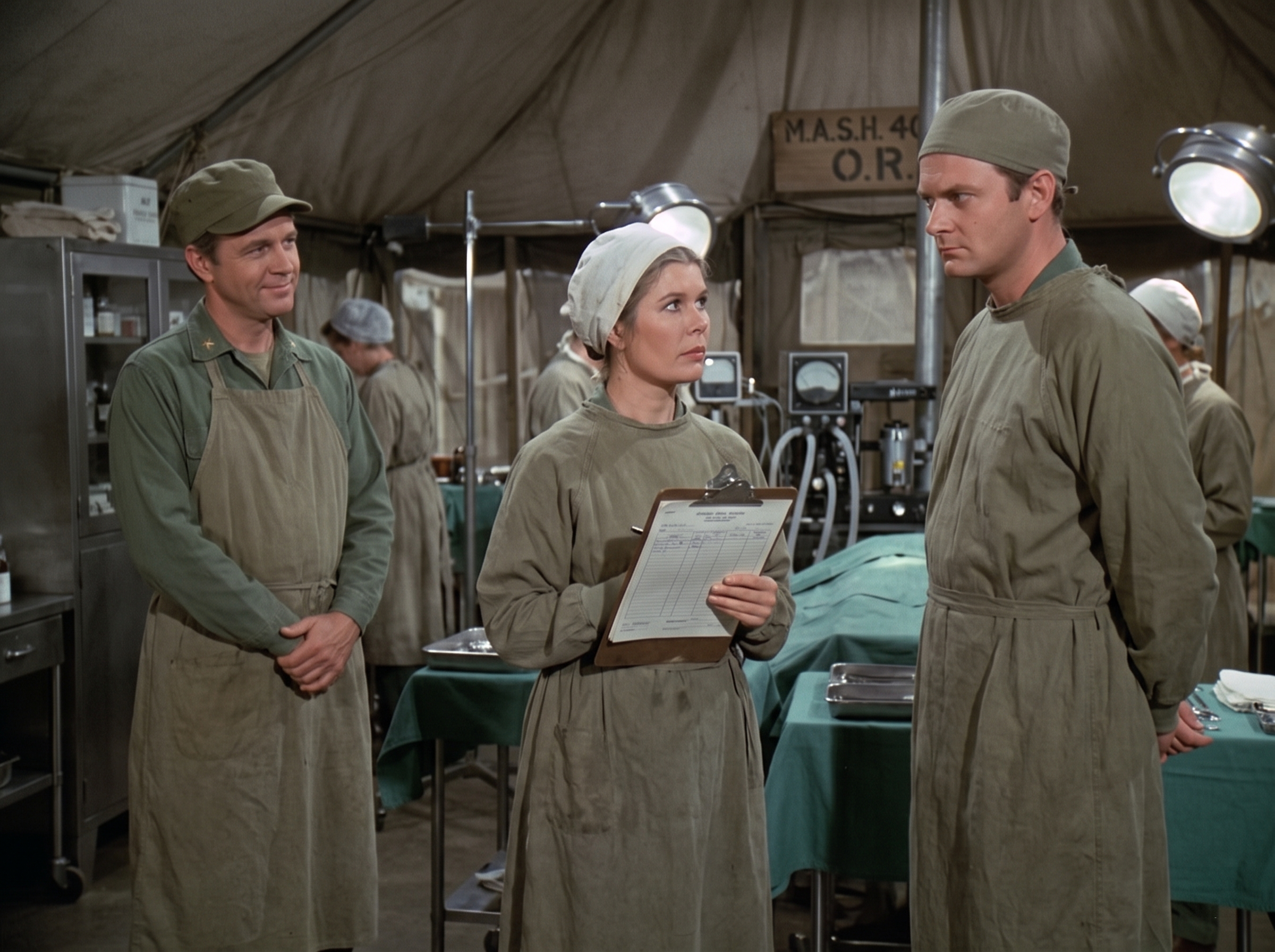
The last of the morning’s wounded were just being wheeled to Post-Op.
The O.R. was finally turning quiet, a heavy, tired kind of quiet.
Captain B.J. Hunnicutt, looking unusually fresh but actually just very, very determined, was making his usual post-surgical rounds.
His simple green uniform still held a few stubborn stains, but his mustache was combed, and he had that easy, encouraging smile he always saved for the hard moments.
Nearby, Major Margaret Houlihan was already changing into a fresh scrub gown and cap, having traded her usual impeccable uniform for the utility of the O.R.
She had her clipboard locked tight in her hands, her brow furrowed in fierce concentration.
“Margaret, you haven’t sat down since yesterday afternoon,” B.J. noted, his voice low enough not to carry.
“The patient charts won’t update themselves, Captain,” Margaret replied, not breaking stride or looking up from her notes.
“They might, if you glare at them long enough.”
“A little discipline goes a long way, B.J.,” she countered, finally glancing at him with a weary but sharp look.
“And a little rest goes a lot further. Radar practically had to prop up Pierce in Post-Op just so he could finish a suture. I think we’re all running on caffeine and pure willpower.”
Just as he finished, another body moved in their periphery.
Colonel Potter, still in his full O.R. scrubs, cap, and heavy green apron, came to a halt right next to them.
His arms were clasped behind his back, a characteristic stance that usually signaled bad news or a lecture.
The expression on his face, though, was different. He looked older than he did that morning.
He stood perfectly still, looking squarely at Major Winchester, who was just across the room, also still in his scrubs and apron, staring down at a surgical tray.
Winchester hadn’t moved a muscle. He was statuesque, his usual commanding posture replace by an absolute, paralyzed silence.
Everyone froze. In the 4077th, silence was far louder than noise.
“Charles,” Potter finally said, his voice surprisingly gentle but razor-edged.
Winchester didn’t answer. He didn’t even blink. He continued to stare at the steel instruments in the tray, as if they held an answer he couldn’t grasp.
Potter slowly walked around Margaret, closing the distance to Charles.
His heavy apron rustled faintly. “Charles?”
The silence stretched, thick and painful. Major Houlihan tightened her grip on her clipboard, her knuckles white.
The O.R. staff was frozen, watching the tableau of the three officers in the foreground, unaware of the figures still working diligently to clean up in the background, out of focus but always present.
“We just did everything we could, Colonel,” B.J. offered quietly.
Potter didn’t turn to him. He was locked on Charles. “Did you lose him, Major?”
Charles blinked once, slowly. He finally lifted his head, his eyes meeting Potter’s. There was no usual arrogance, no quick retort. Only a profound, shattering emptiness.
“He was twenty-one, Colonel.” Charles’s voice was barely a whisper. “Twenty-one. From Boston.”
“I know.”
“He said… he was going to marry a girl named Sarah, and they were going to have a house with a proper garden.” Charles paused, his gaze drifting back down to the gleaming tools. “I told him he would. I promised him.”
The admission hung in the air, weighted with the raw humanity that Charles so often tried to conceal. A promise made not by a major to a soldier, but by one man to another.
Potter put a steady, fatherly hand on Charles’s shoulder. The contact seemed to ripple through him.
“You gave him hope when he needed it most, Charles. That’s not a small thing.”
Major Winchester looked back at Potter, and for a fleeting, impossible moment, his eyes glistened, though he quickly forced his composure back.
“But the gardening… that is gone.”
“It is,” Potter confirmed. “But the boy went knowing someone cared enough to tell him he had a future. He didn’t go alone.”
B.J. finally stepped in, a rare gravity in his voice. “He knew you were fighting for him, Charles. We all saw it.”
Charles Winchester nodded once, a quick, jerky motion, and finally looked down at his own apron, the simple canvas that covered his fine uniform. He let out a long, ragged breath that seemed to empty his entire being of its remaining energy.
Margaret, watching this break in the Great Winchester facade, took a slow breath of her own. She looked down at her clipboard, a simple list of supplies and schedules, which suddenly seemed so terribly small and fragile against the tide of everything else.
“He fought harder than any officer I’ve seen,” Margaret said softly, her stern professional armor slipping just enough.
The acknowledgment hung between them, a silent bridge. Charles slowly began to untie his green apron, his movements robotic and slow.
“You did good work today, Major. All of you,” Colonel Potter said, pulling his own surgical cap from his head, the red scar of the elastic band visible on his forehead. “Go get some coffee. That’s an order.”
Charles dropped his apron onto a nearby chair, revealing the exhausted, tired man beneath. He reached into his scrub gown pocket and pulled out his gold cigarette case, tapping it against his thumb with practiced, refined ritual. It was a small act of reclamation, of putting back on the persona that kept the world out.
But as he looked across the room, past the O.R. lights and the stainless steel, past the faces of his colleagues, towards the Post-Op tent, his usual sarcastic wit was nowhere to be found.
“Just to keep… the chill… at bay,” he mumbled, not looking at anyone, as he walked towards the exit.
B.J. and Margaret shared a final look as they began to strip out of their own O.R. gear. The momentary crack in Winchester’s armor had passed, but they had all seen the heart that lay within, just for a moment, a rare jewel amidst the mud and the blood.
Potter lingered, watching the empty operating tables. He pulled his clipboard close, just like Margaret had, a shared reflex to seek comfort in structure when chaos tried to win. For in this tent, where life and death were simple equations written in surgical ink, a little humanity, even a major-sized crack in an intellectual wall, was the only thing that made any of it bearable.
They fought for the lives they could save, and mourned the hopes that faded with the ones they couldn’t, forever held in the quiet tenderness of the 4077th’s longest shifts.