The Quiet Broadcast of the 4077th
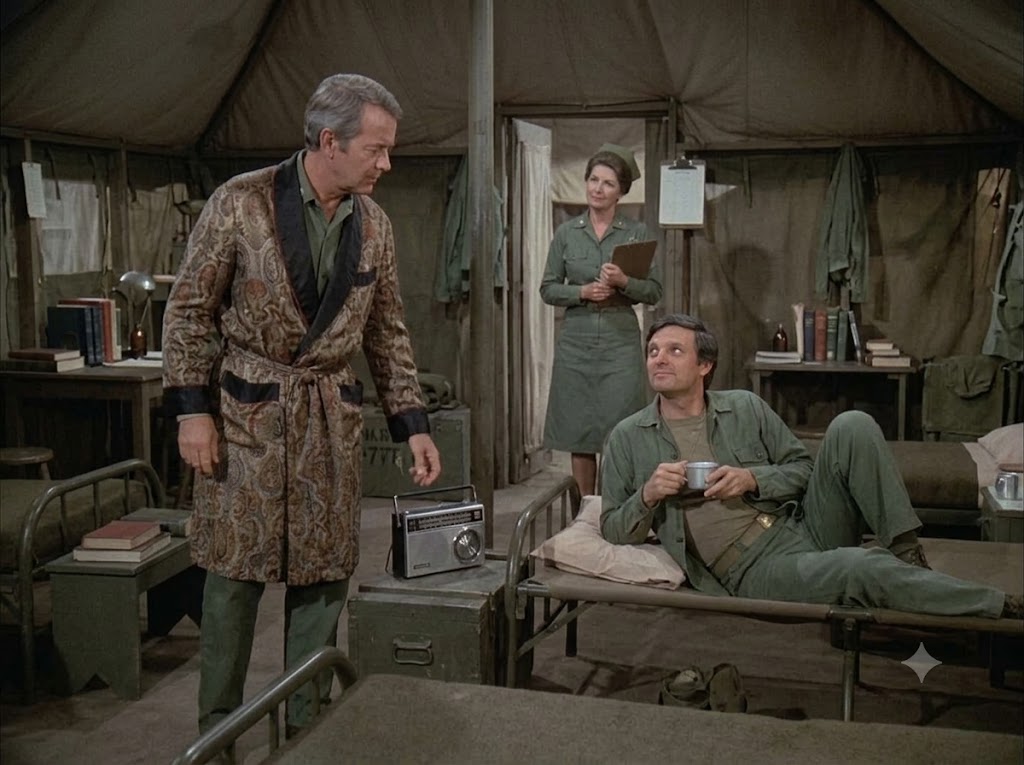
The mud in Korea has a way of seeping into your boots, but the fatigue of a thirty-hour shift in Post-Op seeps straight into your soul. In the quiet lull between the unending choppers, the Swamp becomes less of a tent and more of a sanctuary. It is a place where the static of the world fades into something resembling home, if only you can find the right frequency.
In the center of the dimly lit tent, a small, silver transistor radio sat on a green wooden footlocker. It was a fragile piece of metal and wire, looking entirely out of place among the heavy canvas and olive drab gear of the 4077th.
Charles Emerson Winchester III stood over it, wrapped tightly in his patterned, silk paisley bathrobe. His face was a mask of intense concentration, his fingers hovering just a millimeter above the dials as if he were preparing to perform delicate neurosurgery. To Charles, this wasn’t just a radio; it was a lifeline to the civilized world, to the concert halls of Boston where the air didn’t smell of ether and damp canvas.
Lying back on his cot, propped up against a worn pillow, Hawkeye Pierce held a metal tin cup of lukewarm coffee. His green fatigue shirt was rumpled, his boots still caked with dust, but a wry, knowing smile played on his lips as he looked up at Charles. Hawkeye loved the music, sure, but he loved teasing Winchester’s high-brow sensibilities even more.
“Careful, Charles,” Hawkeye remarked, his voice a low, gravelly drawl born of exhaustion. “If you twist that dial any harder, you might accidentally tune into something dangerous. Like a baseball game. Or jazz.”
Charles didn’t look up, his posture remaining stiffly aristocratic despite the drab army trousers peeking out from beneath his elegant robe. “Pierce, your utter lack of appreciation for the finer arts is a blight on this entire peninsula. I am attempting to capture the Armed Forces Network’s broadcast of the Boston Symphony. If I must endure this swamp, I shall do so with Mozart.”
In the doorway of the tent stood Margaret Houlihan. She held a clipboard against her olive-drab skirt, her posture naturally professional, but her usual stern demeanor was softened by a quiet, tired smile. She had come to deliver the evening nurse rotation schedules, but she paused, caught in the warmth of the small, shared moment.
The silence stretched as Charles gave the dial a microscopic turn. A harsh wave of static hissed through the small speaker, cutting through the damp air of the tent.
Then, out of the crackle, a sound emerged. It wasn’t the sweeping violins of the Boston Symphony, nor was it the comforting voice of a stateside announcer. It was a fragile, distant melody played on a lonely piano, trembling across the airwaves from a station far beyond their coordinates.
The smile slowly faded from Hawkeye’s face, his tin cup frozen halfway to his lips. Charles went entirely still, his hand remaining suspended over the radio, his expression suddenly vulnerable as the faint music filled the canvas room.
—
The notes were thin and scratched with interference, but the melody was unmistakable—a gentle, slow rendering of an old American ballad that none of them had heard since leaving home. It wasn’t grand or operatic; it was simple, human, and aching with a quiet nostalgia that hit the occupants of the tent like a physical weight.
Margaret took a soft step inside, her clipboard lowering slightly as she leaned against the wooden support pole of the tent. The rigid Major Houlihan seemed to melt away, leaving only a woman who deeply missed the normalcy of a quiet evening back home.
“It’s beautiful,” Margaret murmured, her voice barely louder than a whisper, as if a sharp breath might break the fragile signal.
“It’s out of tune,” Charles retorted automatically, but the usual bite was missing from his aristocratic voice. He didn’t turn off the radio. Instead, he slowly lowered his hand, his gaze fixed on the spinning silver dial as the music wrapped around them. For all his talk of high culture, the simple, honest melody had found its way past his defenses.
Hawkeye shifted on his cot, his eyes distant as he stared up at the canvas ceiling. The dry, sarcastic quips he usually used to shield himself from the reality of the war simply evaporated. In the reflection of the silver radio, he wasn’t a surgeon cutting through flesh and bone under blinding lights; he was just a boy from Maine, remembering the sound of the Atlantic surf and the smell of his father’s cooking.
From outside, the soft, distinctive crunch of gravel announced the arrival of B.J. Hunnicutt, who stepped into the tent with his hands shoved deep into his pockets. He stopped when he heard the music, a gentle, bittersweet smile touching his mustache. He didn’t say a word; he just leaned his shoulder against the entryway, thinking of Peg, of Erin, and of a house in California that felt a million miles away.
Radar O’Reilly appeared a moment later, a stack of mail tucked under his arm, his large glasses catching the dim light of the tent. He paused, his innocent eyes darting from Hawkeye to Charles, sensing the sacred gravity of the silence. He quietly slid a letter onto Hawkeye’s footlocker and stepped back, content to just listen to the faraway piano alongside his makeshift family.
For a few minutes, the war ceased to exist. There were no incoming choppers, no political divides, no ranks, and no protocols. There was only an aristocratic Bostonian in a paisley robe, a cynical doctor from Maine, a dedicated head nurse, a young father from California, and a kid from Iowa, all anchored to the same spot by a handful of radio waves.
The song drew to a close, the final piano chord lingering in the air before dissolving back into a gentle hiss of white noise.
Charles cleared his throat loudly, a classic defense mechanism, and pulled his bathrobe tighter around himself. “Well,” he muttered, adjusting his cuffs with an air of practiced indifference. “The acoustics of this tent are utterly abysmal anyway.”
Hawkeye took a slow sip of his coffee, the warmth of the cup grounding him as he looked up at Charles with genuine fondness. “Thanks for the concert, Charles. It was just what the doctor ordered.”
Margaret offered a soft, lingering nod to the room, her professional composure returning as she lifted her clipboard. “Goodnight, gentlemen. Try to get some sleep. The choppers won’t wait for us to feel rested.”
As they began to drift back to their respective duties and cots, the lingering warmth of the broadcast remained in the air, a silent reminder of why they fought so hard to keep everyone alive—so they could all, someday, go home to the music.
In the heart of the 4077th, home wasn’t a place on a map, but a melody shared in the dark.