The Quietest Corner of Rosie’s
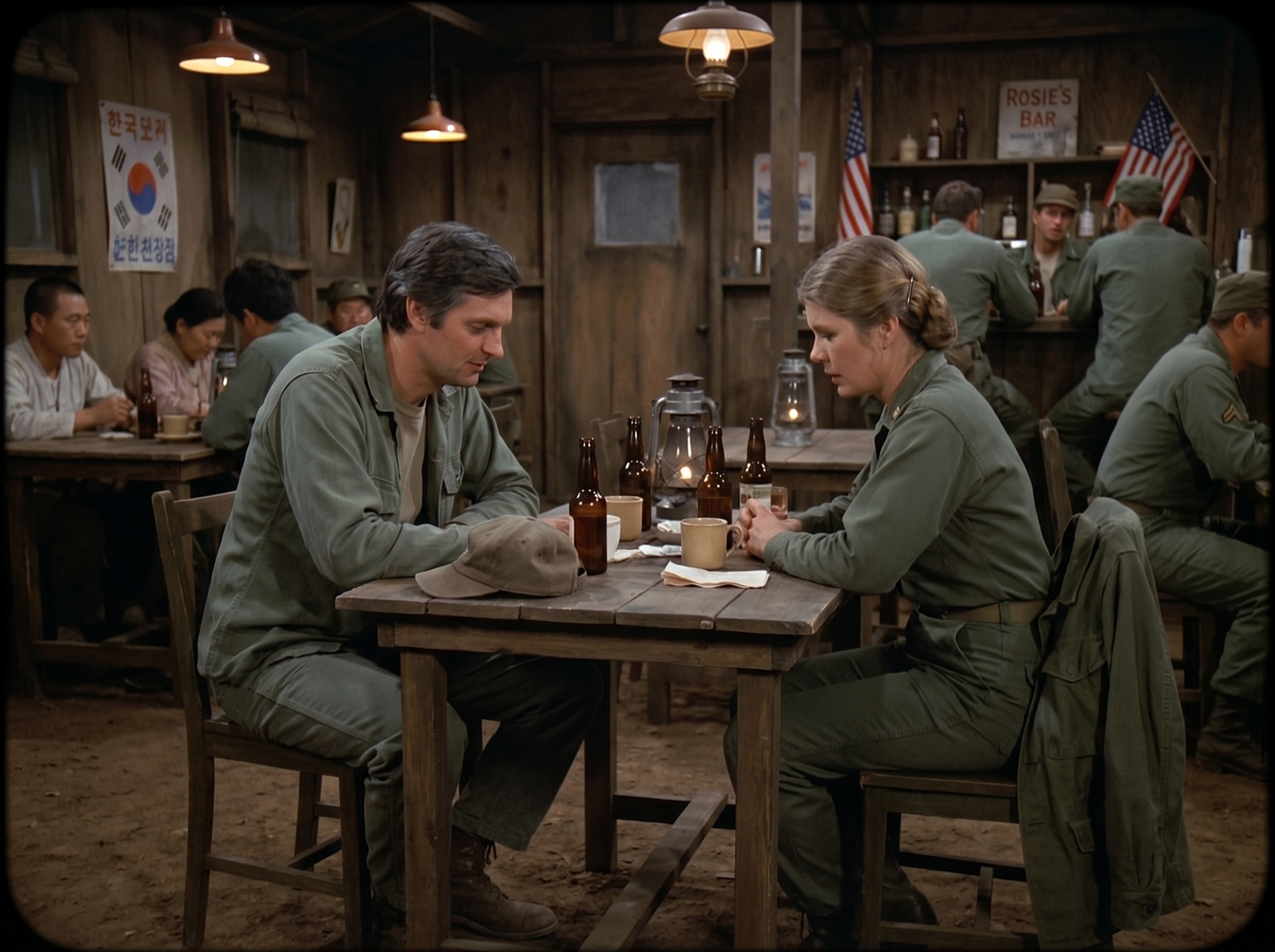
The hum of the generator outside was just a rhythmic, metallic heartbeat, constant and familiar. Inside Rosie’s Bar, the air was thick with the scent of sawdust, stale beer, and the overwhelming desire to be anywhere else but Korea.
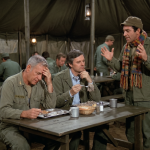
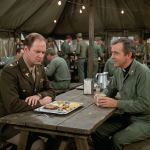
Hawkeye sat hunched over the rough-hewn table, his hands wrapped tightly around a mug that had long since gone cold. He wasn’t looking at the beer bottle in front of him; he was tracing the grain of the wood, his eyes distant, fixed on a memory he couldn’t quite shake from the day’s intake.
Across from him, Margaret sat with a posture that had been forged in the crucible of military discipline. Her uniform was crisp despite the oppressive humidity, her hair pulled back into a tight, practical knot. Yet, there was a softness around her eyes—a rare, unguarded crack in the armor she wore so meticulously.
They hadn’t spoken for nearly twenty minutes. The background noise of the bar—the low murmur of GIs at the back, the clinking of glasses—felt like it was happening in another time zone.
“You’re doing it again, Hawkeye,” Margaret said, her voice low and steady, cutting through the silence like a scalpel. “You’re trying to operate on the world with a butter knife. You can’t fix it all by staring at it.”
Hawkeye looked up then, a flicker of that familiar, sharp-edged wit dancing behind his eyes before it dissolved into plain, unvarnished exhaustion. He opened his mouth to deliver a classic, biting retort, but the words died in his throat.
Instead, his hand trembled—just a fraction—as he reached for his bottle. He stopped, his knuckles white against the dark glass, and the raw, jagged look of a man who had seen too much returned to his face.
“Margaret,” he whispered, his voice cracking, “I think I’ve finally run out of jokes.”
The air in the room suddenly felt thin, pulled taut by the sheer, quiet weight of his admission.
Margaret didn’t recoil. She didn’t offer a platitude or a reprimand. She simply leaned forward, the movement slow and deliberate, and placed her hand over his.
Her touch was surprisingly cool, a grounding anchor in the humid, dim light of the bar.
“Then don’t tell any,” she replied, her tone devoid of its usual sharp edges. “We’ve spent enough time performing for everyone else. If you’re empty, just be empty. It’s allowed.”
Hawkeye let out a shaky, hollow laugh—a sound that was more like a sigh than humor. He turned his hand over, catching her fingers in his, gripping them with the desperate intensity of two people clinging to the only solid thing in a world that had gone completely sideways.
In that moment, the exhaustion didn’t leave them, but it changed. It ceased to be an isolating weight and became something they were sharing, a burden split down the middle.
A few tables away, a soldier stood up to leave, the floorboards creaking under his boots. The sound startled them both, and for a split second, they looked like two school children caught in a secret.
Hawkeye managed a faint, genuine smile—not his surgeon’s smirk, but something softer, something human.
“You know,” he murmured, looking at the flickering lantern light casting shadows across her face, “I think you might actually be the most decent person in this godforsaken valley.”
“Don’t go getting sentimental on me, Pierce,” she warned, though she didn’t pull her hand away. “I have a reputation to maintain.”
They sat there for a long time after that. They didn’t talk about the wounded, the war, or the letters waiting in their tents. They talked about nothing at all—the way the sun hit the hills in the morning, the questionable quality of the mess hall’s latest batch of powdered eggs, and the simple, profound luxury of sitting still in a chair that didn’t vibrate with the arrival of helicopters.
The roar of the war was still outside those walls, hovering just beyond the perimeter, but inside, there was this—a small, fragile island of quiet.
When they finally stood to leave, the walk back to the 4077th felt shorter. The night air was crisp, and the stars were impossibly bright, indifferent to the chaos below.
They walked side by side, not touching, but linked by the silent understanding that they had both made it through another day. They had lost pieces of themselves, sure, but in the dim light of Rosie’s, they had found enough of each other to keep going until morning.
It wasn’t a victory, and it certainly wasn’t a cure, but in the heart of Korea, it was enough.
Some nights, friendship is the only medicine that actually sticks.