A Page from the 4077th’s Log
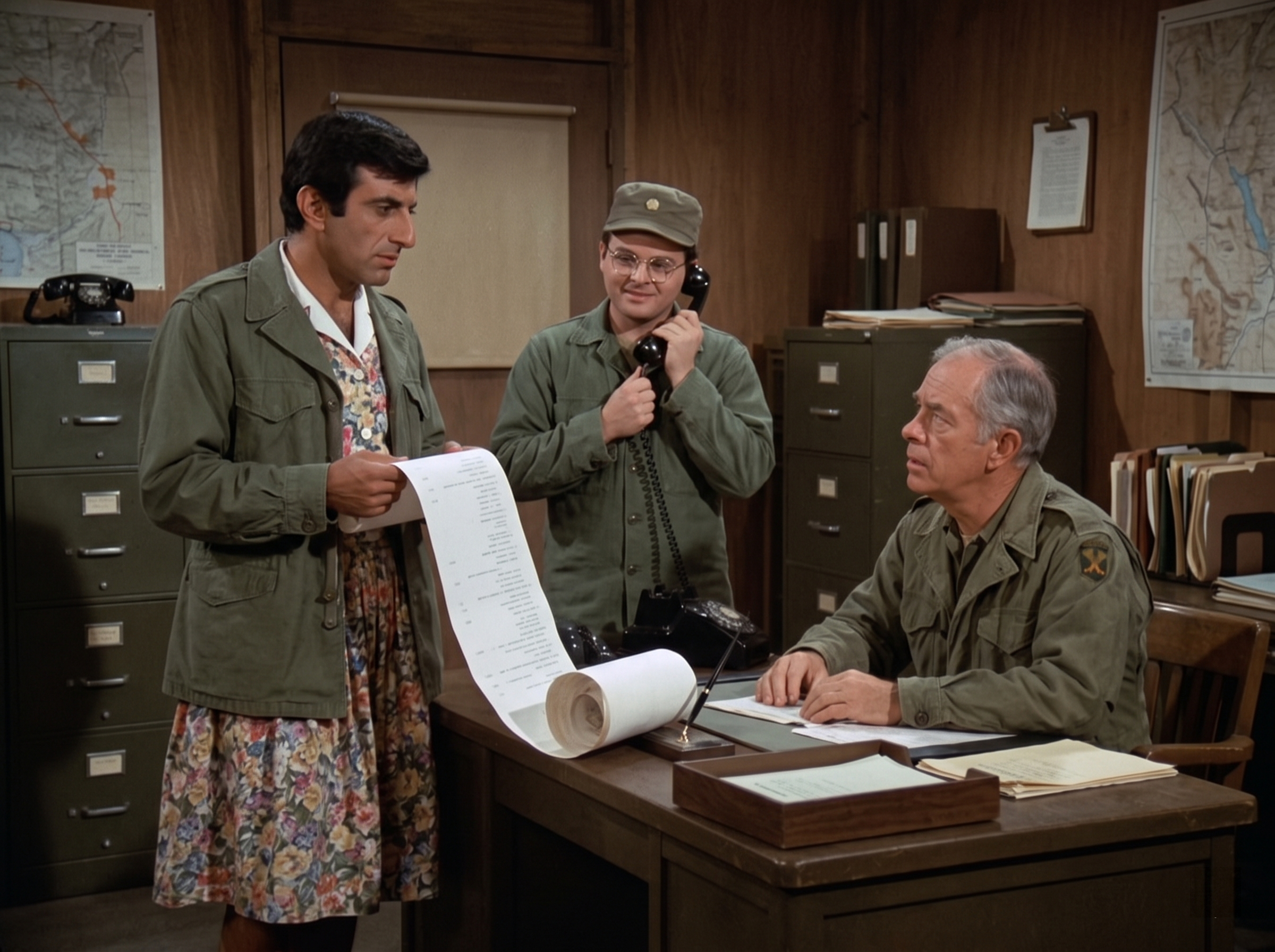
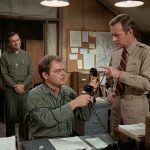
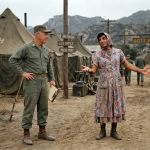
The air in the Colonel’s office was always heavy, a mix of old cigars, stale coffee, and the quiet weight of responsibility. Three men were gathered, each performing their necessary part in this absurd drama we called life in Korea. In the center, Colonel Potter sat at his heavy wooden desk, his posture rigid but his eyes tired. Klinger, a vision in a floral dress beneath his green field jacket, held out a seemingly endless scroll of paper, his face tight with controlled, dramatic frustration. Radar stood behind them, his glasses reflecting the lamp light, the phone pressed hard against his ear.
They were waiting, just like every other day at the 4077th. For information. For supplies. For some sign of normality that wouldn’t get blown away by the first cold wind.
Klinger had been arguing for ten minutes about a misordered shipment of penicillin. It was always penicillin. “Colonel, it’s all right here! Thirty cases of grape-flavored popsicles. Grape, sir! Who ordered them? Did we order them? NO! But what *did* we order? Where is the real order? I’m drowning in paperwork, Colonel, and now I’m going to have to make medical decisions about popsicle flavors?” He gestured with the list, letting another foot unspool onto the desk.
“Klinger,” Potter’s voice was dry, a low rasp of a man who had heard it all. He didn’t look at the list, his focus fixed on Klinger’s earnest, ridiculous, floral-clad face. “We are in Korea. We have twenty people with a bug that doesn’t care about flavor. We will use the grape. And then we will use the penicillin… *if* and *when* it arrives.”
He took a slow, deliberate breath, and then pointed at Radar, who was still on the phone. The little corporal winced slightly, the receiver glued to his ear. “And you, O’Reilly… who is that on the line?”
Radar cleared his throat, his gaze darting between the two men, and his hand tightening around the cord. “It’s, uh… it’s the supply depot, sir. And they, um… they say they have the penicillin.”
The air in the room seemed to still, even as the tension subtly heightened.
Potter’s eyes met Radar’s, an intensity burning there that was entirely fatherly and entirely military. “They have it? Tell me they’re delivering it. We need it, Radar. Not tomorrow. Today.”
Radar swallows hard, his gaze shifting back to the phone, his voice dropping to a near whisper. “I told them, Colonel. But, well… they’re saying there’s another order that was supposed to be delivered first. Another critical order. And it’s for… popsicles.”
Klinger’s eyes went wide. The ridiculousness of the situation, the juxtaposition of medicine and grape flavor, hovered like a bad joke. And then, the true gravity set in.
The silence hung heavy. Even the usual chatter from the OR and the distant *thwup-thwup-thwup* of a chopper seemed to fade, leaving only the soft hum of the generator. The absurdity of it all felt like a physical weight, pressing down on the shoulders of the old soldier and the young clerk and the man who was just trying to feel a little dignified in a dress.
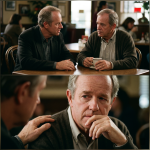
Potter didn’t explode. He didn’t yell. Instead, he just looked older, his face seemingly deeper lined by a weariness that had nothing to do with the hour. He glanced at the papers in front of him, the endless, meaningless forms, and then he let his head fall into his hands, a gesture of absolute defeat and profound, exhausted humanity.
The sight seemed to shock Klinger, cutting right through his performative exasperation. His own posture deflated, and the floral dress, previously a statement of defiance, just looked foolish against his broad shoulders. He looked from his commanding officer to Radar, his eyes full of a sudden, quiet regret.
He slowly, carefully, began to roll up the long scroll of paper. His movements were small and deliberate, a silent act of contrition. When he finally had it organized, he stepped closer and gently, without a word, placed the rolled order on top of the pile on the desk. He didn’t look at Potter, but the simple action spoke volumes—a small olive branch of shared fatigue.
Radar, his own heart breaking for the man who was both his commanding officer and something closely resembling a father, watched this exchange with a profound sadness. When he finally spoke again into the receiver, his voice, usually so clear and earnest, was low and rough.
“I understand,” he said. He didn’t sound like the bright-eyed kid who heard choppers before they arrived. He sounded like a man who had seen too much. “We’ll make due. We always do.” He waited for the other end to disconnect, then slowly, quietly, set the heavy black receiver back onto the cradle.
The simple *click* signaled the end of the hope they had briefly let themselves feel.
Potter didn’t move for another long minute, his face still in his hands. Then, he let out a long, slow sigh, a breath that seemed to carry all the frustration and helplessness and simple, soul-crushing exhaustion of the entire 4077th. He sat up, the same old soldier, but his eyes were soft, reflecting a human pain that was far from any military manual.
“Well,” he began, his voice surprisingly steady, “at least we have the grape.” He offered a weak, tired smile. It was a joke, yes, but it was a shared joke, a small nod to the relentless absurdity they had learned to live with.
Klinger let out a small, wet chuckle, and Radar gave a weak smile of his own. The moment of shared pain, of shared defeat, had brought them together, a quiet reminder that they weren’t just a colonel and a clerk and a theatrical orderly. They were a found family, bound together by a war they didn’t choose and a bond of shared survival that was stronger than any supply depot’s incompetence.
For a few more precious, quiet moments, they just sat there, three men in an office in Korea, connected by an unspoken tenderness and the profound, bittersweet feeling that, no matter what flavor popsicles arrived, they would face it together.
Because sometimes the only supply that truly matters is human warmth.