The Weight of a Red Stamp
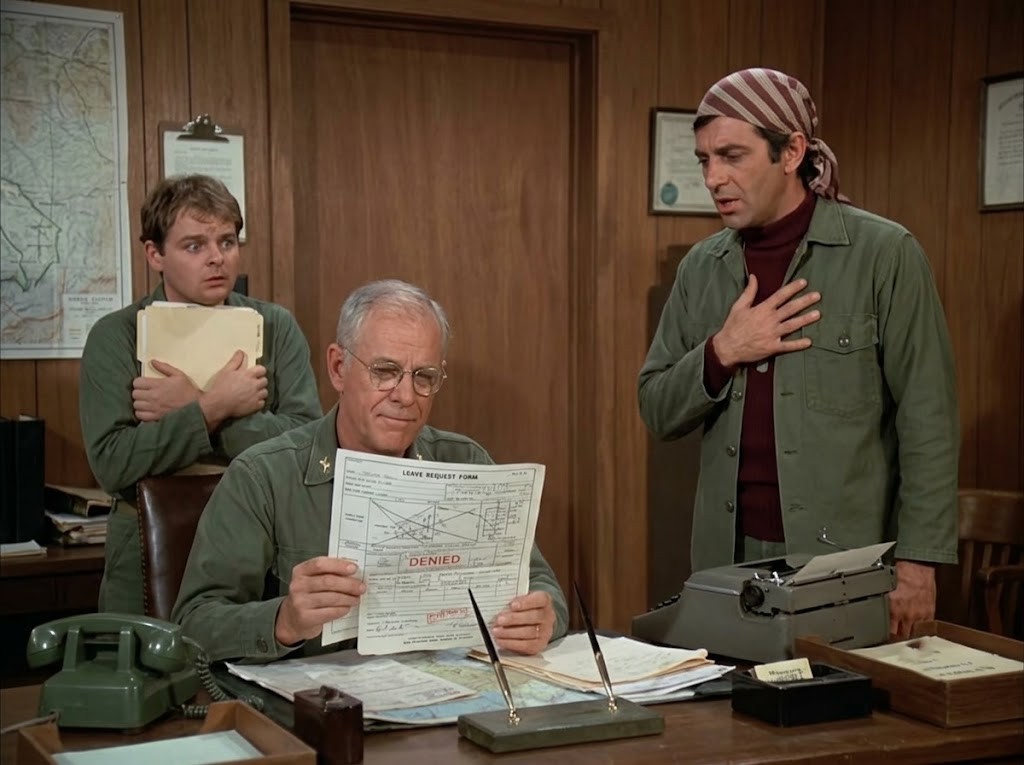
The mud in Korea has a way of seeping into your boots, your bones, and eventually, your soul. But inside the wood-paneled walls of the CO’s office at the 4077th, a different kind of storm was brewing over a single piece of paper.
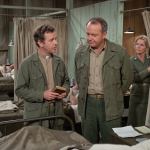
Colonel Sherman T. Potter adjusted his glasses, staring down at the document resting in his weathered hands with a mixture of practiced skepticism and fatherly fatigue.
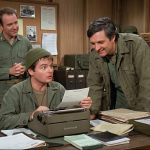
Behind him, Corporal Radar O’Reilly held a stack of manila folders against his chest like a shield, his wide eyes darting between the Colonel and the man standing across the desk. Radar looked as though he were bracing for an artillery shell, or worse, a legendary Potter tirade.
The man in question wasn’t wearing his usual chiffon or taffeta today, but the theatricality was entirely intact.
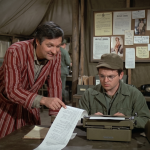
Corporal Maxwell Klinger stood with a hand pressed firmly against his burgundy turtleneck, right over his heart, his face twisted into an expression of pure, unadulterated devastation. He wore a striped bandana tied tightly around his head, looking less like a soldier trying to get out of the Army and more like a tragic hero in an opera that had lost its funding.
“I swear to you, Colonel, on everything holy, this isn’t just another Section Eight scheme,” Klinger pleaded, his voice cracking with just the right amount of desperate vibrato. “This is a matter of life, death, and the Toledo Mud Hens!”
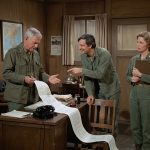
Potter didn’t look up immediately. He slowly traced the edge of the paper, his eyes landing squarely on the large, bold, unforgiving red letters stamped right across the center: **DENIED**.
“Klinger,” Potter said, his voice a low, gravelly rumble that could silence a room faster than a mortar blast. “According to this file, this is the fourteenth time your uncle in Toledo has been afflicted with a rare, terminal case of the vapors. The last time, you claimed he was being held hostage by a rogue band of bowling enthusiasts.”
“A misunderstanding, terms of endearment, sir!” Klinger countered quickly, taking a half-step forward, his eyes pleading. “But this time it’s different. It’s my grandmother. She’s calling for me, Colonel. In her letters, she says she can smell the sweet, smoky aroma of Tony Packo’s hot dogs fading from her memory, and only her favorite grandson can bring her back from the brink!”
Radar let out a tiny, nervous squeak from behind the desk, clutching his folders even tighter. He knew what was coming; he had typed the rejection slip himself under strict orders, but seeing Klinger’s crestfallen face always made his soft heart ache.
Potter sighed, a sound that carried the weight of every wounded kid that had passed through the O.R. tents that week. He looked at the **DENIED** stamp, then up at Klinger’s desperate eyes.
The humor in the room suddenly began to evaporate, replaced by a heavy, suffocating silence. Klinger’s hand dropped from his chest, his shoulders slumping in a way that couldn’t be faked, revealing the deep, exhausting homesickness that every man and woman in the camp fought every single day.
Potter tapped his desk, his expression hardening. “We all want to go home, Corporal. But this camp is currently holding together by a thread, and I need every warm body I’ve got. The answer is no.”
Klinger bit his lip, his eyes glistening with real, unscripted tears as he took a slow step back, the theatrical facade completely shattering to reveal a terribly lonely kid from Ohio.
—
The door to the office creaked open a few inches, and the familiar, lanky form of Captain Hawkeye Pierce slipped inside, followed closely by B.J. Hunnicutt. They had been loitering outside, waiting to see if Klinger’s latest stunt would miraculously succeed, but the heavy atmosphere in the room told them everything they needed to know.
“Rough day at the registry, Max?” Hawkeye asked softly, his usual razor-sharp wit noticeably softened. He leaned against the doorframe, his hands shoved deep into his pockets, looking at Klinger with quiet empathy.
B.J. walked over, placing a steady, grounding hand on Klinger’s shoulder. “We heard the shouting all the way from the Swamp, Klinger. Or rather, we heard the absence of shouting, which is always much worse.”
Klinger didn’t answer. He just stared at the desk, his gaze locked onto that bright red **DENIED** stamp. For all his dresses, his schemes, and his loud proclamations, underneath it all, he was just a boy who missed the Toledo streets, the smell of the river, and a family that felt a million miles away.
Colonel Potter looked at his doctors, then back at Klinger. The gruff exterior of the regular Army officer began to soften, the lines around his eyes wrinkling with a deep, paternal wisdom. He took off his glasses and set them gently on top of the denied leave request.
“Sit down, Klinger,” Potter said, his tone no longer commanding, but remarkably gentle.
Klinger blinked, caught off guard, and hesitated before sinking into the wooden chair opposite the desk. Radar slowly stepped forward, finally lowering the folders, his innocent face filled with anxious hope.
“Do you think I enjoy stamping these?” Potter asked, looking around the room at his makeshift family. “Do you think I like telling a good kid from Ohio that he has to stay in a mud hole while the world he loves keeps spinning without him? I’ve got a wife in Hannibal who hasn’t seen her husband in far too long. I’ve got a son, a home, a horse… I want to go home just as much as any of you.”
The office was quiet, save for the distant, rhythmic thumping of helicopter blades somewhere far beyond the hills—a constant reminder of why they were all there.
“But if I let you go, Klinger,” Potter continued, leaning forward, “who’s going to find us the extra penicillin when the trucks get bogged down in the monsoon? Who’s going to somehow barter three crates of creamed corn for a working generator? Who’s going to keep this crazy circus laughing when we’re all too tired to cry?”
Hawkeye stepped forward, a faint, sad smile playing on his lips. “He’s right, Max. Without you, the Swamp would just be a tent with a still. We’d have no fashion sense left. Winchester would completely lose his mind if he didn’t have your wardrobe to look down upon.”
“And who would I share my pictures of Erin with?” B.J. added quietly, giving Klinger’s shoulder a gentle squeeze. “You’re the only one who doesn’t get tired of hearing about her first steps.”
Radar smiled warmly, stepping right to the edge of the desk. “And I’d miss you, Klinger. Even if you do try to trick me into signing your discharge papers every Tuesday.”
Klinger looked around the room, from the tired, grease-stained faces of the surgeons to the earnest eyes of the farm boy from Iowa, and finally back to the old cavalry man sitting behind the desk. The crushing weight of the denial didn’t vanish, but it suddenly felt a little lighter, shared among people who understood the exact depth of his ache.
He wiped his eyes quickly with the back of his hand, trying to summon a bit of his trademark bravado. “Well… I suppose if I left, the laundry situation would completely fall apart. None of you savages know how to properly starch a collar.”
A collective, relieved chuckle rippled through the small office. The tension that had threatened to break the room apart dissolved into the familiar, warm comfort of camaraderie.
Colonel Potter smiled, picking up his glasses and putting them back on. He folded the denied leave request and slid it into a drawer, putting it away where it couldn’t hurt anyone else today.
“Get out of here, Klinger,” Potter said, though there was nothing but affection in his voice. “Go see if Father Mulcahy needs any help organizing the chapel supplies. And put on a proper uniform before Major Houlihan catches sight of that bandana and has a stroke.”
“Yes, sir. Thank you, sir,” Klinger said, standing up and offering a surprisingly crisp, respectful salute, which Potter returned with a nod.
As Klinger walked out of the office, his head held a little higher, Hawkeye and B.J. followed him, throwing their arms around his shoulders, already debating what kind of local delicacy they could convince Klinger to scrounge up for dinner.
Radar watched them go, then looked back at the Colonel, who was already pulling another stack of casualty reports toward him.
“Radar?” Potter asked without looking up.
“Yes, Colonel?”
“Remind me to write a letter to my Mildred tonight. Tell her I love her.”
“Already on the pad, sir,” Radar whispered, his heart full.
In a place surrounded by conflict, inside that small wood-paneled room, they hadn’t won the war. But for one afternoon, they had looked after one of their own, reminding each other that as long as they had this crazy, dysfunctional family, nobody was truly alone in the mud.
—
Sometimes the best medicine at the 4077th didn’t come from a bottle, but from the quiet understanding that we were all missing home together.