The Weight of a Small Miracle
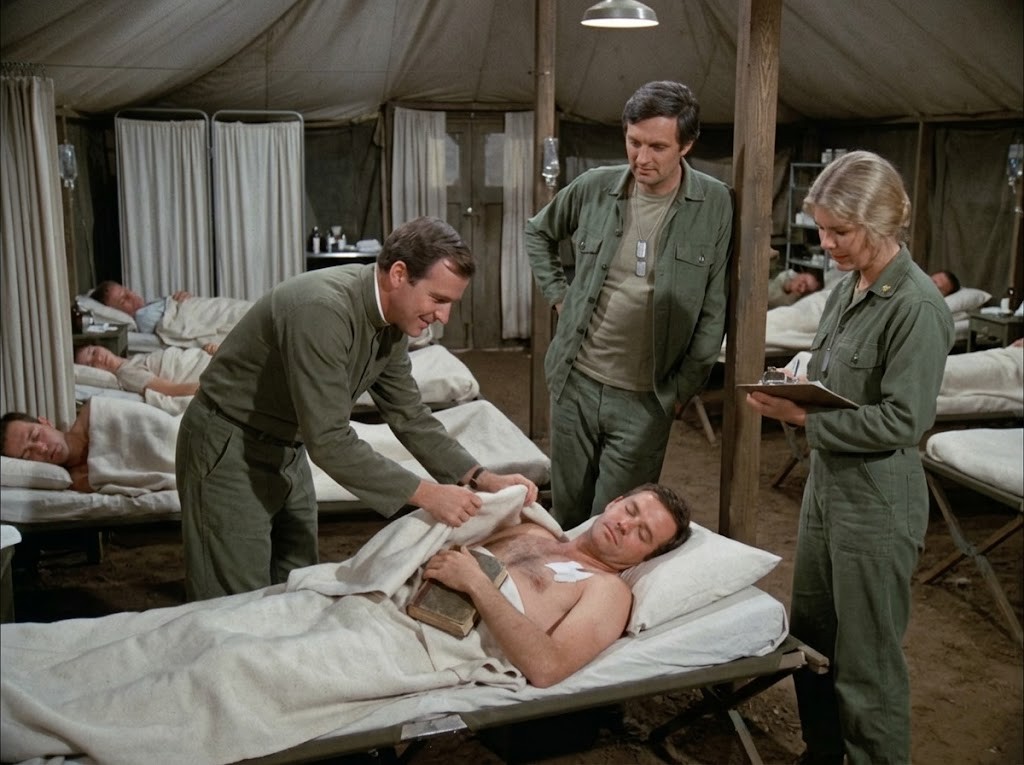
They say the Korean mud has a way of seeping into your boots, your bones, and your mind, until everything you touch feels heavy. But on a quiet Tuesday afternoon in the post-op tent of the 4077th, the heaviest thing in the room was a single, battered book.
The generators hummed their usual mechanical lullaby in the background. The air inside the canvas walls smelled of rubbing alcohol, stale coffee, and the damp earth just outside the door. After a brutal thirty-six-hour shift in the swamp of O.R., the silence was almost deafening.
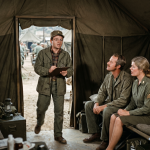
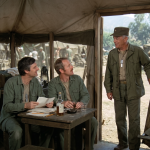
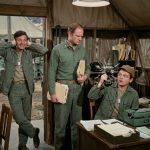
Hawkeye Pierce leaned heavily against a wooden support post, his dog tags resting against his faded olive drab undershirt. His eyes were rimmed with red, his shoulders slumped from a fatigue that sleep couldn’t quite fix. Beside him stood Margaret Houlihan, her clipboard tucked firmly under her arm, her sharp eyes scanning the rows of cots with her signature, fierce professionalism.
Yet, both of them were completely transfixed by the sight at the foot of the bed.
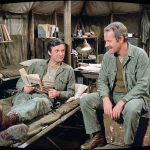
Father Mulcahy was gently tucking a thick wool blanket around a young private who had come within an inch of losing everything. The boy was fast asleep, his breathing shallow but steady. Resting right against his bare, bandaged chest, clutched in his right hand, was an old, leather-bound volume.
“He wouldn’t let go of it, Captain,” Margaret whispered, her voice losing its usual command, replaced by a quiet, protective tenderness. “Not when we brought him in, not when we prepped him, and certainly not now.”
Mulcahy smiled softly, his fingers carefully smoothing the edge of the blanket over the soldier’s arm. “It’s a collection of poetry, Margaret. His mother gave it to him before he shipped out from Ohio. He told me it kept him company in the foxholes.”
Hawkeye shifted his weight, a faint, wry smile touching his lips. “Poetry. Just what a kid needs in a shooting gallery. I usually prefer a good Sears catalog, myself. Better plot development.”
“Don’t joke, Pierce,” Margaret said, though there was no real bite in her tone. She looked down at the boy’s chart. “He was incredibly lucky. The fragment stopped just short of his ribs. A fraction of an inch closer, and…”
She didn’t finish the sentence. Everyone in the tent knew how that sentence ended.
Mulcahy’s hand paused on the blanket. He looked down at the old book, then at the thick square of white gauze covering the boy’s chest. A strange, sudden stillness came over the gentle priest. His smile faded, replaced by a look of intense concentration, as if he were solving a puzzle that had nothing to do with medicine.
“Father?” Hawkeye asked, his sharp instincts picking up on the sudden shift in the room’s energy. “You look like you just saw a ghost. Or worse, the Colonel looking for his ledger.”
Mulcahy didn’t answer right away. He carefully reached down, his fingers hovering just above the leather cover of the book, his face pale under the dim hanging lightbulbs.
—
“Look closer, Hawkeye,” Mulcahy said, his voice barely a murmur.
Hawkeye straightened up, stepping away from the post. Margaret leaned in, her clipboard forgotten for a moment.
The Father gently turned the book slightly, revealing the deep, jagged tear in the thick leather spine. It wasn’t just weathered from the elements. The leather had been violently gouged, the pages beneath it crushed and torn in a perfect, brutal indentation.
The room went completely still. The dry humor died in Hawkeye’s throat.
The fragment hadn’t just stopped short of the boy’s ribs by luck. It had struck the poetry book first. The thick, dense pages of his mother’s gift had absorbed the deadly velocity of the shrapnel, slowing it down just enough to turn a fatal wound into a survivable injury.
“Well, I’ll be,” Hawkeye breathed, the sarcasm completely draining from his voice. He reached out, his surgeon’s fingers gently tracing the torn leather, recognizing the exact trajectory. “That’s… that’s a hell of a library card.”
Margaret swallowed hard, a sudden brightness in her eyes. She looked from the book to the sleeping private, whose chest rose and fell in a peaceful, unbroken rhythm. “He has no idea, does he?”
“Not yet,” Mulcahy said softly, finally pulling the blanket up to the boy’s chin, ensuring he was warm and secure. “He was too exhausted when they brought him in. He just asked me to make sure we didn’t lose his book.”
“We won’t lose it,” Margaret said firmly, her voice thick with emotion as she made a quick note on her clipboard—perhaps the most important note she’d made all day. “I’ll personally make sure it stays right by his side until he’s discharged.”
Hawkeye looked at the priest, a profound respect shining through his tired eyes. For all his jokes about the army, the war, and the absurdity of their existence in this godforsaken mud, moments like this were the anchor. They were the reminders of why they kept cutting, why they kept sewing, and why they kept waking up every morning.
“You know, Father,” Hawkeye said, his voice dropping to a warm, gentle register, “I usually don’t give much credit to upper management. But today, I think whoever is running the library upstairs deserves a promotion.”
Mulcahy looked up, his kind eyes crinkling at the corners with a mixture of relief and humility. “Sometimes, Captain, inspiration comes in the most ordinary bindings.”
They stood there for a few more moments in the quiet tent, a doctor, a nurse, and a priest, sharing a silent sanctuary of grace amidst the chaos of the 4077th. Outside, the distant sound of a jeep starting up broke the spell, reminding them that the war was still waiting. But inside, for just one beautiful minute, a small miracle had taken up residence in a canvas ward.
In a place where we fought so hard to save lives, it was a beautiful reminder that sometimes, love and a few pages of poetry could do the heavy lifting for us.