The Knot That Bound the Forty-Ninth
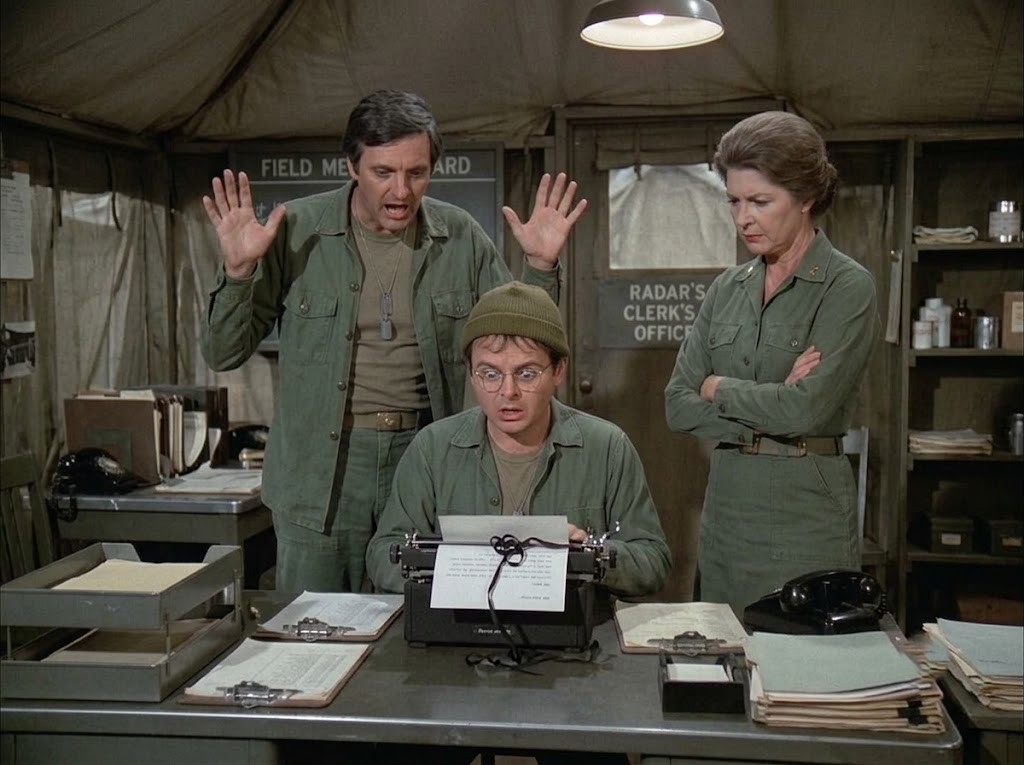
The old Smith-Corona typewriter in Radar’s office had survived three supply-line delays, two mortar scares, and a steady diet of cheap, gritty ink ribbons. But tonight, with the autumn chill creeping under the canvas walls of the 4077th, the faithful machine chose the absolute worst moment to stage a mutiny.
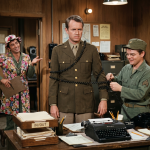
Radar sat frozen in his chair, his thick-rimmed glasses slipping slightly down his nose as he stared at the disaster on the carriage. A bird’s nest of tangled black ribbon had suddenly erupted from the spools, coiling itself into a dense, ink-stained knot right over the middle of the page.
Behind him, Hawkeye Pierce threw his hands up in the air like a man facing a firing squad. His jaw dropped, his dog tags dangling against his olive-drab undershirt as he let out a dramatic gasp of pure disbelief.
“I didn’t touch it, Radar! I swear on Hippocrates’ vintage golf clubs, I was standing a full two feet away when the beast turned on us,” Hawkeye declared, his voice cracking with that familiar mixture of manic energy and exhaustion. “That machine didn’t just jam; it committed corporate suicide right in front of our eyes.”
To Radar’s left, Major Margaret Houlihan stood with her arms tightly crossed over her chest. Her eyes were fixed on the ruined document, her mouth set in a hard, strained line that masked a deeper, exhaustion-born frustration.
The camp had been operating on three hours of sleep for four straight days. The O.R. had finally cleared out an hour ago, leaving everyone with shaking hands, aching backs, and a desperate need for a single piece of good news.
That good news was supposed to be on the piece of paper currently trapped beneath the knotted ribbon. It was a one-time, highly irregular emergency requisition form for five crates of thick, woolen blankets and three cases of real, non-powdered cocoa—a rare gift from a sympathetic supply sergeant in Seoul who had given them a strict midnight deadline to submit the paperwork.
“Corporate suicide or not, Captain, that form was our only ticket to a warm winter,” Margaret said, her voice unusually quiet, stripped of her usual military bark. “The last mail jeep leaves for the airfield in exactly twenty minutes, and if Colonel Potter doesn’t sign a legible copy, our patients will be freezing by November.”
Radar’s fingers hovered over the keys, trembling slightly as he looked at the black ink smudging the official army letterhead. “It just… it just jumped, Major. I was typing ‘Quantity: Fifty,’ and then *ping*, the whole spool went crazy.”
“Can’t you just wind it back in, Radar?” Hawkeye pleaded, leaning over the desk, his hands still raised as if the typewriter might explode if he lowered them. “You’re the wizard of the wireless. You can summon a jeep from thin air using nothing but a paperclip and a polite cough. Surely you can untangle a few inches of nylon ribbon.”
Radar looked up, his large eyes filled with a helpless, heartbreaking kind of panic. “Captain, it didn’t just tangle. The metal teeth on the advancing arm completely sheared off. It’s stuck solid, and the ink is bleeding straight through the only official emergency form we had left in the entire camp.”
Margaret let out a sharp, ragged breath, her shoulders sagging just an inch as the weight of the endless week seemed to press down on the small room. The silence that followed was heavy, broken only by the distant, rhythmic hum of the camp generator and the ticking of the clock on the wall, ruthlessly marching toward the midnight deadline.
—
Hawkeye slowly lowered his hands, the manic humor draining from his face to reveal the deep purple bruises of fatigue beneath his eyes. He looked from the mangled typewriter to Radar’s downcast face, and then to Margaret, whose rigid posture could no longer hide how tired she truly was.
“Alright,” Hawkeye said softly, his voice dropping into that gentle, steady register he usually reserved for frightened young soldiers in the post-op ward. “Nobody panic. Especially not me, because if I panic, I’ll start crying, and I don’t have the fluids to spare.”
He stepped closer, carefully avoiding the mess of carbon paper spread across the desk. He laid a hand on Radar’s shoulder, giving it a reassuring squeeze. “It’s just a piece of paper, Radar. We’ve beaten the North Korean army, we’ve beaten the Chinese army, and we’ve definitely beaten the mess tent’s mystery meat. We are not going to be defeated by an office supply.”
“But Captain, the form has to be pristine,” Radar whispered, staring at his ink-stained thumbs. “The clerk in Seoul is a stickler. If there’s a smudge on the serial number, he rejects it automatically. I don’t have another blank Form 104-B in the whole supply cabinet.”
Margaret took a step forward, her expression softening as she looked at the young corporal. She reached out and gently tapped the top of the typewriter carriage. “We still have twenty minutes, Walter. And if I recall correctly, regulations state that in the absence of official forms, a handwritten field memorandum can be accepted—provided it bears the signature of the commanding officer and the head nurse.”
Radar blinked, looking up. “It does?”
“It does if we say it does,” Hawkeye chimed in, a faint, tired smile returning to his lips. “Who’s going to argue with the Chief Surgeon and the most terrifyingly efficient Major in the United States Army? If they complain, we’ll threaten to send them Charles Emerson Winchester’s laundry.”
Margaret actually let out a tiny, breathless laugh, a sound so rare in the camp lately that it felt like a small miracle. “Don’t be ridiculous, Pierce. But I do have a pad of official nursing reports in my tent. The paper is clean, and the ink won’t run.”
“Then move those boots, Major!” Hawkeye said, giving her a playful nudge. “Radar, get your best fountain pen. The one you use when you’re forged—uh, replicating the Colonel’s signature for a good cause.”
For the next fifteen minutes, the small clerk’s office became a different kind of operating room. Margaret returned with the paper, her hair slightly tousled by the night wind but her focus absolute. Radar sat with his pen poised, his posture straight and determined, while Hawkeye paced the small floor space, dictating the requisition with a blend of military jargon and sheer, poetic desperation.
“Make sure you stress the blankets, Radar,” Margaret commanded, leaning over the desk to watch his handwriting. “Use the medical term for hypothermia risk. Let them know it’s an emergency, not a luxury.”
“Got it, Major,” Radar muttered, his pen scratching furiously against the thick paper. His handwriting was neat, precise, and surprisingly beautiful.
“And add a postscript,” Hawkeye added, pausing by the door. “Tell them if the cocoa arrives before the first snowfall, Nurse Dish will personally send the supply sergeant a signed photograph. And if that doesn’t work, tell them Father Mulcahy will include them in his Sunday prayers, which carry significantly more weight with the Big Clerk upstairs.”
Colonel Potter walked into the office just as Radar was blowing gently on the fresh ink to dry it. The old horse soldier took one look at the tangled typewriter ribbon, the scattered carbon sheets, and the three exhausted souls crowded around the desk. He didn’t ask for an explanation. He had spent enough decades in the army to recognize a successful renegade operation when he saw one.
“Is it readable, Corporal?” Potter asked, pulling his fountain pen from his pocket.
“Yes, sir. Every syllable,” Radar said proudly, turning the pad toward the Colonel.
Potter scrawled his signature at the bottom with a decisive, heavy stroke that nearly tore the paper. “Take my jeep, Radar. Tell Klinger to drive like the devil himself is chasing the mail clutch. If anyone tries to stop you at the airfield, tell them it’s an executive order from the 4077th.”
“Yes, sir!” Radar grabbed his cap, snatched the precious piece of paper, and vanished through the door into the cool night air, his boots thudding against the dirt road.
The office suddenly felt incredibly quiet. The tension that had held the room captive for the last hour evaporated, leaving behind nothing but the heavy, comfortable weight of shared exhaustion.
Hawkeye sank down onto the edge of Radar’s desk, his legs dangling. He looked at the ruined typewriter, reaching out with one finger to gently poke the tangled knot of black ribbon. “You know, if you look at it from the right angle, it kind of looks like a heart. A very messy, ink-covered, broken heart.”
Margaret smiled tiredly, walking over to the door and looking out into the darkened camp where the faint yellow lights of the tents flickered against the Korean hills. “It looks like a mess, Pierce. Just like the rest of this place.”
“Yeah,” Hawkeye murmured, his voice softening as he looked around the small, cramped office that had become the unlikely nerve center of their lives. “But it’s our mess. And somehow, the plumbing still works.”
Colonel Potter patted Hawkeye on the shoulder as he headed back toward his quarters. “Get some sleep, Captain. Tomorrow’s another long day.”
“Aren’t they all, Colonel?” Hawkeye said to the empty room, as Margaret offered him a quiet, understanding nod before slipping out into the night, leaving him alone with the silent Smith-Corona and the comforting knowledge that against all odds, they had taken care of their own for one more day.
In the middle of a forgotten war, sometimes the greatest victories were written by hand on a scrap of clean paper.