The Memorandum on Controlled Solace
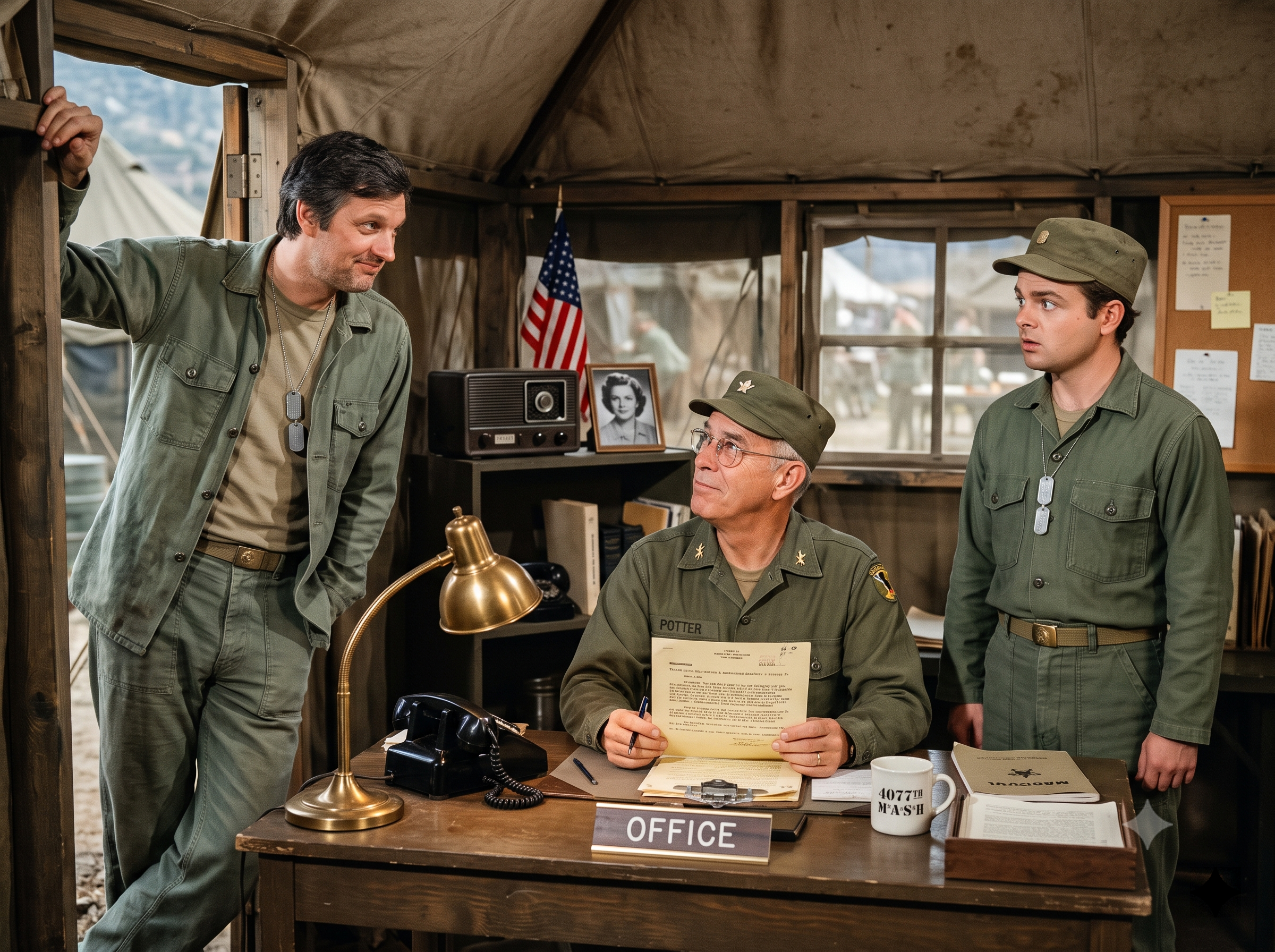
You could always smell the paperwork in Colonel Potter’s office before you saw it. Faint, comforting, and utterly relentless, the scent of carbon copies, aged adhesive, and stale tobacco hung heavy in the warm, lamp-lit air of the tent. It was a smell distinct from the damp canvas and antiseptic that defined the rest of the 4077th, a small bureaucratic sanctuary in the chaos.
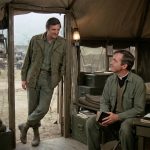
This evening, the usual smell was overlaid by the sharp, dry crackle of unspoken tension. Colonel Sherman Potter sat behind his heavy desk, the light from the brass desk lamp pooling around the single page he held with an expression that was part weary father, part veteran tactician, and entirely unimpressed. The small radio on the shelf hummed a distant tune, its sound struggling against the silence of the room.
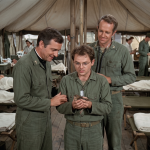
Across from him, Captain Hawkeye Pierce stood, leaning against the rough wooden doorframe as if trying to merge with it, a casual stance that didn’t quite disguise the dangerous sparkle in his eyes. A mischievous smirk, tight and deliberate, played on his face, mirroring the dynamic energy that always pulsed around him, even in the relative calm.
Standing perfectly still beside the desk, Corporal Radar O’Reilly was a statue of abject terror, his small utility cap seemingly the only thing keeping his head on straight. His eyes darted nervously between Potter, the paper, and Hawkeye, clearly ready to explode with either panic or a full confession, whichever was required to make the tension stop. He stood at attention, yet looked like a coiled spring about to snap.
“Radar,” Potter said, his voice quiet, steady, and terrifying in its lack of inflection. He didn’t look up from the page, his finger resting precisely below a heavily typed paragraph that had obviously required every character on the ribbon.
Radar jumped, nearly saluting the entire room at once. “S-sir! Colonel, sir! Yessir?” His voice cracked, an octave higher than usual.
“This is…” Potter sighed, the sound traveling from his very boots, and finally looked up, fixing his gaze on Hawkeye’s smirk. “This is quite a composition, Pierce.”
Hawkeye didn’t move an inch. The smirk deepened. “We try to maintain a high literary standard in surgery, Colonel. We just didn’t expect the critics to be so tough.”
Potter didn’t answer right away. He just looked at him, that long, slow stare that had seen through four wars and endless regulations, while the silence in the room stretched until it felt like it might actually snap like the spring in Radar’s soul.
Continue directly from the high point where Part 1 ended.
Potter finally released his breath, the air whistling through his nose as he set the paper down on the blotter. “’A Proposal for the Controlled Introduction of Culturally Significant Audio-Visual Materials as a Prophylactic Measure Against Combat-Related Psychological Atrophy.’ This is impressive, Pierce. For the first three pages, I thought you were talking about medicine.”
Hawkeye pushed off the doorframe, that dangerous smirk never leaving his face as he took a slow step toward the desk, eyes wide with performative innocence. “It is medicine, Colonel! Sound, texture, a brief respite for the soul! It’s preventive therapy for the entire staff, especially when the OR looks less like a hospital and more like a scene from ‘Dante’s Inferno’ re-interpreted by a chaotic two-year-old.”
“And the specific, prioritized list of ‘Culturally Significant Materials’ you’ve requested?” Potter inquired, his dry humor beginning to color his tone.
Hawkeye clasped his hands together in mock earnestness. “A carefully curated selection, Colonel! We cannot have just any noise polluting the air. We are professionals! We require specific frequencies, particular melodies! Think of the jazz, Colonel! The therapeutic swing of a Benny Goodman arrangement! The soul-soothing strains of Billie Holiday!”
Radar, who had been holding his breath so long he was turning a slight shade of blue-green, finally exhaled in a shaky, high-pitched gasp. “C-Jazz, sir? Colonel?” He looked between the two, his confusion momentarily overriding his fear.
Potter allowed the smallest twitch of a smile to touch his lips. He picked up the paper again and began to read aloud, his voice taking on a slightly higher, more pedantic tone that perfectly captured Hawkeye’s intent. “‘Section IV: Immediate Logistical Requirement. Paragraph A: Prioritized Acquisition for Optimal Staff Morale (OR and Post-Op personnel). (1) 12 (twelve) copies of ‘The Benny Goodman Story,’ Decca Records catalog number DL 8056/57. (2) 10 (ten) copies of…'” He stopped, looking at Hawkeye over his spectacles. “And where, exactly, do you suggest I source ’12 copies of ‘The Benny Goodman Story” from the US Army supply chain?”
Hawkeye just shrugged, the smirk softening into a genuine, tired grin. “Well, Colonel, that’s where you come in. You’re the commander! You know people! You have connections! Think of it as an exercise in command initiative. An opportunity for supply-side innovation!”
Potter didn’t laugh. He just shook his head, a gesture that contained generations of dry tolerance and a fierce, unspoken love for his difficult, brilliant unit. He looked at the paper, then at Hawkeye, then at the nervous wreck that was Radar, and finally at the little photo of Mildred on his shelf. The fatigue, always present, seemed to settle over the room, the same weight of the war that they all carried every day.
“’supply-side innovation,’” he repeated, the words rolling off his tongue with a tired, sarcastic flourish. He looked at Radar. “O’Reilly.”
Radar instantly snapped back to terrified attention. “Sir! Yessir?”
“Take this memo,” Potter began, “and put it with the other… ‘high-priority psychological proposals.'” He handed the page across the desk, his eyes locked on Hawkeye the entire time.
Hawkeye, watching Radar take the paper with trembling hands, didn’t look at Potter. He didn’t smirk, or crack a joke, or try to wit his way out of the silence. He just watched the paper change hands, the mischievous spark in his eyes replaced, just for a moment, by something quieter, something like weary acknowledgment. He looked at the ‘4077TH MAS*H’ mug on the desk, the only thing that really made sense in the entire office, in the entire country.
“And O’Reilly,” Potter added, “before you file that… proposal.” He took a long beat, the warm glow of the oil lamp reflecting in his eyes, making them look even kinder than usual. “Check and see what the Red Cross can do. They seem to understand ‘controlled solace’ a lot better than the supply corps. They might even have a copy of that Goodman album.”
The smirk returned to Hawkeye’s face, slow and careful, but the warmth in his eyes was genuine this time. A small puff of air escaped Radar’s lips, not quite a laugh, not quite a sob, but a perfect exclamation of profound relief. The tension didn’t snap; it just dissolved, melting into the familiar, warm, found-family atmosphere of the office tent, the war outside, but the friendship holding tight within.
“Right away, Colonel,” Radar whispered, the paper clutched to his chest like a sacred relic, as Hawkeye leaned back against the doorframe, the smirk in his eyes, the fatigue in his grin, and the quiet camaraderie of the 4077th filling the room. FINAL LINE.
One reflective closing line suitable for a MAS*H tribute page:
In the heart of the 4077th, friendship wasn’t just a comfort; it was the quiet, enduring mechanism that kept the darkness at bay.