The Weight of a Tuesday in Korea
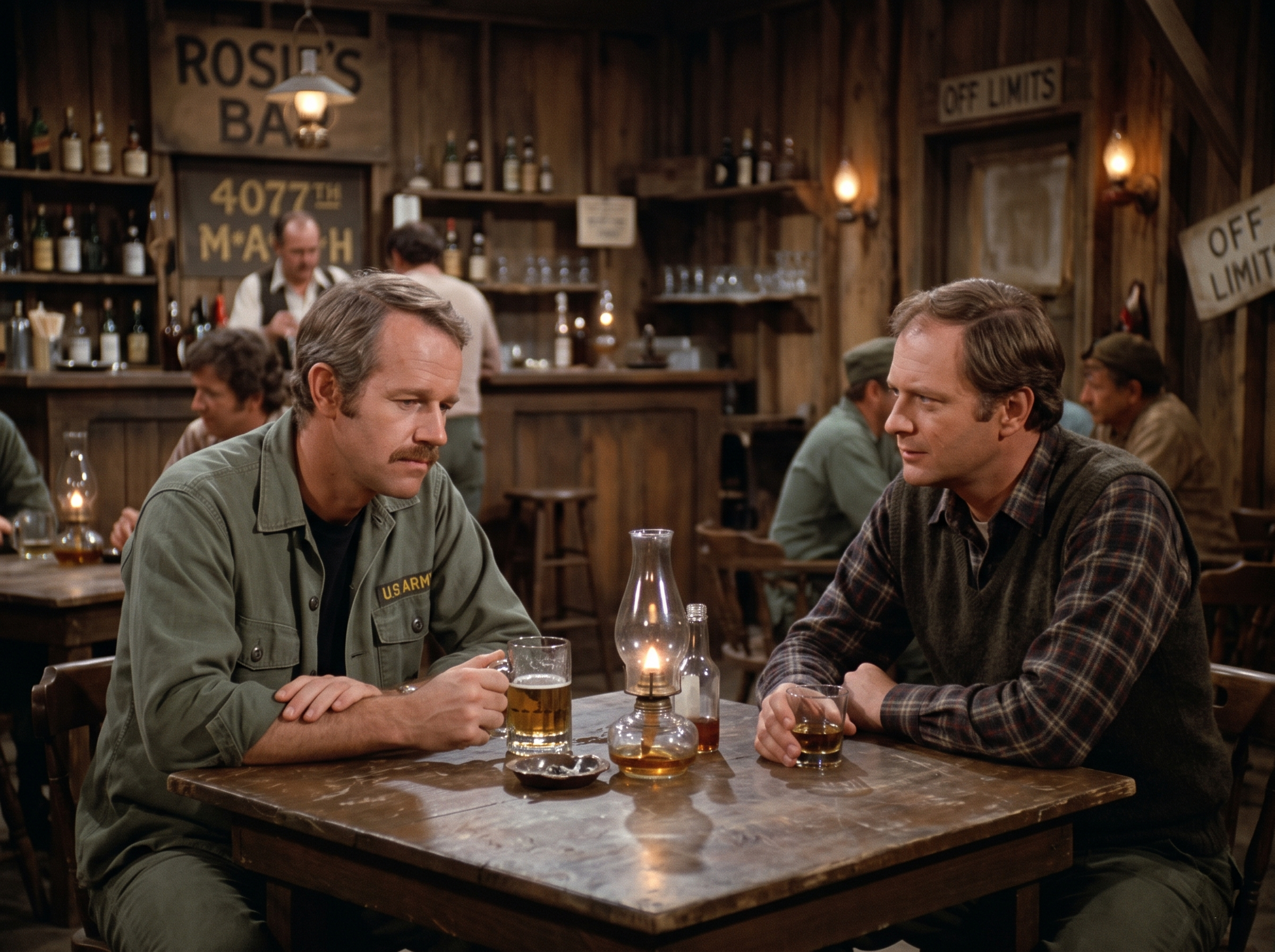
There were nights when the war felt heavy enough to crush the air right out of your lungs, not with noise, but with silence. The 4077th had been running on fumes and black coffee for three straight days. The choppers had finally stopped coming, leaving behind a camp wrapped in an exhausted, ringing quiet.
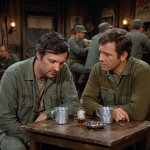
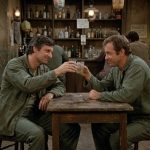
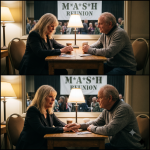
To escape the lingering smell of iodine and ether, B.J. Hunnicutt and Charles Emerson Winchester III had retreated to the only sanctuary available. They sat at a scarred wooden table in the corner of Rosie’s Bar. The small room was bathed in the warm, practical glow of amber lamps, highlighting the faded beige walls and the worn textures of the rustic social club.
Neither man had spoken for twenty minutes. The silence between them wasn’t hostile; it was the comfortable, heavy silence of two men who simply had no words left to give.
B.J. leaned forward, his forearms resting heavily on the sticky tabletop. He was gazing down into his ceramic mug of lukewarm beer, though he didn’t seem to be looking at the drink at all. His eyes were distant, filled with a quiet empathy and a subtle, understated sadness that he rarely let show in the Swamp.
He looked lived-in, his olive drab shirt rumpled, his shoulders carrying the invisible weight of a man stationed eight thousand miles away from the only two people who mattered to him.
Across the table, Charles sat with his usual impeccable, albeit tired, posture. Even in a rundown Korean bar, Major Winchester maintained a controlled dignity, holding his glass of watered-down scotch with measured grace.
Yet, beneath his refined exterior, Charles was uncharacteristically unguarded. His expression held a mix of wounded pride and reluctant compassion as he watched the younger surgeon across from him.
“It’s Tuesday,” B.J. said finally, his voice barely rising above the hum of the old refrigerator behind Rosie’s counter.
Charles blinked slowly, swirling the amber liquid in his glass. “I believe the calendar on the bulletin board would agree with you, Hunnicutt. Though here, Tuesday feels remarkably like a Friday, which feels remarkably like a month.”
B.J. offered a faint, weary smile, still staring at his mug. “Tuesday afternoons at home. That was my day off at the clinic. Peg and I used to take Erin down to a little park near the house.”
He traced the rim of his cup with a tired finger. “I was just sitting here trying to remember the exact color of the oak leaves this time of year. I can see the tree, I can see Peg on the blanket… but the color of the leaves is fading.”
B.J. looked up, his eyes meeting Winchester’s. There was no joke to be made, no punchline to soften the blow of a father missing his life.
Charles gripped his glass tighter. He recognized that particular brand of pain. In fact, a letter from his sister Honoria was currently burning a hole in the breast pocket of his uniform, detailing a grand autumn gala in Boston that he was entirely absent for.
“Winchester,” B.J. asked gently, noticing the tension in the older man’s jaw. “Are you alright?”
Charles stiffened, his aristocratic armor reflexively pulling tight around him. He opened his mouth, the usual sharp, defensive deflection resting right on the tip of his tongue. He wanted to change the subject, to scoff at the sentimentality, to build a wall between his own homesickness and B.J.’s open heart.
But as he looked at B.J.’s exhausted, earnest face in the soft light of the bar, Charles hesitated, leaving the heavy question hanging in the dusty air.
Charles closed his mouth, the sarcastic remark dying in his throat. He looked down at his glass, then back up to B.J., the wounded pride in his eyes softening into something that looked remarkably like defeat.
“Alright?” Charles murmured, his voice losing its usual theatrical projection. “I suppose that depends entirely on one’s definition of the word, Hunnicutt.”
He reached into his pocket with controlled, deliberate gestures and pulled out the crisp, cream-colored envelope bearing the Winchester family crest. He didn’t open it, merely laid it on the worn wooden table between them.
“Honoria,” Charles said quietly. “She writes to tell me that the Boston Symphony Orchestra performed Beethoven’s Seventh last night. It is a family tradition to attend the opening of the season.”
B.J. sat up just a fraction, listening intently. He didn’t interrupt. He knew how rare it was for Charles to willingly lower the drawbridge to his private world.
“She described the evening in agonizing detail,” Charles continued, his eyes focused on the envelope. “The chill in the evening air off the Charles River. The smell of roasted chestnuts near the concert hall. The exact shade of the velvet curtains as they parted.”
Charles let out a breath that was half-sigh, half-tremor. “She meant well, of course. She wanted me to feel as though I were there. But all she successfully accomplished was reminding me of precisely how far away I truly am.”
He took a slow sip of his scotch, the reluctant compassion in his gaze turning inward. “So, to answer your question, B.J…. no. I am not alright. I am sitting in a dirt-floored establishment, drinking something that aggressively masquerades as scotch, wearing clothes that smell perpetually of mildew and despair.”
B.J. offered a soft, knowing nod. “It’s a cruel trick, isn’t it? The mind’s ability to put you right back in your living room, only to pull the rug out a second later.”
“A cruel trick indeed,” Charles agreed, his voice a low, gravelly whisper. “I find myself forgetting small things, too. The precise timbre of my father’s laugh. The specific way the light hits the stained glass in our foyer at four o’clock in the afternoon.”
They sat in silence again, but the air between them had fundamentally changed. The vast chasm of background, class, and temperament that usually separated the laid-back Californian and the aristocratic Bostonian had vanished.
In the dim, amber light of Rosie’s, they weren’t a bumpkin and a snob. They were just two desperately tired men, clinging to the fading memories of the lives they had been forced to leave behind.
B.J. finally broke the quiet, a genuine, bittersweet warmth returning to his eyes. “You know, Charles, when we finally get out of this place, I’m going to send you a postcard from that park in Mill Valley.”
Charles arched a solitary eyebrow, a hint of his familiar, dry wit returning to his features. “And I suppose you expect me to reply with a letter detailing the cultural superiority of Massachusetts?”
“I wouldn’t expect anything less,” B.J. chuckled softly, the sound carrying a comforting, grounded weight. “I might even read it.”
“Don’t make promises you can’t keep, Hunnicutt,” Charles replied, a faint, genuine smile tugging at the corner of his mouth. “My descriptions of Boston’s architecture are famously dense. You might pull a muscle trying to comprehend them.”
B.J. laughed, a quiet, rumbling sound that seemed to chase a bit of the weariness from the room. He lifted his ceramic mug, holding it out toward the center of the table.
“To Beethoven’s Seventh,” B.J. offered softly.
Charles looked at the chipped mug, then lifted his own slightly cleaner glass, tapping it gently against B.J.’s with a dull clink.
“And to the oak leaves of Mill Valley,” Charles replied, his tone perfectly sincere. “May they retain their color until you return to see them.”
They drank in unison, the shared moment anchoring them against the storm of the war waiting just outside the door. They were still tired, still miles from where they belonged, but the heavy burden of the evening felt just a little bit lighter to carry.
Charles carefully tucked Honoria’s letter back into his pocket, smoothing down the flap of his lived-in uniform. B.J. finished the last of his beer, his posture relaxing, the deep ache of homesickness subdued by the steady, quiet presence of an unlikely friend.
As they stood up to leave, bracing themselves for the cold Korean night and the inevitable return to the Swamp, neither man said another word. They didn’t need to.
Some wounds couldn’t be fixed with a scalpel or a suture, but sometimes, just knowing someone else was carrying the exact same ache was all the medicine you needed to make it through the night.