The Sign of the Twelfth
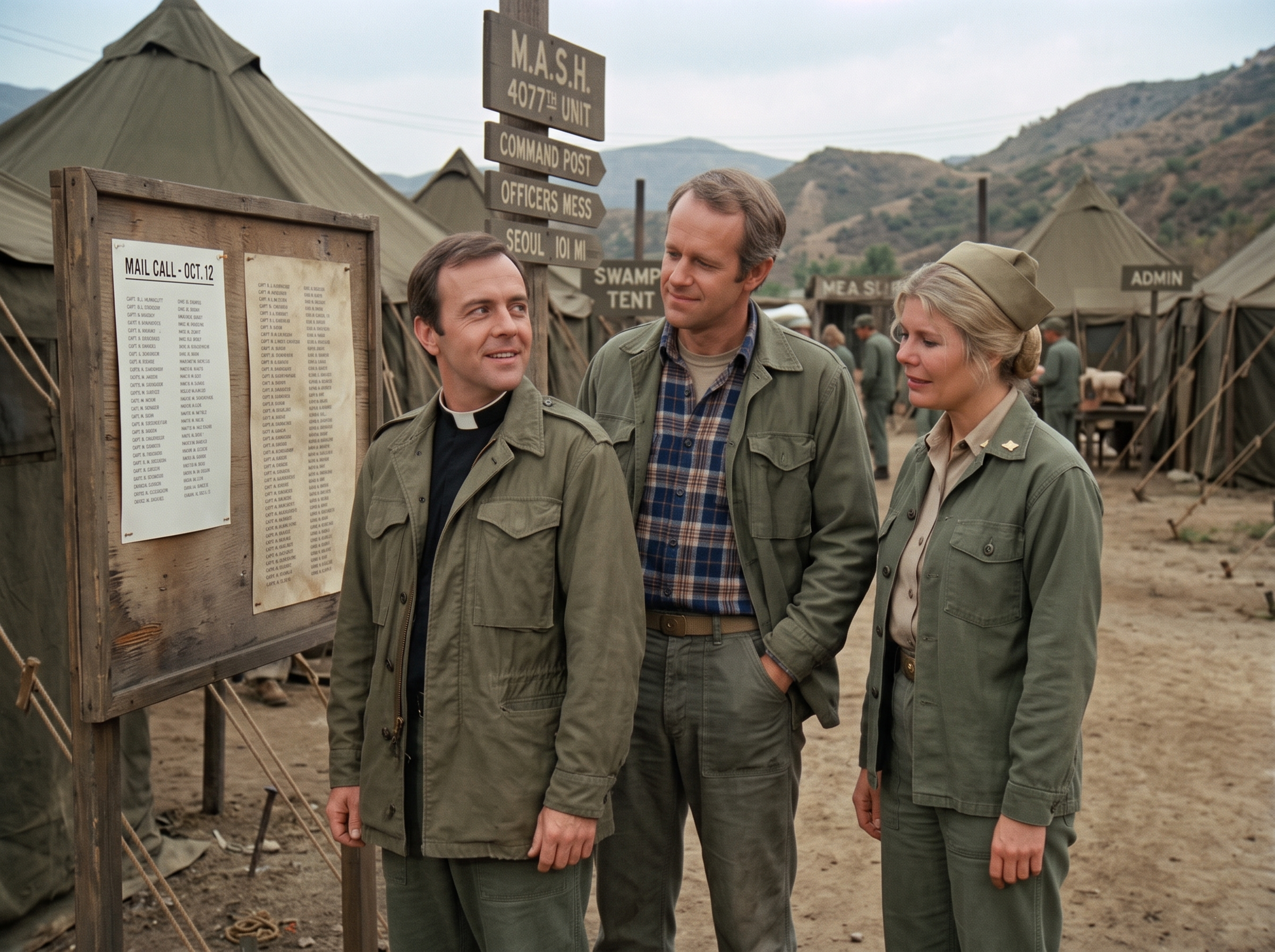
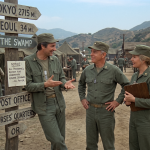
If you looked closely at the 4077th MAS*H, it wasn’t just canvas, dust, and tired faces; it was a geography of hope. A small wooden signpost by the admin tent told you where to find things—the Command Post, the Officers’ Mess, and Seoul. A piece of wood on two posts, covered in arrows pointing in different directions. And right next to it was the bulletin board.
The bulletin board was the camp’s nerve center, a shrine to expectation, and a constant reminder of how far home really was. Every list posted there held a hundred tiny prayers for a letter, a package, or even just a name that wasn’t on the casualties.
Today was a quiet day. The guns were distant. The helicopters were down. But a new list had appeared, simple, hand-typed on large cards, the four specific names clearly legible: Hunnicutt, Houlihan, Potter, Mulcahy. A smaller, dense paper held hundreds of other names below them, but those four stood out like landmarks.
It was Father Mulcahy who arrived first. He looked at the list and his soft, hopeful smile of quiet joy was enough to warm the dusty compound. His hand touched the wooden frame, a simple gesture of connection and anticipation. He looked up at the Korean hills, imagining the mail clerk’s truck on the dusty road.
B.J. Hunnicutt joined him moments later, hands dug casually into his field jacket pockets, clad in a worn plaid shirt that seemed to hold a piece of the California coast in its fibers. His smile was more of a relief, a small, calm acknowledgment. He’d been waiting months for a specific letter about his daughter.
“It’s finally here, Father,” B.J. said softly, looking at the two lists. “Mail call, at last. The wait is over.”
Mulcahy nodded, his expression unwavering. “There is something about the smell of a fresh list, isn’t there, B.J.? A scent of possibility.”
“And a scent of home, if we’re lucky,” B.J. added, a homesick tone creeping into his voice.
The dynamic shifted when Margaret Houlihan walked over, immaculate in her fatigue shirt and garrison cap, standing tall and professional. Her eyes scanned the list, finding her name and holding it with a sharp, controlled focus. But beneath her professional veneer, a flash of hidden emotional vulnerability was visible, a quiet softening around her eyes. She, too, had been waiting for a personal connection, not a military orders packet.
“Good morning, Major,” Mulcahy greeted, his gentle presence a calm center for the three.
“Good morning, Father. B.J.,” Margaret said, her voice unusually subdued.
The three of them stood there in silence, a rare, shared moment in the sun. B.J. broke the silence. He shifted his stance, looking first at Father Mulcahy, then at Margaret, and then at the date on the larger list placard. Oct. 12th. His casual demeanor dropped for a moment, replaced by a meaningful look. “You know what today is, don’t you, Father? Margaret?”
Mulcahy’s simple smile didn’t waiver. He knew exactly what B.J. meant. He nodded, once. B.J.’s look intensified, and he stepped closer. “It’s the twelfth.”
Margaret looked from B.J. to Mulcahy. Her expression of controlled vulnerability deepened. B.J. met her eyes, and a wordless message passed between the three of them. It wasn’t just a list; it was the list. The shared waiting, the delayed packages, the connection to a specific, private hope that none of them had spoken of outside this small group. The air crackled with a sudden, intense anticipation that had nothing to do with standard letters and everything to do with a shared, found-family promise. The high point was this shared, knowing silence. The wait was over, but the resolution was still hidden inside a box or an envelope.
B.J. was the first to speak, breaking the high-tension silence. “Well, are we going to stand here and watch the paint dry on the wood, or are we going inside? The envelopes and boxes aren’t going to open themselves.”
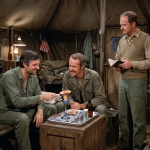
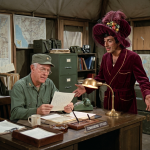
Father Mulcahy unpinned the list with a care that made it feel like a sacred text. They walked to the Admin tent, their footsteps making soft puffs in the dirt. Inside, the usual controlled chaos of Klinger’s domain was slightly subdued. Klinger, in a flowered kimono and a surprising degree of dignity, pointed toward the small table where several packages and a stack of mail were waiting. The four specific names on the list correspond to three different containers.
Margaret stepped forward, her controlled professional mask returning, but a softer edge remaining. She picked up a thick package addressed to her, marked from a leading medical publishing house. It was the special medical journal on rare tropical diseases that she had been waiting for months to receive for her nursing staff. She held it with reverent care, a rare genuine smile spreading across her face.
“It’s here, Father,” she whispered. “All the new research we’ve needed for the OR.“
B.J. Hunnicutt reached for the battered box labeled with his home address. He carefully opened the cardboard flaps to reveal the contents: a bundle of slightly smudged crayon drawings from his daughter, Peg, showing a very abstract house and what appeared to be a purple cow. Tucked inside was a worn copy of the Saturday Evening Post, probably from his wife, knowing he needed the distraction. He held the drawings with a tenderness that spoke of an unimaginable homesickness. His face, reflecting that calm, homesick relief from earlier, softened as he touched the crayon marks, his eyes fixed on the simple art.
“It’s a whole village, Peg says,” B.J. murmured, a slight chuckle catching in his throat.
Father Mulcahy picked up the third and smallest package, a wooden box marked with a parish seal. His soft, hopeful smile of quiet joy remained, but now it was filled with a humble gratitude. He opened the lid to reveal the polished silver communion service set he had been waiting for to replace the makeshift, chipped cups he had been using for the camp’s service. His sister had sent it, knowing it was the only piece of home he really needed. He held the silver chalice, the simple metal gleaming in the dim light of the tent, and a quiet pride and humbleness emanated from him. He bowed his head, a single tear welling up and running down his nose.
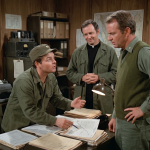
The three of them stood in the Admin tent, surrounded by the physical validation that they were still connected to a world where houses were built and crayon drawings were made, and silver communion sets were polished. The packages from home were not just things; they were proof of love and proof that life continued elsewhere, separate from the gore and fatigue. They were colleagues, but in that shared moment, they were a found family, united by their individual connections to home, and for this moment, connected to each other through the shared triumph of the mail’s arrival.
A tired surgeon from the morning’s shift shuffled by, looking at the three of them holding their packages, a small smirk playing on his face. “Loot for the lucky,” he commented. A dry humor typical of the 4077th. B.J. managed a small, tired smile in return. The fatigue was always present, the humor a desperate measure.
Father Mulcahy gently closed the silver box. “We must be grateful,” he said simply. “For all signs, large and small.“
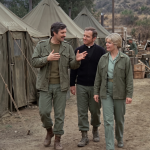
They share a moment of quiet peace. Outside, the signpost with its arrows pointing to Seoul, to home, and to the Command Post, was still visible through the tent flap. The MAS*H family stood together. The four specific names on the list placard meant something now. They had each found a piece of their distant home. A pieces of wood and a list of names held more hope than any flag. The nostalgia is in the memory of this small moment of normalcy and connection amidst the war. The final image: the signpost and the dirt compound, with the three of them just starting to walk out of the admin tent, their faces now carrying a shared sense of restored, if temporary, humanity.
They were all far from home, but in moments like these, they found a piece of it together.