A Delivery from the Real World
In the 4077th, quiet was a suspicious character. It rarely visited, and when it did, it usually meant something terrible was winding up just over the horizon.
But tonight, the silence in the camp was just the heavy, exhausted aftermath of a grueling three-day marathon in the Operating Room. The relentless rhythm of the choppers had finally faded into the distant hum of the camp’s generators.
Inside the cramped, lived-in canvas sanctuary of The Swamp, the air was thick with the smell of damp wool, stale gin, and the lingering, metallic ghost of iodine. The single, hanging practical lamp cast a soft, warm glow over the modest everyday clutter.
It illuminated a space that was less a military tent and more a makeshift, desperate approximation of home. Footlockers doubled as tables, and the muted olive and tan canvas walls felt like the edges of the entire universe.
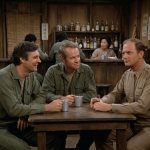
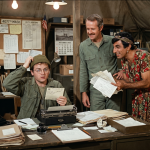
Hawkeye Pierce was slumped casually on his cot, his long legs stretched out in a posture of total, bone-deep surrender. He held a cigarette between his fingers, the thin trail of smoke curling toward the canvas ceiling.
He wore his fatigue shirt loose, the fabric worn and soft from a hundred harsh launderings. He was running on fumes, coffee, and sheer nervous energy, but his face still held that trademark tired, witty smirk.
Across from him, B.J. Hunnicutt was slouched in his wooden chair, leaning forward over the back of it with an easygoing, dryly amused smile. He was wearing his familiar brown sweater vest over his greens, a small, stubborn piece of civilian comfort in a sea of army issued drab.
They weren’t talking. They didn’t need to. They were simply sharing the profound, silent relief of not having their hands inside another human being.
Then, the tent flap parted with a soft rustle of canvas.
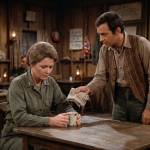
Radar O’Reilly stepped into the warm light, looking exactly like a boy who had accidentally wandered onto a battlefield. He stood earnestly near the tent opening, his shoulders slightly hunched beneath his oversized green fatigues.
He wasn’t holding his usual clipboard or a stack of requisition forms. Instead, he was clutching a thick, slightly crumpled manila envelope against his chest with wide-eyed, innocent confusion.
Hawkeye didn’t move from his slump, but he turned his head playfully toward the door, his smirk widening just a fraction. “Enter, O’Reilly. And state your business. If you’re here to tell us the war has been cancelled due to a lack of interest, you’re interrupting my celebration.”
B.J. chuckled softly, a low, grounding sound. “Leave the kid alone, Hawk. Can’t you see he’s carrying the weight of the world? Or at least, the weight of the army postal service.”
Radar blinked, looking down at the envelope and then back up at the two surgeons. He didn’t offer his usual nervous stammer. Instead, he looked genuinely baffled.
“I’m sorry to bother you sirs, really I am,” Radar said, his voice quiet. “I know you guys just got off a long shift and you’re trying to decompress your brains.”
“My brain is already decompressed, Radar,” Hawkeye said, taking a slow drag of his cigarette. “In fact, I think I left it in the scrub room sink. What do you have there? A newly discovered supply of un-powdered eggs?”
“No, sir,” Radar said, stepping slightly further into the light. He held the envelope out with both hands, like it was something fragile. “It’s the mail. The late chopper from Seoul dropped off a pouch. Mostly just official stuff. Forms for Colonel Potter, a requisition denial for Major Winchester…”
“A tragedy in one act,” B.J. murmured, smiling warmly.
“Right,” Radar continued, swallowing hard. “But then there was this. The clerk in Seoul stamped it ‘Return to Sender’ because it didn’t have a proper military address. But the pilot, Sparks, he knows I sort the mail here. He handed it to me directly.”
Hawkeye finally sat up a little straighter, the witty smirk faltering just enough to show the sharp, observant doctor underneath. “What is it, Radar?”
Radar looked down at the handwriting on the crumpled paper. “It’s addressed to ‘The Fellas in the Smelly Tent, 4077th MAS*H, Korea’.”
B.J. raised an eyebrow, leaning further forward on his chair. “Well, that certainly narrows it down to everywhere.”
“But that’s not the weird part, Captain,” Radar said, his wide eyes looking up, shining slightly in the warm lamp glow. “The return address… it’s not from a family member. It’s from a Private First Class Thomas Miller. And sirs… we sent Private Miller to Tokyo in a body bag three weeks ago.”
The quiet of The Swamp suddenly felt entirely different. The soft, tired humor evaporated, replaced by a sudden, heavy stillness. Hawkeye’s hand froze mid-air, the cigarette smoke stinging his eyes, as he stared at the impossible envelope in the corporal’s trembling hands.
For a long moment, the only sound in The Swamp was the low, rhythmic thrum of the distant generator and the faint whistle of the Korean wind against the canvas.
Hawkeye slowly lowered his cigarette, his eyes fixed on the manila envelope. The witty armor he wore so effortlessly had completely vanished, leaving behind the raw, exhausted face of a man who remembered every single casualty.
B.J. dropped his easy smile. He sat back in his chair, his broad shoulders suddenly looking very heavy. He remembered Private Miller. They both did. He was a kid from Illinois with a pocket full of baseball cards and a chest wound that wouldn’t stop bleeding. They had worked on him for four hours. It hadn’t been enough.
“Radar,” Hawkeye said, his voice uncharacteristically soft, stripped of any sarcasm. “Are you sure?”
Radar nodded earnestly, stepping closer to Hawkeye’s cot and offering the envelope. “Yes, sir. I checked the logs. It’s his serial number on the return address. But the postmark… it’s from Chicago. From two weeks ago.”
Hawkeye took the envelope. It felt heavy. He looked at B.J., who offered a silent, steady nod of support. The found-family loyalty of the 4077th wasn’t just about sharing jokes and gin; it was about sharing the ghosts, too.
With careful, precise movements—the same steady hands he used in surgery—Hawkeye tore open the top of the envelope. He reached inside and pulled out a stack of lined notebook paper and a small, square photograph.
Hawkeye stared at the photograph for a long time. The silence stretched out, thick and tense. Radar shifted nervously from foot to foot, his hands now empty, wringing his cap.
Then, very slowly, the corners of Hawkeye’s eyes crinkled. A different kind of smile appeared on his face—not his usual defensive smirk, but a smile of profound, overwhelming disbelief.
He handed the photograph to B.J.
B.J. took it, holding it up to the warm glow of the lantern. It was a picture of a young man sitting in a wheelchair on a sunny front porch in America, holding up a newspaper with the current date. He looked pale, he was missing his left leg, and he looked incredibly, undeniably alive.
“I don’t believe it,” B.J. whispered, his voice thick with sudden emotion. He looked up at Hawkeye. “Hawk… he made it.”
“Read the letter,” Hawkeye said, his voice raspy.
B.J. unfolded the notebook paper. He cleared his throat, reading aloud into the quiet tent.
‘Dear Fellas in the Smelly Tent. I hope this gets to you. The nurses in Tokyo told me that’s what you called your quarters. They also told me that I died on your table for two minutes before you brought me back.’
B.J. paused, taking a slow, shaky breath. Hawkeye kept his eyes trained on the canvas floor, listening intently. Radar stepped closer, completely absorbed.
B.J. continued reading. ‘They said you put so much of your own blood into me that I’m officially half-doctor now. I just wanted to write and tell you that the other half made it home to Chicago. My mom is making meatloaf. It’s terrible, but it’s the best thing I’ve ever eaten. Thank you for not giving up on me when you should have. Keep your heads down. Yours truly, Tommy.’
B.J. slowly lowered the letter. He carefully placed it on his knee, his hands resting over it. He looked across the small space at Hawkeye.
Hawkeye was staring at the wall, blinking rapidly. The deep lines of fatigue around his eyes seemed to soften. The crushing weight of the war, the endless tide of wounded, the bitter futility of it all—for just this one, singular moment, it was pushed back into the dark.
“Well,” Hawkeye finally said, his voice thick but laced with a gentle, returning wit. “If he thinks our tent smells bad, wait until he tries his mother’s meatloaf. I hear Chicago meatloaf is a court-martial offense.”
B.J. laughed, a warm, resonant sound that filled the tent. “You’re a cynical man, Pierce.”
“I have to be, Beej,” Hawkeye smiled softly, finally looking up. “If I wasn’t cynical, I might actually start believing we’re doing some good around here.”
Radar, who had been holding his breath, finally let it out in a long sigh. His innocent, wide-eyed confusion had melted away into a beaming, proud smile. “I knew I shouldn’t let them throw it out,” he said softly. “I just knew it belonged in here.”
“You did good, Radar,” B.J. said gently, handing the photograph back to Hawkeye. “You did real good. Go get some sleep. You’ve officially delivered the best mail we’ve had all year.”
Radar nodded, pulling his cap tight on his head. “Goodnight, Captains. Sweet dreams.”
“Goodnight, Radar,” Hawkeye said.
As the corporal slipped back out into the cool Korean night, the tent flap fell shut, sealing The Swamp back into its private world. Hawkeye looked at the photograph one more time. He didn’t put it in his footlocker. Instead, he reached over and carefully tucked the edge of the picture into the wooden frame of the canvas wall, right next to his bed, where the warm lamplight could hit it.
He leaned back onto his cot, took a final, slow drag of his cigarette, and closed his eyes. The war would undoubtedly be waiting for them tomorrow with more noise, more mud, and more tragedy. But tonight, inside the faded green walls of their shared sanctuary, they had won.
In a place where tomorrow was never promised, a simple letter from home was the only medicine that truly healed the doctors.