The Corporal, The Dress, and the Distance Home
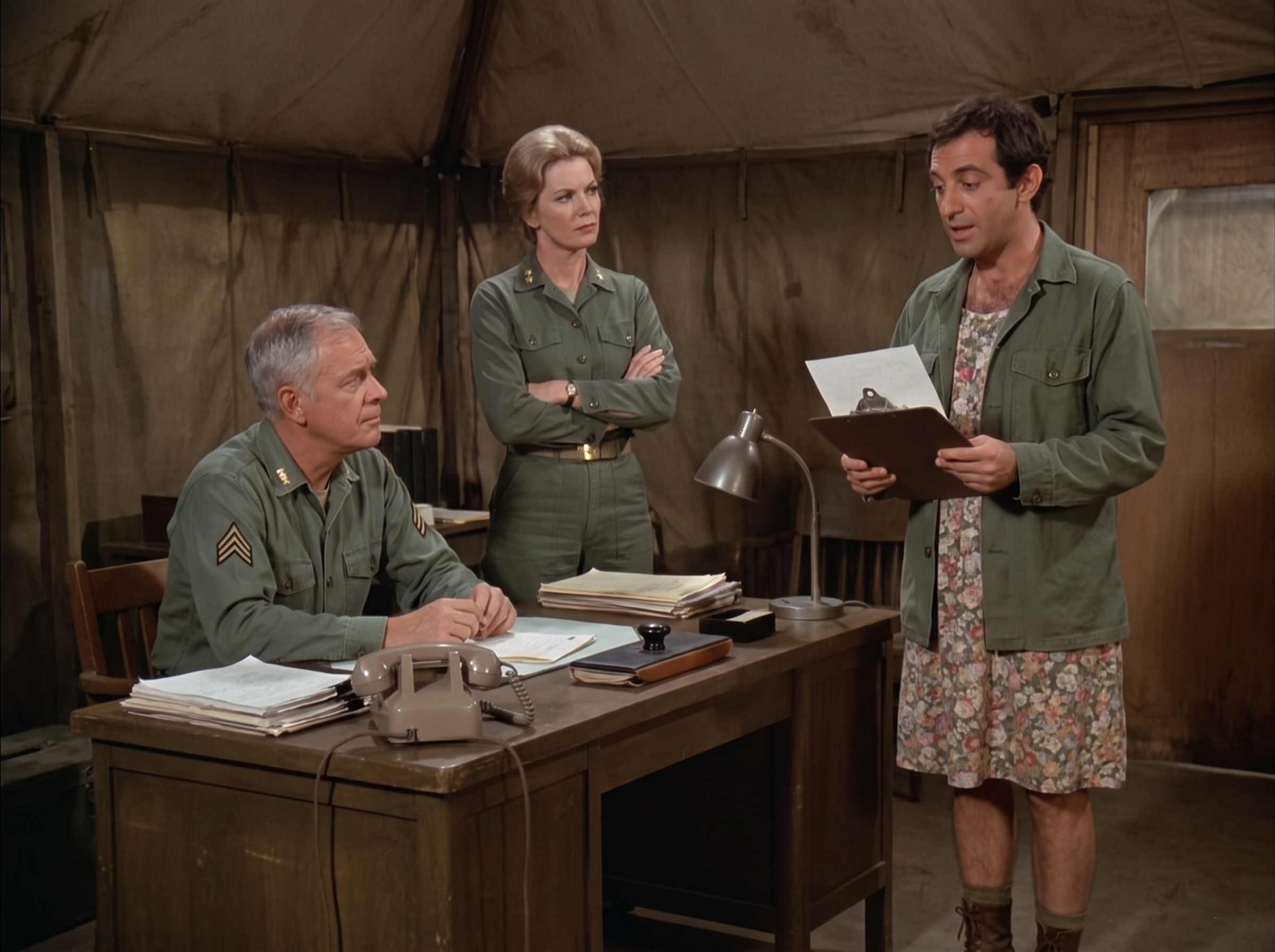
The war outside was nothing but the dull, rhythmic thud of distant artillery, but inside Colonel Sherman Potter’s office, the silence was heavy enough to bottle.
The canvas walls of the 4077th Mobile Army Surgical Hospital held the late afternoon heat like a thick wool blanket.
Dust motes danced lazily in the soft, even light that filtered through the tent flaps, casting a warm, faded brown and olive hue over everything it touched.
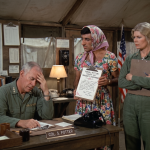
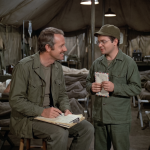
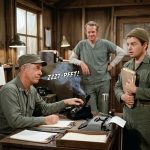
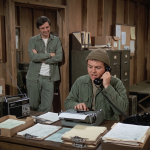
Behind a simple wooden military desk, cluttered with endless stacks of carbon-copy requisitions and a heavy field phone, sat Colonel Potter.
He leaned forward slightly, resting his arms on the desk.
His lined face wore a look of weary, fatherly exasperation, the kind of calm authority that could only be earned by commanding a camp full of brilliant, exhausted lunatics.
Beside the desk stood Major Margaret Houlihan.
She was a rigid pillar of sharp professional dignity, her arms crossed tight against her chest.
Her green fatigues were crisp and practical, but the stiff posture couldn’t entirely hide the bone-aching fatigue they all shared.
She cast a deeply skeptical, fiercely annoyed glance at the man standing before them, her lips pressed into a thin line of spectacular disapproval.
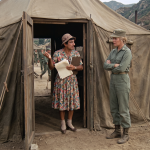
Corporal Maxwell Q. Klinger stood in the center of the office, holding a standard-issue clipboard as if it were a sacred scroll.
He was dressed in his own unique, tragicomic interpretation of military protocol.
A delicate, faded floral print dress peeked out from beneath an unbuttoned, worn olive-drab army jacket.
The rough, muddy canvas of his combat boots clashed spectacularly with his bare shins, and the open collar of the dress revealed a very prominent, hairy chest.
Yet, Klinger’s posture was magnificent.
He stood with theatrical, comic pride, his dark eyes wide and full of an emotionally sincere plea.
“I am telling you, Colonel,” Klinger said, his voice rising in dramatic cadence. “It is a documented medical phenomenon. The sudden, irrepressible urge to match one’s accessories to the local flora.”
Potter rubbed his temples, a slow, heavy sigh escaping his lips. “Klinger, there isn’t a flower blooming within fifty miles of this mud pit.”
“Which only exacerbates the condition, sir!” Klinger countered quickly, tapping the clipboard. “The psychological deprivation of petunias has driven me to the brink. I have it all written down right here. An official request for reassignment to a botanical garden in Ohio.”
Margaret let out a sharp, dismissive scoff.
“Corporal, this is the most ridiculous, transparent, utterly insulting piece of garbage you have ever attempted to pass off in this office,” she snapped.
Klinger turned to her, placing a hand over his heart in mock devastation.
“Major Houlihan, you wound me. This is my medical truth.”
“It’s a dress from a Sears catalog, Klinger,” Margaret shot back. “And it clashes horribly with that jacket.”
Klinger opened his mouth to defend his fashion choices, but the words seemed to catch in his throat.
He looked down at the clipboard, the theatrical energy suddenly draining out of his shoulders.
The silence in the tent stretched out, thick and uncomfortable.
When Klinger finally looked back up, the comedic mask had slipped, leaving behind something terribly raw and desperately tired.
“It’s not just the flowers, Colonel,” Klinger whispered, his voice cracking, shedding all pretense of the joke. “My wife, Laverne… she sent a letter today. She says the neighborhood feels empty. She says she’s starting to forget what my voice sounds like.”
The heavy silence returned to the office, completely shifting the gravity in the room.
The dry comedy that usually padded the walls of the 4077th evaporated, leaving behind the stark, lonely reality of a mobile army hospital thousands of miles from home.
Colonel Potter stopped rubbing his temples.
He slowly lowered his hands, folding them neatly on the paperwork covering his wooden desk.
The look of weary exasperation on his face softened into something much deeper, something profoundly fatherly and quiet.
He looked at Klinger not as a commanding officer dealing with a malingering corporal, but as an older man looking at a frightened, homesick kid.
Beside him, Margaret’s rigid posture faltered.
Her arms, crossed so tightly in professional defense, slowly loosened, falling to her sides.
The fierce annoyance in her eyes melted away, replaced by a sudden, aching flash of empathy.
She knew all about letters that made you feel farther away from the world.
She knew exactly what it felt like to have the people you loved forget how to wait for you.
“Klinger,” Potter said, his voice low and remarkably gentle. “Son, put the clipboard down.”
Klinger hesitated, his knuckles white as he gripped the edges of the wood and metal.
Slowly, he lowered the board to his side, the floral hem of his dress swaying slightly with the movement.
“I can’t sign that reassignment, Maxwell,” Potter said softly. “You know I can’t. A lack of petunias isn’t going to get you a ticket back to Toledo. And even if you wrote down the real reason… the army doesn’t issue Section 8s for a broken heart.”
Klinger swallowed hard, his eyes dropping to his muddy combat boots.
“I know, sir,” he mumbled. “It’s just… sometimes you have to try. If I stop trying, it means I’ve accepted that I belong here.”
Margaret took a small half-step forward.
When she spoke, her voice lacked its usual commanding bark. It was quiet, steady, and unexpectedly tender.
“You don’t belong here, Corporal,” Margaret said. “None of us do. But you are needed here.”
Klinger looked up, surprised by the softness in the Major’s tone.
“You think I don’t see how hard you work?” Margaret continued, her chin lifting slightly. “You parade around here in ridiculous outfits, trying to convince us all you’re crazy. But when the choppers land, you’re the first one out there on the pad. You carry stretchers until your hands bleed. You organize the blood supply. You keep this camp running while the rest of us are drowning in the O.R.”
Potter nodded slowly in agreement, his eyes locked on the young corporal in the dress.
“The Major is right,” Potter said. “You’re a good soldier, Klinger. Whether you like it or not. And right now, this terrible, godforsaken patch of dirt needs you.”
Klinger stood quietly for a long moment, absorbing the words.
The desperate homesickness didn’t vanish—it never really did—but the crushing weight of it seemed to lighten just a fraction.
He wasn’t just a number on a reassignment form.
He was seen. He was valued. He was part of this strange, exhausted, mismatched family.
A small, reluctant smile tugged at the corner of Klinger’s mouth.
He slowly raised the clipboard again, holding it with a renewed sense of his trademark theatrical dignity.
“Well,” Klinger said, his voice finding its familiar, dramatic rhythm once more. “I appreciate the sentiment, Colonel. Major. But I must insist that my condition is worsening. If I am not exposed to a reasonably priced suburban garden center within the next forty-eight hours, I cannot be held responsible for my fashion choices.”
Potter chuckled, a dry, warm sound that filled the tent.
He reached out and pulled a fresh requisition form toward him, uncapping his fountain pen.
“I’ll tell you what I can do, Klinger,” Potter said, not looking up as he wrote. “I’ll authorize an extra five minutes for your next phone call home to Laverne. You can remind her exactly what your voice sounds like.”
Klinger’s eyes widened, a genuine spark of joy breaking through his weary expression.
He snapped to attention, throwing a crisp, perfect military salute, despite the floral print dress and the unbuttoned jacket.
“Thank you, Colonel,” Klinger said softly.
“Dismissed, Corporal,” Potter replied gently. “And Klinger?”
“Yes, sir?”
“The Major is right,” Potter added, glancing up. “That dress really does clash with the jacket.”
Klinger grinned, turning smartly on his heels and marching out of the office, the canvas flaps falling shut behind him.
The silence returned to the office, but it no longer felt heavy.
Potter and Margaret shared a brief, knowing look.
They were all a million miles from home, surviving on nothing but bad coffee, dark humor, and the quiet grace of looking out for one another.
Margaret crossed her arms again, but this time, the gesture was comfortable, almost relaxed.
Potter sighed, returning to his paperwork, the war waiting patiently just outside the door.
In a place built on the business of saving lives, sometimes all it took was a shared moment of grace to save a soul.