The Weight of the Paper War
The Korean War didn’t just bleed you dry; sometimes, it tried to smother you in triplicate.
It was a quiet Tuesday afternoon at the 4077th, or at least as quiet as things ever got in a mobile army surgical hospital. The distant, rhythmic thumping of artillery had faded into a dull, low hum behind the mountains. The camp was finally catching its breath after a grueling thirty-six-hour session in the Operating Room.
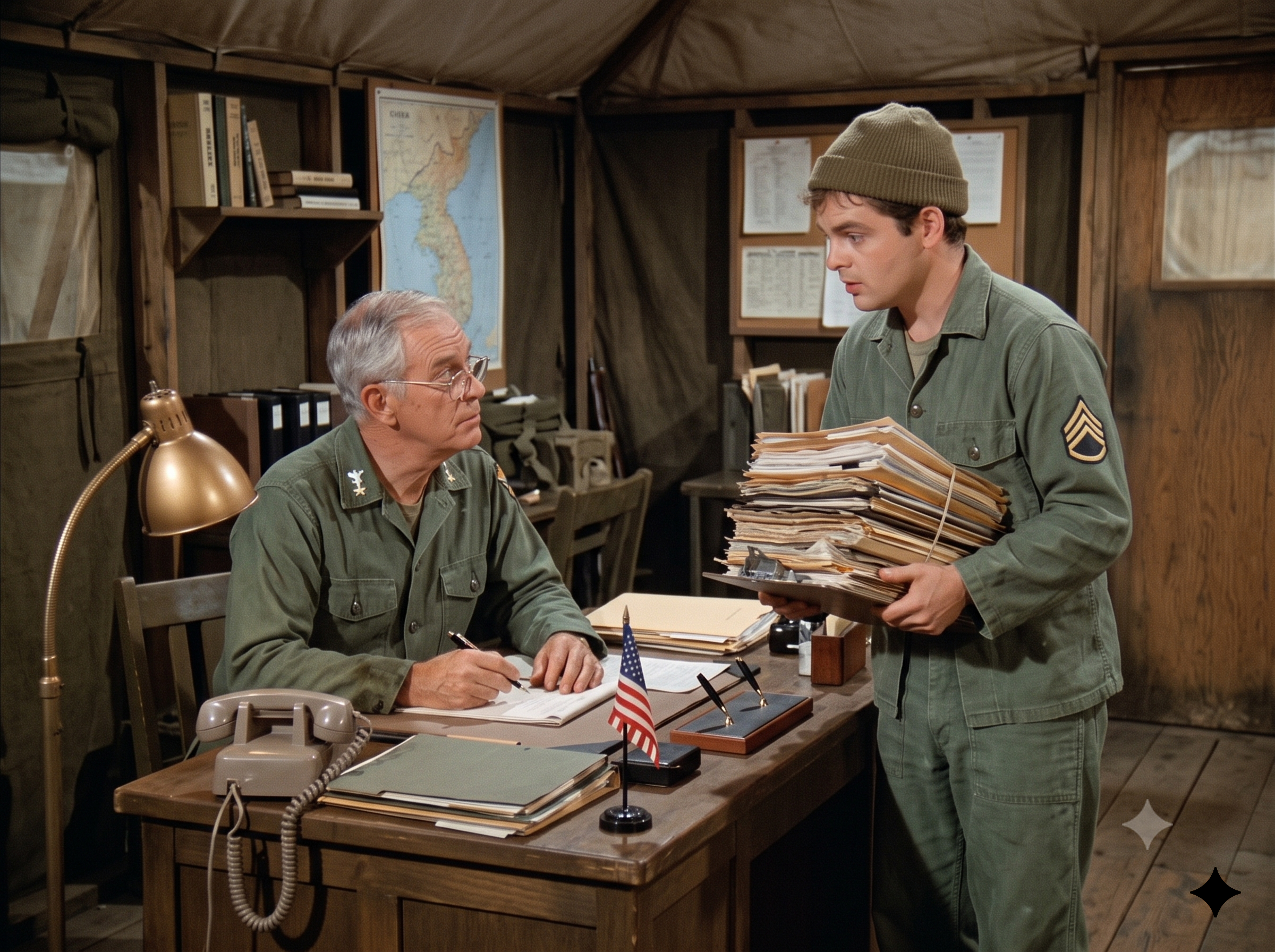
Inside the commanding officer’s tent, the atmosphere was heavy with exhaustion and the smell of stale coffee. Colonel Sherman T. Potter sat behind his simple wooden desk, bathed in the warm, practical glow of his desk lamp. The canvas walls of the office seemed to hold the heat of the afternoon sun, making the small space feel like a well-worn oven.
Potter had just settled in to write a letter to his beloved Mildred. He had his reading glasses perched perfectly on the bridge of his nose, his favorite fountain pen in hand, and a rare moment of absolute peace.
Then, the door opened.
It wasn’t a dramatic entrance, but rather a slow, struggling shuffle. Corporal Walter Eugene O’Reilly edged his way into the office, his olive-drab knit watch cap pulled down tight. But it wasn’t Radar’s quiet entrance that caught the Colonel’s attention. It was what the boy was carrying.
In his arms, balanced precariously on a single, groaning wooden clipboard, was a stack of paperwork so impossibly thick it defied the laws of physics. It looked like the entire administrative history of the United States Army, bound together by two strained rubber bands and a prayer. Faded manila folders, tan canvas forms, and endless sheets of carbon paper were stacked nearly up to Radar’s chin.
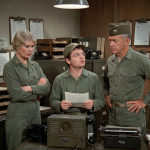
Radar stood before the desk, his face a picture of earnest, sweet, nervous confusion. He leaned in slightly, trying to keep the mountain of bureaucracy from toppling over onto the Colonel’s boots.
Potter didn’t say a word. He just stopped his pen mid-sentence.
He slowly looked up over the rims of his spectacles. He offered the boy a dryly amused, fatherly glare of weary wisdom. It was the look of a career military man who had seen two World Wars and was now silently, profoundly judging the absolute absurdity of this one.
“Corporal,” Potter finally said, his voice a low, gravelly rumble. “Tell me that you have decided to take up weightlifting, and that you are merely using those files as a barbell.”
Radar swallowed hard, his eyes wide and innocent. “Uh, no, sir. I wish I was, sir. But this is the mail from I Corps.”
“All of it?” Potter asked, his eyebrows inching toward his hairline. “Did they send us the library of Congress by mistake?”
“No, Colonel. This is just the new daily requirement for the camp inventory,” Radar explained, his voice trembling slightly under the physical strain. “They, uh… they want a full accounting of everything.”
“Everything?” Potter repeated, the weariness settling deep into his bones.
“Yes, sir,” Radar squeaked, leaning forward as the top half of the stack began to list dangerously to the left. “Every tongue depressor. Every roll of gauze. Every spare tire, every cot, every single serving of creamed chipped beef, and every drop of iodine.”
Potter stared at the teetering tower of red tape. He looked at the nervous farm boy from Ottumwa who was sweating bullets trying to hold it all together.
“And if I don’t sign all… four thousand pages of this right now?” Potter asked softly.
Radar’s eyes darted nervously to the side, then back to his commanding officer. “Well, sir. According to General Hammond’s office, if this isn’t signed and sent back on the 1600 chopper…”
The stack shifted again, a single file sliding out an inch. Radar gasped, hugging the pile tighter to his chest.
“…they’re going to cut off our supply of surgical thread, sir,” Radar whispered, his voice cracking with sheer panic.
Colonel Potter didn’t yell. He didn’t throw his pen across the room. He didn’t even sigh.
He just sat there in the warm, yellow light of the desk lamp, a monument of quiet, fatherly exasperation. He looked at the small American flag resting on his desk, then back to the terrified clerk standing before him.
The absurdity of it all washed over him like a cold wave. Three miles down the road, boys were dodging shrapnel in the mud. Right here in this camp, his doctors were currently sleeping on their cots, their hands still stained with iodine, exhausted from saving lives. And in Tokyo, some brass hat with too much time and a clean uniform was threatening their surgical supplies over a missing inventory of creamed chipped beef.
“Put it down, son,” Potter said gently, gesturing to the corner of his desk. “Before you give yourself a hernia and end up on one of my operating tables.”
With a massive sigh of relief, Radar stepped forward and let the massive stack slide onto the wooden desk. It hit the surface with a heavy, dull thud that rattled the field phone in its cradle. A tiny cloud of ancient, military-grade dust puffed into the air.
Radar stood at attention, though his shoulders slumped with fatigue. “I’m sorry, Colonel. I tried to tell the courier that you were busy saving lives, but he said the Army marches on its paperwork.”
“The Army,” Potter said, slowly removing his glasses and rubbing the bridge of his nose, “marches on its stomach, its boots, and the grace of God. Paperwork is just the mud we have to wade through to get there.”
Potter leaned forward and inspected the towering stack. It was genuinely ridiculous. Forms in triplicate, cross-referenced with regulations that hadn’t been updated since the Truman administration took office. He reached out and tapped the top folder with the end of his fountain pen.
He knew how much this kid cared. Radar carried the entire administrative weight of the 4077th on his small, narrow shoulders. He kept the generators running, the food coming, and the mail flowing. He was a nineteen-year-old kid fighting a war with a typewriter and a clipboard, and he took every single regulation to heart because he thought it kept his people safe.
Potter felt a swell of quiet, protective tenderness for the boy.
“Radar,” Potter said, his voice entirely stripped of its command edge, leaving only the warmth of a grandfather. “Take a breath. You look like a rabbit cornered by a pack of hounds.”
“I just don’t want us to lose our thread, sir,” Radar mumbled, looking down at his boots. “Hawkeye and B.J. need that thread. If they don’t have it, they can’t sew people up. And if they can’t sew people up…”
“Nobody is losing any thread on my watch, Corporal,” Potter interrupted softly.
Potter put his glasses back on. He grabbed a blank piece of official 4077th letterhead from his top drawer. He uncapped his fountain pen and began to write in his elegant, sweeping script.
Radar watched, his brow furrowed in confusion. “Uh, Colonel? The signature line is on page 4, page 19, page 82, and then every third page after that until page 600.”
“I am aware of how to fill out a Form 409-J, son,” Potter said dryly, not looking up from his writing. “I’ve been filling them out since before you were old enough to ride a bicycle without training wheels.”
Potter finished his note, signed it with a flourish, and blew gently on the ink to dry it. He stood up, picked up the single sheet of paper, and slapped it right on top of the mountain of files.
Radar leaned in to read it.
It was a memo addressed directly to General Hammond’s office. It read: “The 4077th MASH is currently engaged in the business of saving human lives. We have adequate beans, bandages, and bullets. We will continue to use them as needed. If you require a more detailed inventory, you are formally invited to come to the front lines and count the tongue depressors yourself. Sincerely, Colonel Sherman T. Potter.”
Radar’s eyes went wide as saucers. “Sir! You can’t send that! That’s… that’s insubordination!”
“No, Radar,” Potter smiled, a warm, genuine smile that reached all the way to his eyes. “That is a command decision. There is a time for playing by the book, and there is a time for reminding the bookkeepers that there is a war on.”
Potter walked around the desk and placed a heavy, comforting hand on Radar’s shoulder. He gave it a firm, reassuring squeeze.
“Now,” Potter instructed, pointing to the massive stack. “I want you to take this entire pile of bureaucratic mule fritters, carry it out behind the mess tent, and feed it to the burn pit.”
Radar stared at him, caught between terror and absolute awe. “The… the burn pit, sir?”
“You heard me,” Potter said, turning back toward his chair. “And when the courier comes back, you hand him that single piece of paper. You tell him it slipped my mind to fill out the rest, what with the incoming wounded and all.”
A slow, tentative smile began to spread across Radar’s face. The heavy burden of anxiety that had been crushing him all afternoon seemed to evaporate into the stifling air of the tent. He looked at the Colonel not just as a commanding officer, but as the steady, unbreakable anchor of their makeshift family.
“Yes, sir,” Radar said, his voice finding its usual peppy rhythm again. He grabbed the clipboard and began the monumental task of lifting the stack back into his arms.
“And Radar?” Potter called out as the boy struggled toward the door.
Radar paused, peering around the side of the paper mountain. “Yes, Colonel?”
“When you’re done saving the camp from the horrors of administration,” Potter said, sitting back down and pulling his letter to Mildred back in front of him. “See if you can scrounge up two grape Nehis. I think we’ve both earned a drink.”
Radar’s smile stretched from ear to ear. “I’ve got two cold ones hidden behind the plasma cooler right now, sir. I’ll be right back.”
As the door clicked shut, leaving Potter alone in the quiet warmth of his office, the Colonel chuckled softly to himself. The war was a terrible, ugly, exhausting thing. But as long as they had each other—and as long as they knew when to ignore the rules—they were going to be just fine.
Some days the heaviest casualties were patience and sanity, but the 4077th always found a way to carry the load together.