Coffee, Confessions, and a Cold Wind from the Front
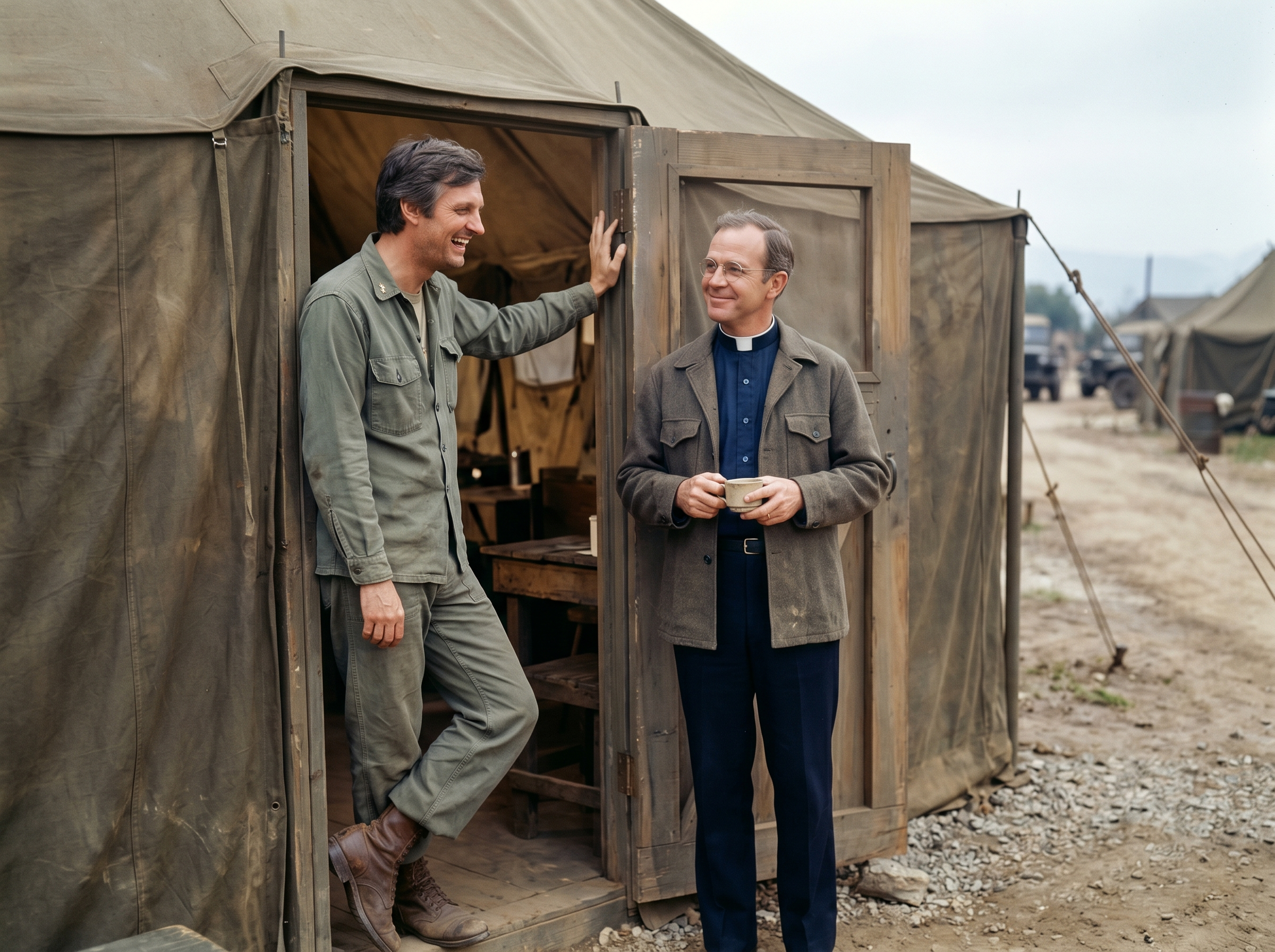
The morning air always seemed to carry a sharp, metal tang of helicopter exhaust, but that day, it was different.
It was just cold.
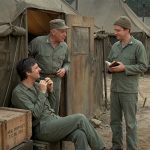
Hawkeye stood leaning against the rough wooden doorframe, one battered leather boot hiked up and resting on the splintered wood.
He’d slept, maybe, two hours? Maybe. It felt like ten years.
His olive drab jacket was stained with who-knows-what, the collars turning gray.
His face was a roadmap of exhaustion, lines grooved too deeply around his eyes.
But he was laughing.
He was laughing hard, his shoulders shaking with the quiet, desperate mirth that came when you were so tired you could cry but chose this instead.
He watched Father Mulcahy, who was standing just outside on the gravel path.
Mulcahy looked, by contrast, infuriatingly pulled together.
His collar was a pristine white band, standing out against the dark blue cleric’s shirt.
His green-grey field jacket was buttoned against the chill, showing only the slight rumpling of life at the 4077th.
The Father was smiling, a slow, patient smile that always seemed to say: *I know you’re using that humor as armor, Pierce.*
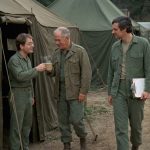
He was holding a tin mug, steam rising from it, in both hands, savoring the warmth.
“I’m telling you, Francis,” Hawkeye was saying, his voice a gravelly whisper.
“I think that latest supply list Radar sent included ‘two crates of refined pessimism.’ I can feel it soaking into the ground.”
Mulcahy let out a soft chuckle, taking a careful sip from his cup.
“He’s doing his best, Hawkeye. He tries to manage, well, everything.”
“He is the center of the solar system,” Hawkeye agreed, pushing himself upright slightly.
“If he stops rotating, we all fall into the sun. Or worse, out of coffee.”
They shared a quiet moment. It was a comfortable silence, built over months of shared dread and late-night calls for comfort.
The Swamp, its interior just a dark tangle of messy bunks and hanging clothes, loomed behind Hawkeye.
Outside, the camp was stretching and groaning.
The distant hum of some generator was the only constant companion to their conversation.
Hawkeye watched the Father, his smile softening.
“Seriously, Mulcahy. How do you do it? Every single day.”
The Father seemed to consider this, his gaze drifting towards the edge of the tent line.
“One foot in front of the other, Captain. And prayer. And sometimes… just making a very good cup of coffee.”
Hawkeye felt a small surge of genuine warmth, the first he’d felt all morning.
The humor was fading, leaving something more fragile and real in its place.
He thought of the kid from Ohio. The one he’d worked on for six hours. The one who didn’t make it.
His laughter had been a mask, and the Father knew it. The Father always knew.
He looked around the empty doorway. “Is B.J. in there? He’s probably slept right through the dawn.”
Mulcahy smiled. “I think he went to check on the wounded from last night’s shift. He was worried about that young corporal.”
The memory of the corporal hit Hawkeye like a physical blow.
He felt the sudden, crushing weight of fatigue press down again.
His foot slid off the doorframe. He leaned heavier on his shoulder.
The banter, the lightness, it was all draining away.
Mulcahy must have seen the change. He paused mid-sip.
The Father’s smile did not waver, but his eyes narrowed with a sudden, deep concern.
“Hawk?” he said softly. “You didn’t sleep at all last night, did you?”
The question hung in the air, a simple inquiry that opened up a cavernous truth.
The quiet understanding in the Father’s face was more than Hawkeye could bear.
He felt the armor he’d built crack.
His mouth went dry.
His laughter was gone.
He just stood there in the doorway, suddenly feeling exposed to the cold wind.
He gripped the doorframe, knuckles white.
Hawkeye didn’t answer right away. He couldn’t.
The words were stuck in his throat, choked by everything he couldn’t say.
He stared at the ground, at the loose gravel that was all that separated him from the mud.
“No, Francis. I didn’t sleep,” he said, his voice flat and empty.
Mulcahy didn’t offer a platitude. He didn’t quote a scripture.
He simply moved a little closer, holding the warm mug.
“It was the boy from Ohio, wasn’t it?” the Father said gently.
Hawkeye closed his eyes, seeing the operating room again, the too-bright light, the smell of blood and sterile solution.
“I tried, Francis,” Hawkeye whispered. “I tried everything. I had my hand on his chest. I felt his heartbeat fade. It just… it faded.”
His hand, resting on the wooden frame, was shaking visibly now.
He wasn’t laughing anymore. The performance was over.
He was just a tired, broken man in the middle of a war.
Mulcahy stood there, watching him, a profound sadness etched onto his gentle face.
The comedy, the dry wit, the banter they usually used to pass the endless days, was useless here.
“You’re a good doctor, Hawkeye. You give them a chance. You did everything you could,” Mulcahy said, his voice quiet but firm.
Hawkeye shook his head, a single, definitive *no*.
He let out a shaky breath that was almost a sob.
“A good doctor makes them better, Father. A good doctor keeps them alive so they can go home and be kids.”
He pushed himself away from the frame, pacing the two steps the small platform allowed.
“This isn’t *medicine*. This is just… triage on a dying patient.”
He turned back, his eyes burning with unshed tears.
“We are just plugging holes until they bleed out. We aren’t healing anyone. We are just… presiding over the end of the world.”
He leaned his head back against the canvas of the tent, closing his eyes again, letting the cold fabric press against his forehead.
The wind picked up, rustling the ropes. The quiet of the camp felt heavier now.
Mulcahy waited. He knew when to speak and when to just *be there*.
After a long moment, the Father took another slow sip of his coffee.
He held the mug out towards Hawkeye.
“I made too much. Would you like a little?”
Hawkeye opened his eyes and looked at the outstretched mug.
It was such a simple, human gesture. A shared cup of coffee in the cold.
He reached out and took the mug. His fingers brushed Mulcahy’s.
The warmth from the ceramic cup was real. It was tangible.
He raised it to his lips and drank. The coffee was terrible, as always, but it was hot.
He swallowed, and for a moment, the lump in his throat eased.
He handed the mug back. “Thanks, Francis. You’re right. You do make good coffee.”
It was a weak attempt at humor, but the Father took it for what it was—a thank you.
Hawkeye pushed himself upright. The lines in his face were still deep, but the desperate tension was gone.
“B.J. went to check on the wounded, you said?” he asked.
The Father nodded. “He was worried. That corporal meant a lot to him, I think.”
Hawkeye nodded. He understood. B.J. carried his own weight, but he always had room for others’.
“Well,” Hawkeye said, pushing his foot back up onto the frame, a ghost of his former self.
“I suppose I should go find him. If I don’t, Radar will assume I’ve been killed by the cold or, worse, Winchester.”
Mulcahy laughed, a genuine, joyful sound.
“Yes, you probably should. Radar is very precise.”
Hawkeye looked down at his boot, then out at the camp.
The war was still going. The helicopters would come back. More boys would die.
But standing here, in this doorway, with this man, with this cup of terrible, beautiful coffee…
He was alive. They were both alive.
And that, in the middle of everything, was enough.
It was everything.
He looked at the Father, and for the first time in hours, a genuine smile touched his lips.
It wasn’t armor this time. It was connection.
“Thanks for the coffee, Francis. And… thanks for everything else.”
Father Mulcahy simply smiled back, taking a final sip. “You’re very welcome, Hawk.”
Hawkeye stepped out of the doorway and onto the gravel.
He adjusted his field jacket, buttoning it up to the collar.
The cold was still there, sharp and metal-tasting.
But it didn’t feel as deep now.
As he walked away, towards the distant operating tents where his friends were already working,
he could still feel the lingering warmth of the ceramic mug in his hand.
It was a cold morning at the 4077th.
But as long as they had each other, and a pot of terrible, beautiful coffee, they would make it.
One foot in front of the other.
Until they all got to go home.
In the stillness of a Korean dawn, sometimes all that kept you going was the warmth of a shared moment, and the quiet, enduring hope that one day, the coffee would finally be good.