Gravity and the Company Clerk
In a place held together by surgical tape, bad coffee, and sheer willpower, the paperwork was the only thing that made sense.
At least, it made sense to Corporal Walter “Radar” O’Reilly.
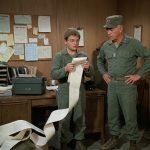
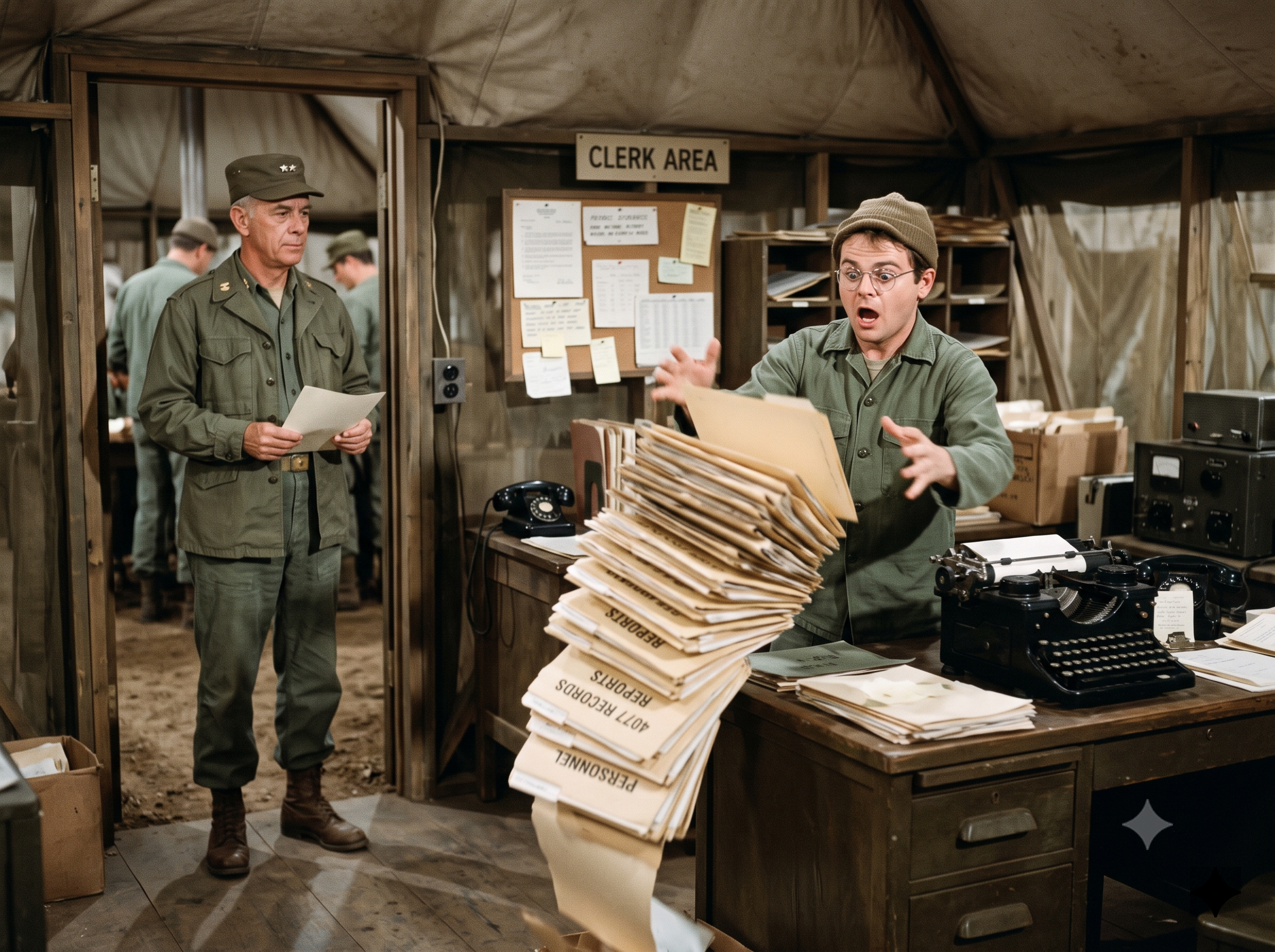
The clerk’s office was his domain, his sanctuary away from the blood and the noise of the OR. It was a modest, utilitarian space, filled with the rhythmic clack of his heavy black typewriter, a bulletin board covered in faded memos, a black field phone, and the ever-present, overwhelming tide of beige paper clutter.
It was a quiet Tuesday afternoon at the 4077th. The fighting had paused, leaving the camp heavy with the kind of deep, aching fatigue that only settles in when the cannons finally stop firing.
Radar had spent the last three hours organizing the month’s personnel records.
He was tired. His eyes burned behind his round, wire-rimmed glasses, and his trademark green knit cap was pulled low over his forehead. But he was determined. He had built a massive tower of manila folders right on the edge of his wooden desk.
It was a marvel of military engineering.
Perfectly sorted, beautifully aligned, and towering into the air, the stack defied both gravity and common sense.
The canvas door flapped open. Colonel Sherman T. Potter stepped just inside the doorway, bringing the soft, dusty light of the compound with him.
The veteran commander looked worn but steady in his practical green fatigues. He held a single piece of paper in his hand.
“Radar,” Potter said, his voice a low, gravelly rumble. “I need the latest supply manifest for the mess tent. Looks like we’re out of creamed corn. The camp is rejoicing, but I suppose we should order something to replace it.”
Radar jumped, eager to please. “Yes, sir! Got it right here, sir!”
He turned to his magnificent, impossible tower of files. “It’s right near the middle. I just have to…”
He pinched a single folder.
He pulled.
It was a fatal miscalculation.
The structural integrity of the pile gave way with a soft, terrifying whisper of sliding paper.
Radar gasped.
His eyes went wide in sudden, innocent panic. He threw his arms out, his fingers spread wide in a frantic, desperate attempt to catch the uncatchable.
But he was too late.
The massive stack of files—boldly stamped with “PERSONNEL,” “4077 RECORDS,” and “REPORTS”—pitched forward into the empty air. The heavy folders fanned out beautifully, suspended for one horrifying second before the inevitable disaster.
And Colonel Potter didn’t flinch.
Standing perfectly still by the door, the old cavalryman simply watched the catastrophe unfold, letting out a perfectly calm, dryly amused sigh of endless fatherly patience.
The sound of three hundred manila folders hitting the wooden floorboards was remarkably unspectacular.
It sounded like a giant deck of cards giving up all at once. Papers slid across the desk, bounced off the heavy typewriter, and cascaded down into a chaotic, beige ocean around Radar’s boots.
For a long, painful moment, the clerk’s office was completely silent.
The dust motes danced in the soft, even light filtering in through the canvas.
Radar stood frozen in his exact posture of horror. His arms were still reaching out to a tower that no longer existed. His mouth was still formed in a silent, tragic “Oh.”
He looked like a boy who had just dropped his mother’s best Sunday china.
Slowly, agonizingly, he lowered his arms. He looked at the floor, then up at his commanding officer.
“I… I think I found the creamed corn manifest, sir,” Radar squeaked, his voice trembling slightly. “It’s, uh… it’s somewhere in the ‘C’ section. Which is currently buried under the ‘P’ for personnel section.”
Colonel Potter didn’t yell.
He didn’t turn red in the face, and he didn’t bark an order about military discipline or the destruction of Army property.
Instead, the veteran commander slowly lowered the single piece of paper he was holding. He looked at the sea of forms, requisitions, and transfer orders blanketing the floor. Then, he looked at his pale, exhausted company clerk.
Potter let out a slow, breathy chuckle that barely made a sound. It was a sigh that carried thirty years of military experience and a deep, unspoken affection for the boy in front of him.
“Well, son,” Potter said gently, leaning comfortably against the doorframe. “I’ve seen the United States Army try to organize itself for three wars now. I gotta say, your method is by far the most visually spectacular.”
Radar let out a breath he seemed to have been holding since breakfast.
“I had it perfectly balanced, sir,” Radar explained, gesturing weakly at the mess. “It was… it was a load-bearing folder.”
Potter took a slow step into the room, his boots crunching slightly on a stray requisition form. He stooped down with a small grunt, his old joints popping softly in the quiet room.
He reached into the top layer of the disaster and pulled out a single, perfectly clean sheet of paper.
“Is this it?” Potter asked.
Radar squinted, pushing his glasses up his nose. “Yes, sir. How did you…?”
“Cavalry luck, Radar,” Potter said, straightening up and tapping the paper against his leg.
He looked closely at the clerk. In the soft light of the office, Potter could see the dark, bruised circles under Radar’s eyes. He saw the slight, nervous tremor in the boy’s hands.
The 4077th didn’t just run on blood and plasma. It ran on the endless, unseen labor of a kid from Iowa who worried about everyone else before he ever thought about himself.
“Leave it, Walter,” Potter said quietly.
Radar blinked, confused. “Sir? But the files… the Inspector General’s report is in there. I have to alphabetize…”
“The Inspector General is in Tokyo, drinking scotch and sleeping in a real bed,” Potter said, his tone softening into something deeply fatherly.
“These papers aren’t going anywhere. They don’t bleed. They don’t cry. And they certainly don’t need to be sorted right this second.”
Radar looked down at the mess, his shoulders slumping in defeat. “It’s gonna take me all night to put this back together, Colonel.”
“No, it isn’t,” Potter replied firmly.
“Because for the next four hours, you are officially off duty. Go to the mess tent. Get a cup of something that faintly resembles coffee. Then go to your cot, pull a blanket over your head, and close your eyes.”
“But sir, the morning reports…”
“That’s an order, son.”
Potter offered a small, warm smile—the kind of smile that made the mud, the cold, and the blood of Korea feel just a little bit further away.
“The war will still be here when you wake up. God willing, it won’t be, but it probably will. The paperwork can wait.”
Radar looked at the Colonel, his innocent panic melting into a profound, quiet gratitude. He swallowed hard and nodded.
“Yes, sir. Thank you, sir.”
Potter turned to leave, pausing just at the edge of the doorway. He looked back at the chaotic sea of beige folders covering the floor.
“And Radar?”
“Yes, Colonel?”
“When you do put this all back together… maybe build two towers instead of one. Gravity is a tough enemy to outflank.”
Potter stepped out into the compound, the screen door clicking shut behind him.
Alone in the quiet office, the young clerk looked at the fallen files. He smiled a small, tired smile, and reached up to adjust his knit cap. For the first time all week, the paperwork had finally stopped moving.
Some heroes carry rifles, others carry scalpels, but the bravest ones carry the weight of the world in manila folders.