The Quiet After the Choppers
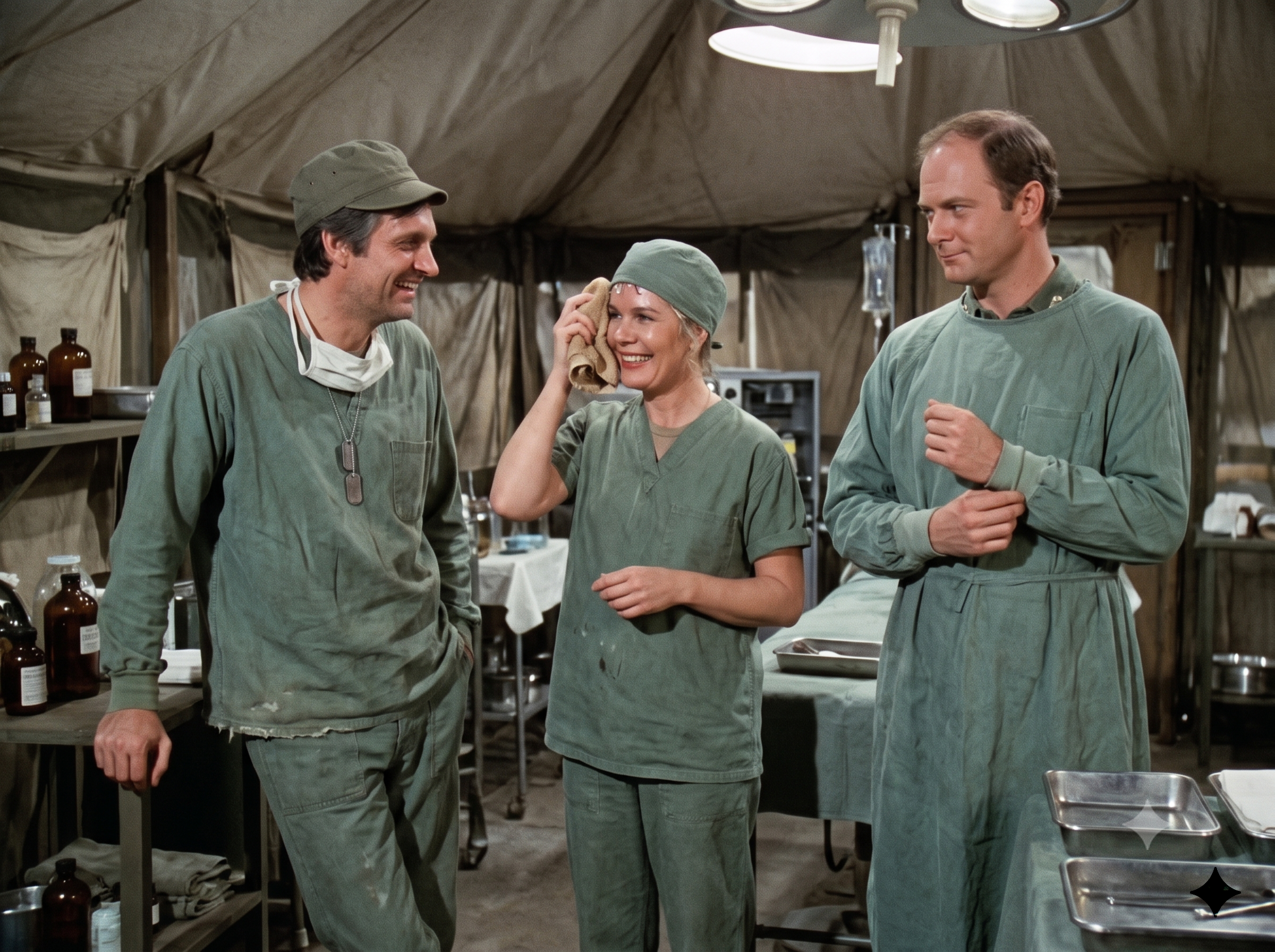
The heavy, rhythmic thumping of the generator was the only sound left in the world. For the first time in eighteen straight hours, the sky above the 4077th was empty of helicopters.
Inside the surgical tent, the frantic ballet of life and death had finally slowed to a heavy, exhausted crawl. The overhead lamps, still blazing with a harsh and unforgiving light, now illuminated a room drained of its desperate energy.
Captain Benjamin Franklin “Hawkeye” Pierce peeled his surgical mask down past his chin with a profound sigh. The elastic snapped lightly against his neck, a tiny punctuation mark at the end of an agonizingly long sentence.
He didn’t walk so much as he simply allowed gravity to pull him toward the nearest sterile supply cabinet. His spine seemed to dissolve as he slumped casually against the muted green shelving.
His green scrub shirt, damp with sweat and the general miseries of the Korean War, clung to his weary frame. The familiar metallic clink of his dog tags settling against his chest sounded unusually loud in the quiet tent.
Hawkeye closed his eyes for a fraction of a second, feeling the deep, aching burn in his calves and the stiffness in his shoulders. When he opened them again, his gaze drifted across the room, seeking a familiar anchor in the fading sterile light.
A few feet away, Major Margaret Houlihan was fighting her own silent battle with gravity. She wasn’t standing at attention. She wasn’t barking orders at the nurses or quoting Army regulations.
She was just Margaret, a bone-tired surgical nurse who had spent the last shift holding back the tide of war with nothing but clamps, gauze, and sheer willpower. She reached for a rough, olive-drab towel, pressing it against her forehead to catch the sweat that threatened to sting her eyes.
Even in her shapeless surgical greens, with her hair tucked hastily beneath a cotton cap, there was a quiet dignity about her. But the rigid, guarded demeanor of “Hot Lips” had been entirely burned away by the relentless hours at the operating table.
On the other side of the operating table stood Major Charles Emerson Winchester III. He was entirely quiet, which, for Charles, was usually a sign of deep distress or profound exhaustion.
He was meticulously adjusting the cuffs of his surgical gown, his long, aristocratic fingers moving with controlled, precise gestures. It was a small, fussy attempt to reclaim some sense of order and civilization in a canvas room that had seen nothing but chaos since yesterday afternoon.
Hawkeye watched them both, letting a slow, exhausted smirk spread across his unshaven face. The silence in the room was heavy, thick with the shared trauma and unspoken relief of surviving another influx of wounded.
He knew someone had to break it before the ghosts of the shift settled in for good. Hawkeye pushed himself up slightly, leaning his elbows on the cabinet behind him.
“You know, Major,” Hawkeye rasped, his voice rough with fatigue but laced with his trademark wit. “If I didn’t know any better, looking at you right now, I’d say you actually enjoyed holding that retractor for the last six hours.”
He offered her an emotionally alert, quietly wounded smile, waiting for the inevitable explosion.
Normally, this would be the moment Margaret would straighten her spine. She would usually point a trembling, furious finger at his chest and threaten him with a court-martial for insubordination, lack of military bearing, or just for breathing too loudly.
Charles froze, his fingers pausing on his gown, bracing for the shrill, deafening blast of Margaret’s righteous Army indignation.
Margaret lowered the towel from her forehead. She stood perfectly still, looking across the sterile trays at Hawkeye. The air in the tent grew incredibly thick.
She opened her mouth, her eyes locking onto Hawkeye’s, and the entire room seemed to hold its collective breath, waiting for the storm to break.
But the storm never came.
Instead, a soft, incredibly warm sound slipped past Margaret’s lips. It started as a weary exhale and blossomed into a genuine, unguarded laugh.
She didn’t raise her voice. She didn’t invoke the name of General MacArthur. She just stood there in the harsh O.R. light, her shoulders shaking slightly as a beautiful, amused smile lit up her face.
It was a smile that stripped away rank, regulations, and bravado. It was the smile of a woman who had seen the worst of humanity all night and was choosing to embrace the best of it in this quiet morning hour.
Hawkeye’s smirk melted into something far softer. The defensive armor of his wisecracks slipped away, leaving only deep, abiding affection for the woman standing across from him.
He didn’t just respect Margaret as a nurse; in moments like this, he recognized her as a fellow captive in this muddy, canvas purgatory. They were bound together by blood, terrible coffee, and an impossible job.
“I’ll have you know, Captain Pierce,” Margaret said, her voice rich with a tender, tired humor, “that my retractor technique is textbook. They teach it at Fort Ord.”
“Oh, I’m sure they do,” Hawkeye shot back, his eyes crinkling at the corners. “Right between ‘How to Polish Your Boots with Mud’ and ‘Advanced Mess Tent Survival.’ But seriously, Margaret… you were brilliant tonight.”
Margaret looked down, her smile turning bashful as she dabbed at her neck with the rough towel. Coming from Hawkeye, a compliment without a punchline was a rare and precious currency.
From his spot across the room, Charles watched the exchange. He gave his gown one final, sharp tug, trying his best to look utterly disinterested.
“Please, Pierce,” Charles drawled, his Boston accent thick but lacking its usual venom. “Do not encourage the Major. If she believes she has achieved perfection in a swamp, we shall never hear the end of it.”
Hawkeye and Margaret both turned to look at the aristocratic surgeon. Charles was trying to maintain his mask of haughty superiority, but his eyes betrayed him.
There was a reluctant, compassionate softness in Winchester’s expression. He looked at Hawkeye, then at Margaret, and despite his best efforts, a tiny, fond smirk tugged at the corner of his mouth.
He would never admit it aloud—he would sooner eat a plate of Igor’s creamed chipped beef—but Charles cherished these two lunatics. In a world gone entirely mad, their irreverent, chaotic brilliance was the only thing keeping him tethered to his sanity.
“Don’t worry, Charles,” Hawkeye chuckled, crossing his arms loosely over his chest. “I’m sure the Nobel committee is already drafting your award for ‘Best Dressed Surgeon in a Combat Zone.'”
“I should certainly hope so,” Charles sniffed, though the warm glint in his eye remained. “Someone must maintain the standards of civilization while the two of you wallow in your peasant camaraderie.”
Margaret laughed again, a soft, musical sound that made the drafty O.R. tent feel remarkably like home. She tossed the brown towel onto a nearby tray, the tension completely gone from her shoulders.
For a few precious minutes, there was no war. There were no generals, no enemy lines, and no incoming wounded.
There was only a tired kid from Maine, a dedicated Army brat, and a brilliant snob from Boston, standing in a circle of fading light. They were exhausted, practically dead on their feet, and smelling of iodine and fear.
But as they shared that quiet, lingering joke, the heavy burden of the 4077th felt just a little bit lighter. They drew strength from the simple, profound fact that they were in it together.
Hawkeye pushed himself off the cabinet, moving slowly toward the door. “Come on,” he said softly, looking back at Margaret and Charles. “I think we’ve earned a drink. Or at least a nap on something that doesn’t smell like ether.”
Margaret nodded, falling into step beside him, while Charles followed closely behind, still muttering good-naturedly about the indignities of field medicine.
As they pushed through the canvas flaps and stepped out into the cold Korean morning, the O.R. finally went dark, holding onto the warmth of their shared laughter just a little while longer.
In a war that took everything, the quiet moments of shared humanity were the only things they got to keep.