The Language of Home
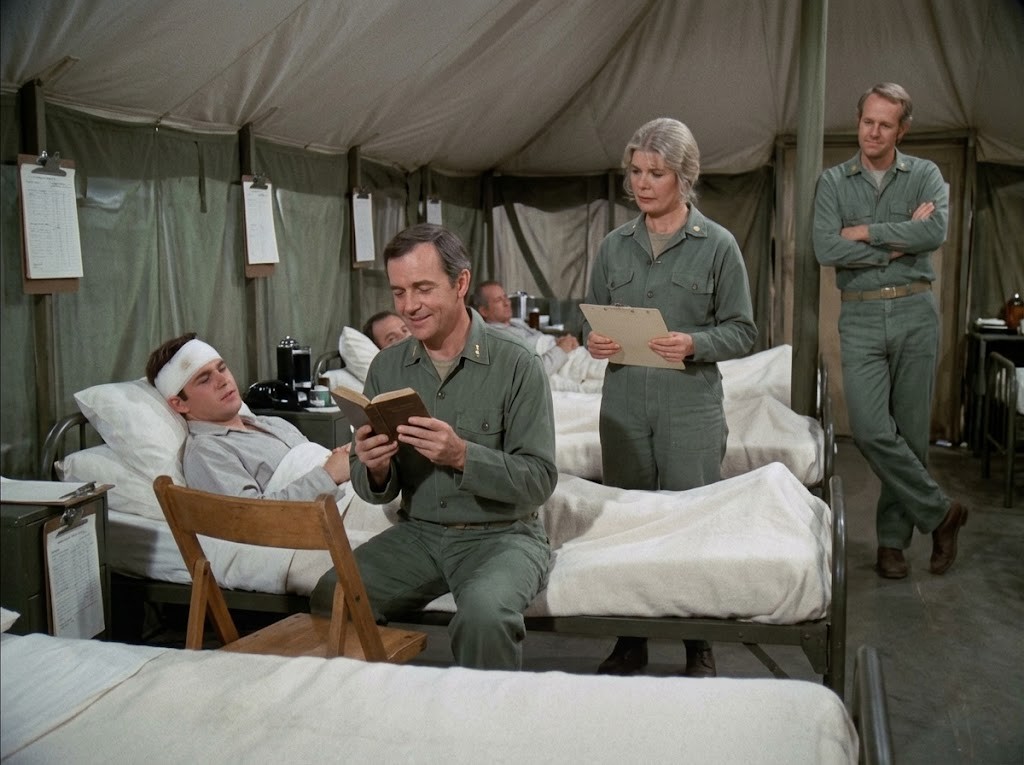
The canvas of the post-op tent always smelled of damp earth, old laundry, and isopropyl alcohol. It was a scent that clung to your skin long after the shift was over, a permanent reminder of where you were.
Tonight, the tents were quiet, save for the rhythmic, exhausted breathing of a dozen recovering boys. The frantic chaos of the OR had finally broken, leaving behind a heavy, bone-deep silence.
In the center of the room, Father Mulcahy sat on the edge of a cot, his thumb gently smoothing the worn leather cover of his pocket Bible. His face wore the quiet, patient smile of a man who spent his days translating horror into hope.
Lying in the cot was Private Billy Miller, a nineteen-year-old from Ohio with a thick white bandage wrapped tight around his forehead. Billy hadn’t spoken a word since they wheeled him out of surgery; his eyes were wide, staring blankly at the green canvas ceiling.
“Sometimes,” Father Mulcahy said, his voice a soft, steady anchor in the dim room, “the hardest part isn’t the mending of the skin, Billy. It’s the waiting for the mind to catch up.”
A few paces away, Margaret Houlihan stood rigid, a clipboard clutched tightly against her green fatigue shirt. Her grey-streaked hair was pinned back with military precision, and her jaw was set, but her eyes betrayed her.
She wasn’t looking at the charts; she was looking at Billy’s pale, frozen face. Her chest rose and fell with a sharp, controlled breath as she tried to maintain the fierce professional exterior that kept her from shattering.
Leaning against the wooden support pole near the back of the tent stood B.J. Hunnicutt, his arms crossed over his chest. His trademark mustache couldn’t entirely hide the tired downturn of his mouth.
B.J. shifted his weight, his boots creaking softly on the wooden floorboards, his gaze fixed on the young soldier. He wanted to crack a joke, to find some lighthearted piece of home to throw into the quiet room, but the words felt heavy tonight.
“He’s physically stable, Father,” Margaret whispered, her voice cracking just a fraction before she caught it. “The shrapnel is gone. His vitals are strong. But he won’t look at us.”
Mulcahy opened the small book, the pages rustling like dry autumn leaves in the still tent. “The boy is a long way from Ohio, Margaret. Sometimes, a soul just closes its doors until the storm passes.”
Billy suddenly turned his head, his eyes locking onto the small book in the priest’s hands. His lips moved, trembling, but no sound came out, just a desperate, silent gasp for air.
Father Mulcahy leaned in closer, his expression shifting from gentle comfort to absolute, undivided focus. He didn’t read a verse; instead, he simply held the book where Billy could see the faded gold lettering on the spine.
“This belonged to my parish back in Philadelphia,” Mulcahy said softly, his voice wrapping around the frightened boy like a warm blanket. “It’s seen its share of rainy Sundays, broken hearts, and potluck dinners.”
A tiny, choked sound finally escaped Billy’s throat, a ragged breath that sounded like a child waking from a nightmare. “My… my grandmother had one,” he whispered, his voice incredibly small. “It smelled just like that.”
Margaret closed her eyes for a brief second, a wave of profound relief washing over her face before she quickly snapped her clipboard tight. She stepped forward, her hand reaching out to gently adjust the blanket over Billy’s shoulder with an uncharacteristic, maternal softness.
“Then your grandmother was a very wise woman, Private,” Margaret said, her tone strict but her eyes shining with sudden, unspoken warmth. “And she’d expect you to eat your broth tomorrow morning.”
From the back of the tent, B.J. let out a soft, breathy laugh, the tension melting from his shoulders as he leaned back against the pole. “Hear that, Billy? The Major’s standard operating procedure requires a full recovery. No exceptions.”
Billy’s eyes shifted from the priest to the nurse, and finally to the tall doctor with the friendly mustache. For the first time in three days, the terrifying fog of the front lines seemed to clear from the boy’s face.
“I think,” Billy whispered, his eyelids suddenly growing heavy as the stubborn adrenaline finally left his system, “I think I can do that, sir.”
Father Mulcahy smiled, closing the Bible with a soft click and resting his hand on the boy’s uninjured arm until the soldier’s breathing turned deep and even.
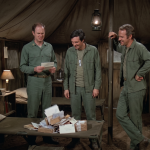
In the corner of the 4077th, surrounded by mud, olive drab canvas, and the distant, low rumble of artillery, three tired people stood watch over a boy who had finally found his way back.
They didn’t have much to offer the kids who came through their doors—just clean bandages, a bit of prayer, and a temporary family made of strangers. But in the quiet hours after the storm, when the world felt entirely broken, sometimes that was exactly enough.
In a place where tomorrow was never promised, they kept each other alive with the quiet pieces of yesterday.