Ink, Paper, and a Colonel’s Compass
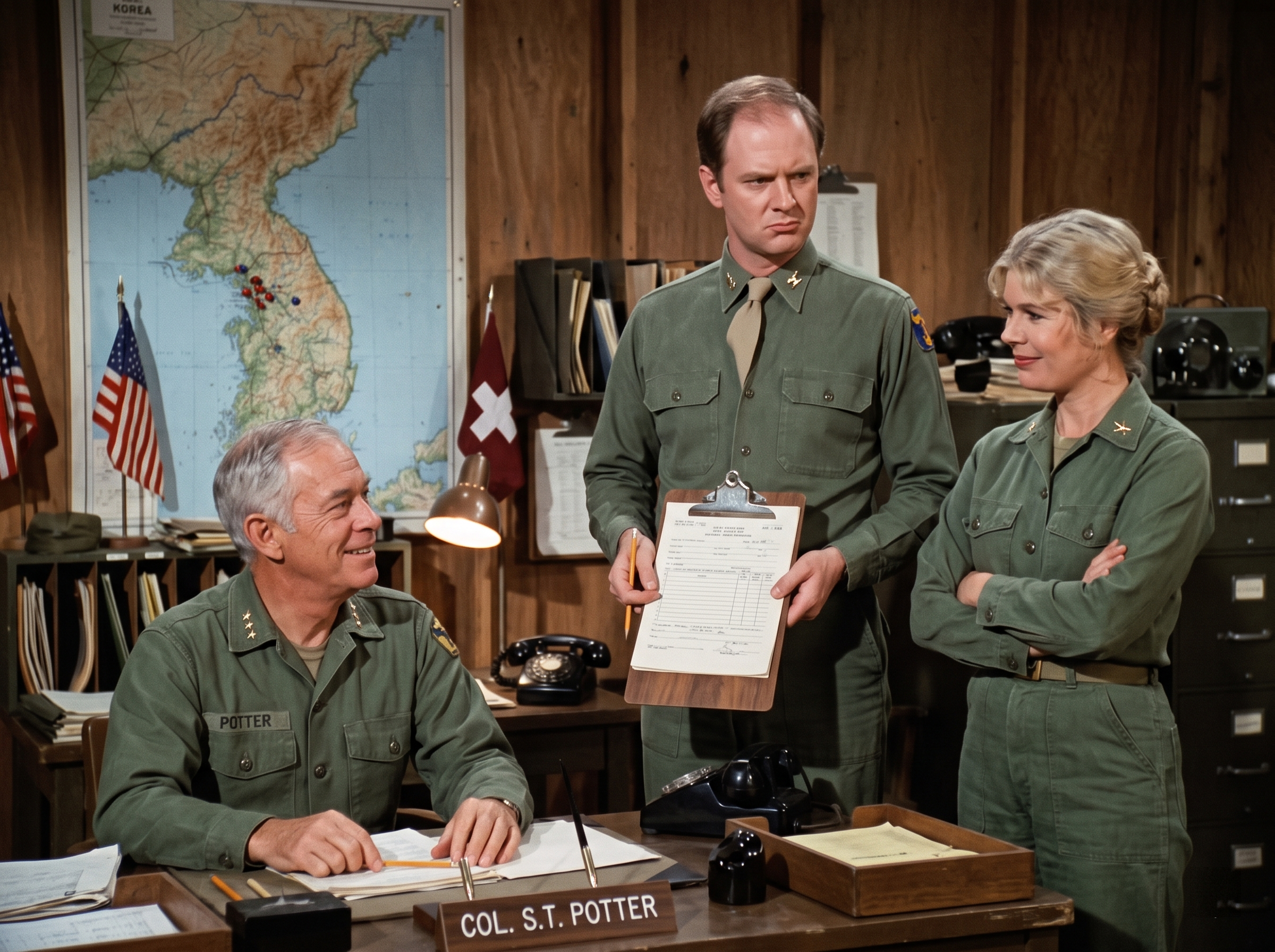
The ink-stained wars were fought over mahogany desks, far from the red-lined maps pinned to the wall. Colonel Sherman Potter’s office in the 4077th MASH was usually a refuge of calm, a place where wisdom was dispensed along with coffee, but today, a specific kind of storm had breached the door. The familiar clutter of his desk—the inkwell, the pencils, the small American flag, and the red and white Medical Corps cross—seemed to offer no protection from Major Charles Emerson Winchester III’s huffy tirade.
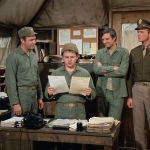
Charles, impeccably controlled even in worn standard-issue OD fatigues, was holding a standard requisition clipboard out toward the Colonel like a defensive shield. His face was twisted in refined exasperation. Behind him, Major Margaret Houlihan, her arms crossed and a professional smirk dancing on her lips, watched the scene with a practiced lack of surprise. She was a regular observer of the major’s dramatic performances.
Charles had been lecturing the Colonel for five minutes about the absurdity of a new directive requiring triplicate signatures for every supply request, regardless of item value. He was currently making a point about the erosion of trust within the officer corps, and the unnecessary burden placed upon those already laboring under ‘provincial standards.’ ‘This unit, Colonel, operates in a state of administrative anarchy!‘ he had declared, emphasizing each word with a dramatic flourishing of the clipboard. ‘Trust is the foundation of military operations! It is how empires are built, and how campaigns succeed! And yet, we are reduced to treating medical officers as untrustworthy scoundrels for daring to request a new set of requisition pens!‘
Potter, sitting relaxed behind his desk, nameplate clearly visible, was listening with a warm, fatherly smile that was dangerously disarming. He knew Charles could find a bureaucratic insult in a polite ‘good morning,‘ and he generally let the major exhaust himself before stepping in. He appreciated the Major’s competence in surgery and understood that this, this performance, was all part of his sophisticated coping mechanism.
But Charles’s current tirade was particularly dramatic, involving flourishes of the clipboard and declarations about ‘civilized efficiency.‘ His eyebrow had ascended to such heights it was threatening to secede from his forehead, and his voice was reaching a crescendo that was threatening the peace of the entire compound.
After declaring that standard operating procedures should be tools of organization, not instruments of administrative torture, Charles huffed, presenting the clipboard to Potter one final time. “Colonel, tell me. Is there any hope for this unit, for our work, when we are strangled by the very threads of our own protocol?” He waited, chest slightly expanded, expecting either a lecture in practicality or a dismissal. Instead, Colonel Potter leaned forward, the smile remaining, and said softly, “Major Winchester, I admire your devotion to detail. Truly. But I sometimes wonder, between the commas and the correct signatures… do you ever worry we might get lost in the ink?” And for the first time that afternoon, Major Winchester was absolutely, utterly, silent.
The silence stretched for a moment, thick and surprising in the cluttered office. Margaret’s smirk widened, appreciating the simple wisdom of Potter’s deflection. She knew the major hated being caught off guard, and this was a direct hit to his pompous logic. Charles sputtered, then swallowed, as if the silence was fighting him. He lowered the clipboard, looking past the Colonel to the map of Korea on the wall, the pushpins marking territory that seemed so very far away, yet was terrifyingly close.
“We could all be lost in far worse than ink, Colonel,” Charles finally said, his voice quieted, lacking its usual performative edge. “A little order in a world of chaos… is that too much to ask? Even for ‘provincial standards’?” He had managed to salvage his sarcasm, but the vulnerability was palpable. He was holding onto his rules like a drowning man to a plank.
Margaret didn’t laugh this time. She dropped her arms, turning toward the map herself before looking back at the desk. She thought about the hours she spent trying to bring order to the records, to ensure the medicine was where it needed to be. “He’s right, Colonel. About the charts, anyway. We still have seventy post-op charts from the last rush that need review. Triplicate or not.” She offered a quiet solution that cut through the administrative noise, focusing on the human cost of their delay.
Potter nodded slowly. He understood them both. He tolerated Hawkeye’s irreverence and B.J.‘s puns and Klinger’s theatrics because he knew everyone in this swamp needed an anchor. He knew that for all his fussiness, Major Winchester was one of the finest surgeons he’d ever worked with.
“Major Houlihan is right about the charts, Charles. Priorities,” Potter said, standing up. He gestured to the field phone on his desk, the radio across the room. These were the true tools of their work. “Maintain those standards, Major. The rules keep the supply lines running, keep the order when everything feels like it’s falling apart.”
Potter walked around his desk, a dry smile returning. He didn’t lecture, he just spoke with the weariness of experience, of a man who had seen too many wars. He knew that for Charles, the rules and protocols weren’t just a nuisance; they were a sanctuary, a reminder of the civilized world he’d been yanked from. They were his anchor in the swirling chaos of Korea.
“Tell you what,” Potter continued, patting Charles on the arm, a small, genuine gesture of friendship. “I’ll sign the forms. In triplicate. I’ll even check the margins. But you and Major Houlihan? Go get some real work done on those charts. Let me worry about the ink for a while.”
Charles looked at the Colonel, surprised, then a quiet nod passed between them. He picked up the clipboard again, but this time with a purpose other than complaint. Margaret smiled softly, her professional demeanor remaining, but the warmth of understanding was clear in her eyes. She saw the care beneath Potter’s dry exterior.
They were a found family, an odd collection of people thrown together by circumstance and the terrible geometry of war. Sometimes they fought over rules, over protocols, over the absurd smallness of paperwork when the big picture was so terrifying.
But in moments like this, after the posturing and the complaints had faded, they found their rhythm again. It was the human pulse of the 4077th MASH, quiet, steady, and full of care, beating against the noise of the artillery and the helicopters.
Charles held the clipboard a moment longer, then placed it down gently. Potter shared a look with Margaret, and the three of them understood, without words, the strength found in their odd camaraderie. The ink wars would continue, but for now, the real work, and the real people, came first.
Sometimes the firmest orders were written not in ink, but in shared compassion.