The Office of Endless Paperwork (and Even More Endless Friendship)
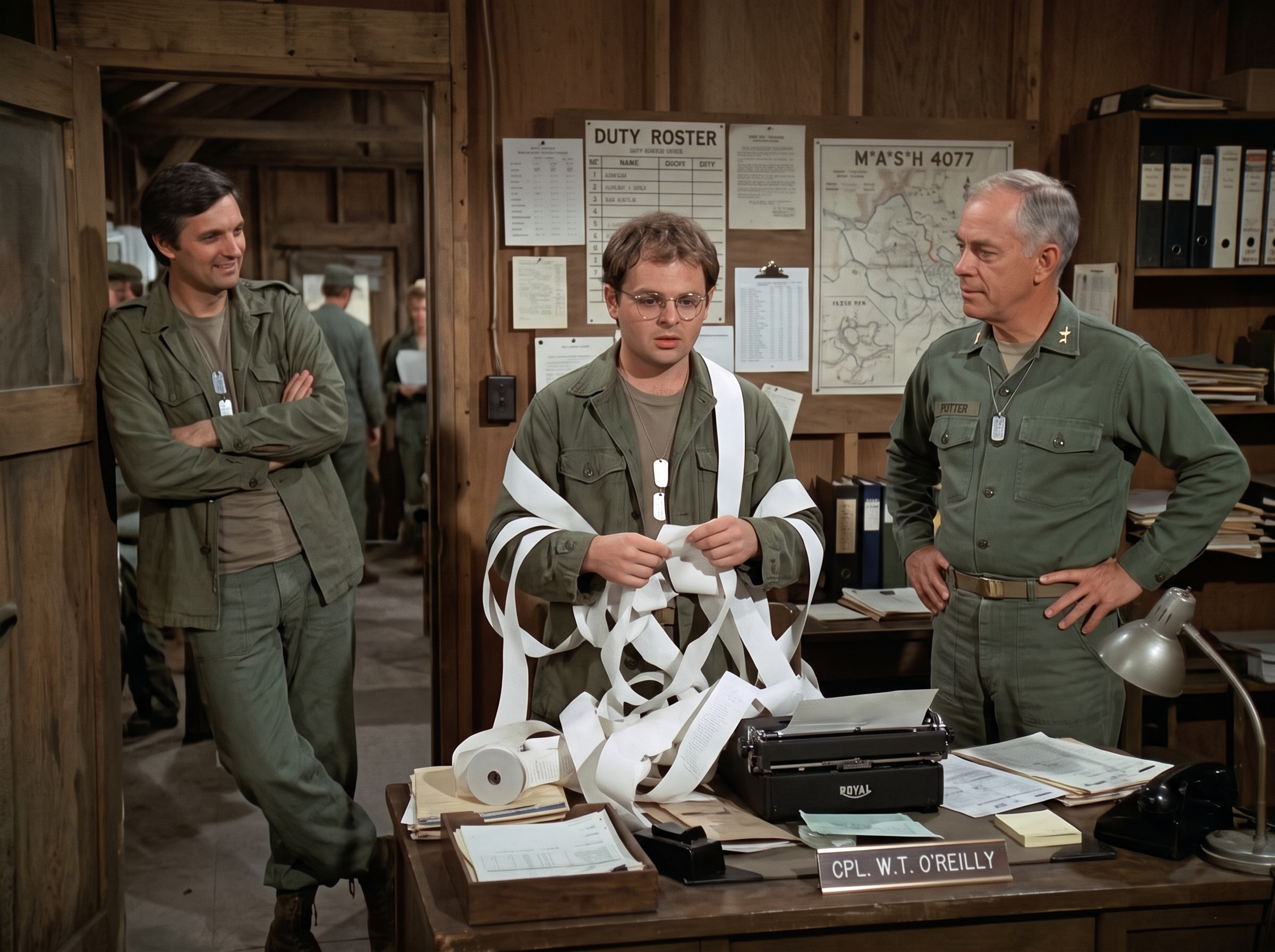
The smell of ink and stale coffee never truly left the office of Corporal Walter “Radar” O’Reilly. It was a sensory constant in the swirling, messy heart of the 4077th, a small fortress built of stacked requisition forms, mimeographed orders, and a Royal typewriter that had seen better days. The clacking was constant, but sometimes, a deeper, heavier kind of silence settled in the brief spaces between a chopper’s arrival.
This was one of those slow afternoons. The heat hung low in the Quonset hut, making the starched fabric of military uniforms stick to skin. Requisition sheets piled higher than the maps on the wall, and the constant, cascading drip of information felt less like command and more like a gentle, endless rain of bureaucracy.
Radar O’Reilly was not a man easily overwhelmed by the paperwork that defined his world. He ran the office with an intuitive, efficient logic that baffled his superiors and frustrated the surgeons. But today, the teletype machine had delivered an uninvited avalanche.
The small event that captured this perfect moment of human folly began with a cascade of paper. Radar, trying to organize the endless flow of supply lists and personnel orders that had been spooling for hours, had misjudged. A single roll of ticker tape had spilled, then collapsed, creating a chaotic white river that quickly flowed across his desk. In a frantic, adorable panic, he’d tried to re-coil it, but instead, he had somehow managed to get tangled.
He was hopelessly wrapped. Long, white coils of the paper cascaded around him, draping over his shoulders, encircling his torso, and falling to the floor. His signature eyeglasses were slightly askew on his nose, and his face was a portrait of pure, nervous confusion. He was bound, not by chains, but by the very information he spent his life managing. He looked utterly lost within the visual joke of his own competence.
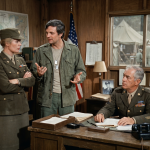
The tension in the tiny office was gentle but absolute. Colonel Sherman T. Potter had arrived minutes ago for a quick check-in. Instead of issuing orders, he stood observing the visual spectacle. He had his hands planted firmly on his hips, a pose that signaled a mix of authority and deep, patient amusement. He watched Radar struggling, a faint, dry smile tugging at the corners of his mouth. It was a look that said, ‘I’ve seen everything the war can throw at me, and yet, here we are.’
Captain Hawkeye Pierce was the last ingredient. He didn’t enter the room so much as he casually accepted its existence. Leaning against the rough-hewn wooden doorframe, he watched the chaos unfolding with a relaxed, playful grin. His arms were crossed over his tired M-1951 field jacket. He was a man who used humor to keep the abyss at bay, and Radar, looking like a mummy made of military orders, was a perfect target for his sharp but loving wit.
Radar O’Reilly, bound by coils of white paper, held up a small, frantic section. He looked from Colonel Potter to Hawkeye and back, his voice small and full of vulnerability. ‘Colonel, I was just trying to organize… and then it all just…’ The tension of his earnest desire to please collided with the spectacular nature of his failure. It was the high point of his small-scale vulnerability, and for a moment, they all just looked at him.
The silence held for a beat. Radar O’Reilly’s eyes were wide, and the small nameplate that read “CPL. W.T. O’REILLY” sat clearly visible on his cluttered desk, anchoring him to the very identity he was currently failing to uphold. The Royal typewriter sat waiting for commands that could not be issued until the operator was freed from the data itself.
It was Colonel Potter who broke the quiet. He didn’t scold. He didn’t even drop his hands from his hips. Instead, a soft, fatherly chuckle slipped out, mixing with the dry air of the Quonset hut. It was the kind of laugh that only comes from a man who understands that in a world defined by the absolute chaos of war, the small absurdities are a form of grace.
’Well, Son,’ Potter said, his voice a steady, dry rasp. ’If you needed new carpeting for the office, you could have just put in a requisition form. A lot less tangled, and certainly better for your circulation.’ His humor was not sharp; it was stabilizing, a paternal way of acknowledging the problem without making it into a crisis.
Hawkeye Pierce, leaning by the doorway, seized the moment. He pushed himself off the wooden frame, his smile warming into a genuine, playful expression. ’I don’t know, Colonel,’ Hawkeye said, his voice dripping with ironic affection as he eyed the paper avalanche. ’I think it’s art. A powerful, symbolic piece. It says: ‘Bureaucracy is Choking the Common Man.’ Radar, you’re not just a clerk, you’re an artist. A misunderstood genius bound by your own medium.’
He moved into the room, stepping over a section of the white cascading paper. ’Can I get an autograph? Maybe not right on the paper, it seems you’re all booked up. But I can tell this work is going places. Likely to the latrine, but still, places.’ His wit, as always, was a weapon that defused the pressure, turning Radar’s shame into shared laughter.
The visual of Hawkeye helping Radar untangle was its own testament to friendship. He didn’t just pull the paper off; he made a dramatic spectacle of it. ’Hold still, the muse is still with you. I don’t want to break the continuity.’ He carefully unspooled a coil from Radar’s shoulders, making a playful sound as if it were heavy chain.
Radar’s nervousness slowly began to melt away under the lighthearted attention. His shoulders relaxed. He even managed a small, sheepish grin as Hawkeye unrolled a section from his arm. ‘I was just trying to make it efficient,’ Radar offered again, but this time, without the tremor in his voice. He understood, as they all did, that the humor was a warm blanket they could wrap around each other to keep the cold out.
As Hawkeye worked, a quiet understanding settled in the room. They all knew why they were laughing. In the operating room, they were serious, efficient, and forced to witness unimaginable suffering. Here, in the cluttered office, a small disaster involving a teletype roll was a gift. It was a reminder that they were still human, capable of silly mistakes, capable of shared amusement, capable of taking care of one another in the small, seemingly insignificant ways that kept them sane.
Colonel Potter watched the two of them, a soft, weary warmth in his eyes. He saw the genuine care beneath Hawkeye’s wit, the loyalty beneath Radar’s earnestness. This was the found family that the war had thrown together, and it worked. ’Alright, enough artistry. The war won’t wait for you to find the end of that spool. Once you’ve liberated yourself, Corporal, I have a request for some clean supplies that isn’t a modern art installment.’
Potter turned to leave, his dry authority re-established, but not before giving Radar a small, reassuring nod. Hawkeye finally clapped Radar on the shoulder, now cleared of most of the white cascading paper. ’Good job, artist. Now, if you can write me a note excusing me from the rest of my life, I’d appreciate it. Make it on normal paper, though. I have a feeling the brass won’t appreciate the metaphor.’ He share a quick smile with Radar before stepping back to lean in the doorway once more. The sound of the ticker starting again filled the room, but this time, it was just the steady pulse of their shared world, a sound they could manage, together.
In a place where everything was broken, these small, human moments were the only things that held them together.