The Geometry of Hope in a Tin Tray
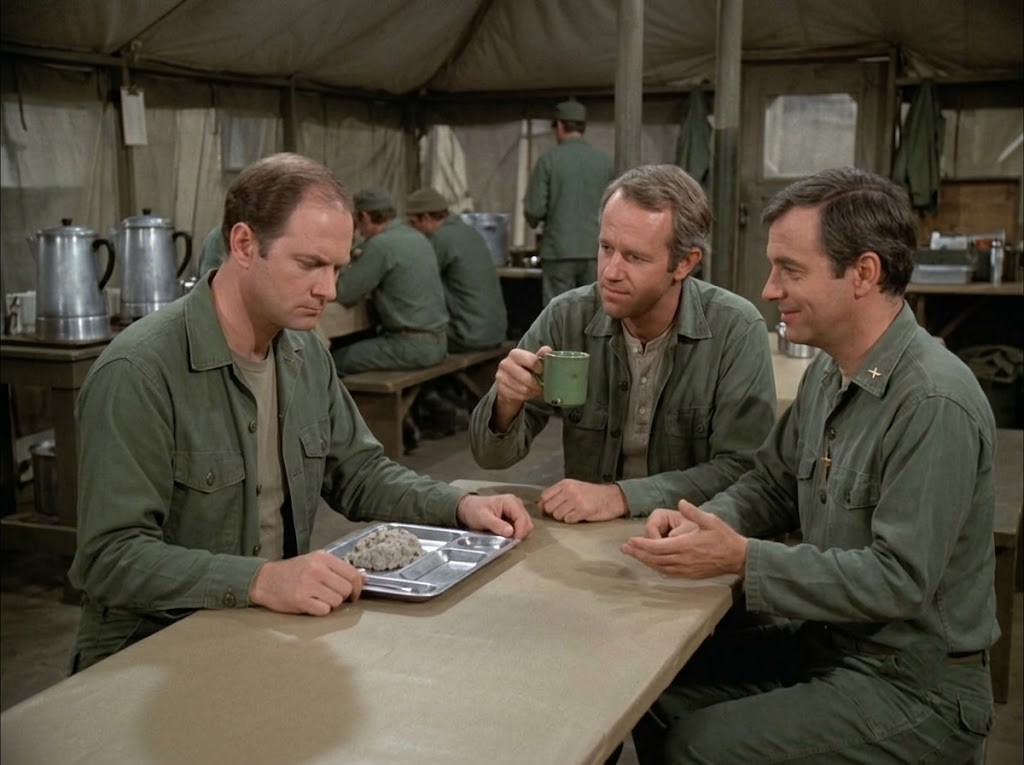
Some days at the 4077th didn’t end with a bang, but with the slow, exhausting hum of a generator and the smell of boiled cabbage. The OR had been quiet for twelve hours, which should have been a blessing, but the silence only allowed the weight of the Korean peninsula to settle heavily on everyone’s shoulders.
Inside the mess tent, the air was thick with the regular clatter of metal silverware and the low murmur of tired voices.
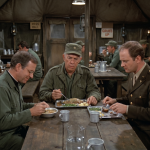
Major Charles Emerson Winchester III sat alone at the end of a long wooden table, his posture stiff despite the crushing fatigue in his bones. In front of him sat a standard-issue aluminum tray, completely empty except for a solitary, unidentifiable scoop of greyish slop.
He didn’t move. He didn’t pick up his fork. He simply stared at the mystery meal as if it were a personal insult delivered directly from the Pentagon.
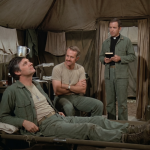
BJ Hunnicutt slid onto the bench opposite Charles, a chipped green ceramic mug cradled in his hands. A moment later, Father Mulcahy joined them, his gentle smile carrying its usual quiet comfort into the drab, canvas-walled room.
Usually, a meal like this would provoke a theatrical, ten-minute monologue from Charles about the culinary superiority of Boston’s finest dining rooms. He would invoke the names of French chefs, curse the camp cook, and demand an immediate transfer to a civilized theater of war.
But tonight, Charles was entirely silent.
“You’re tracking its movements, aren’t you?” BJ asked softly, nodding toward the tray. “Don’t blink, Charles. I think it’s trying to camouflage itself against the metal.”
Charles didn’t look up, nor did he offer his usual sharp, aristocratic retort. He merely adjusted his hands on the table, his fingers twitching slightly against the rough wood.
Father Mulcahy leaned forward, his kind eyes scanning the Major’s pale, drawn face. “Are you feeling quite well, Charles? You didn’t say a word during the afternoon briefing, and you barely touched your tea.”
“I am perfectly adequate, Father,” Charles murmured, his voice lacking its customary booming resonance. It sounded small, hollow, and terribly distant.
BJ set his green mug down, the humor fading from his eyes as he exchanged a quick, concerned glance with the priest. When Charles Emerson Winchester III lost his desire to complain, it wasn’t a sign of peace—it was a warning sign of profound exhaustion.
The silence stretched between them, heavy and suffocating, as Charles continued to stare down at the pathetic lump of food, his shoulders dropping just a fraction of an inch into total defeat.
“It’s Thursday,” Charles said suddenly, his voice barely louder than a whisper.
BJ leaned in closer, resting his arms on the table. “Thursday? Is it? The days all sort of blur together into one long Wednesday for me.”
“In Boston, on the last Thursday of June, my family gathers on the north terrace,” Charles said, his eyes still fixed on the grey scoop on his tray. “The air smells of salt water, wild roses, and imported sherry. My mother serves poached salmon with a delicate dill cream sauce.”
He finally lifted his head, looking at BJ and Father Mulcahy, and for a fleeting second, the proud, unyielding Major looked incredibly vulnerable.
“And here I sit, looking at a substance that defies the laws of both nutrition and geology,” Charles whispered, a faint, bitter trace of his usual sarcasm returning, though it lacked any real sting. “It is… remarkable how a single scoop of whatever this is can make a man feel so utterly erased.”
Father Mulcahy placed a comforting hand on the table, gesturing gently. “The distance can feel like an ocean we cannot cross, Charles. But memory is a powerful thing. It keeps those terraces alive, even in a tent in Korea.”
“Memory is a curse, Father,” Charles replied softly, though his tone was no longer cold. “It reminds us of what we are missing every single second we spend in this purgatory.”
BJ took a sip from his mug, his thoughts drifting for a brief moment to San Francisco, to Peg, and to a little girl who was growing up without him. He understood the ache in Charles’s chest perfectly; it was the same ache everyone in the camp carried, buried beneath jokes, martinis, or work.
“You know, Charles,” BJ said, a warm, grounded smile returning to his face. “Salmon is highly overrated. Too many bones. And dill cream sauce is just an excuse to hide the fact that you’re eating fish.”
Charles blinked, looking offended. “It is a classic culinary masterpiece, Hunnicutt, you absolute philistine.”
“Maybe,” BJ chuckled, nudging the green mug toward the center of the table. “But does your fancy French chef in Boston know how to turn powdered coffee, lukewarm water, and pure determination into something that vaguely resembles a drink? Because Igor outdid himself tonight. It actually tastes like coffee-flavored water instead of water-flavored mud.”
Father Mulcahy let out a soft, musical laugh. “He speaks the truth, Charles. We must celebrate the small victories where we find them. Even if those victories are served in a chipped mug.”
Charles looked from BJ’s steady, encouraging gaze to the Father’s gentle countenance, and the rigid tension in his neck finally began to dissolve. The aristocratic mask didn’t fall away entirely—it never did—but it softened into something deeply human.
He looked back down at his tray, let out a long, theatrical sigh, and picked up his fork.
“If I die of food poisoning before the night is out, Hunnicutt, I am leaving my entire collection of classical records to Hawkeye, just to spite you,” Charles muttered, prodding the grey lump with the prongs of his fork.
“That’s the spirit,” BJ said, his smile widening. “And don’t worry, if you start glowing in the dark, the Father here will give you a very nice blessing.”
“I shall keep my prayers brief and grammatically correct, just for you, Major,” Father Mulcahy teased gently, his eyes twinkling with warmth.
Charles took a tiny, hesitant bite, chewed with an expression of profound suffering, and then looked across the table at his two companions. The food was terrible, the tent was drafty, and the war was far from over, but as the three of them sat together under the dim canvas roof, the distance to Boston didn’t feel quite so infinite anymore.
In the quiet corners of the 4077th, it wasn’t the brass or the battles that kept them going, but the gentle hands of friends holding the world together over a tin tray.