The Quiet Hour Between Rounds
The mud had finally stopped clinging to everything, but the exhaustion was a different story—it seemed to have settled permanently into the canvas walls of the 4077th.
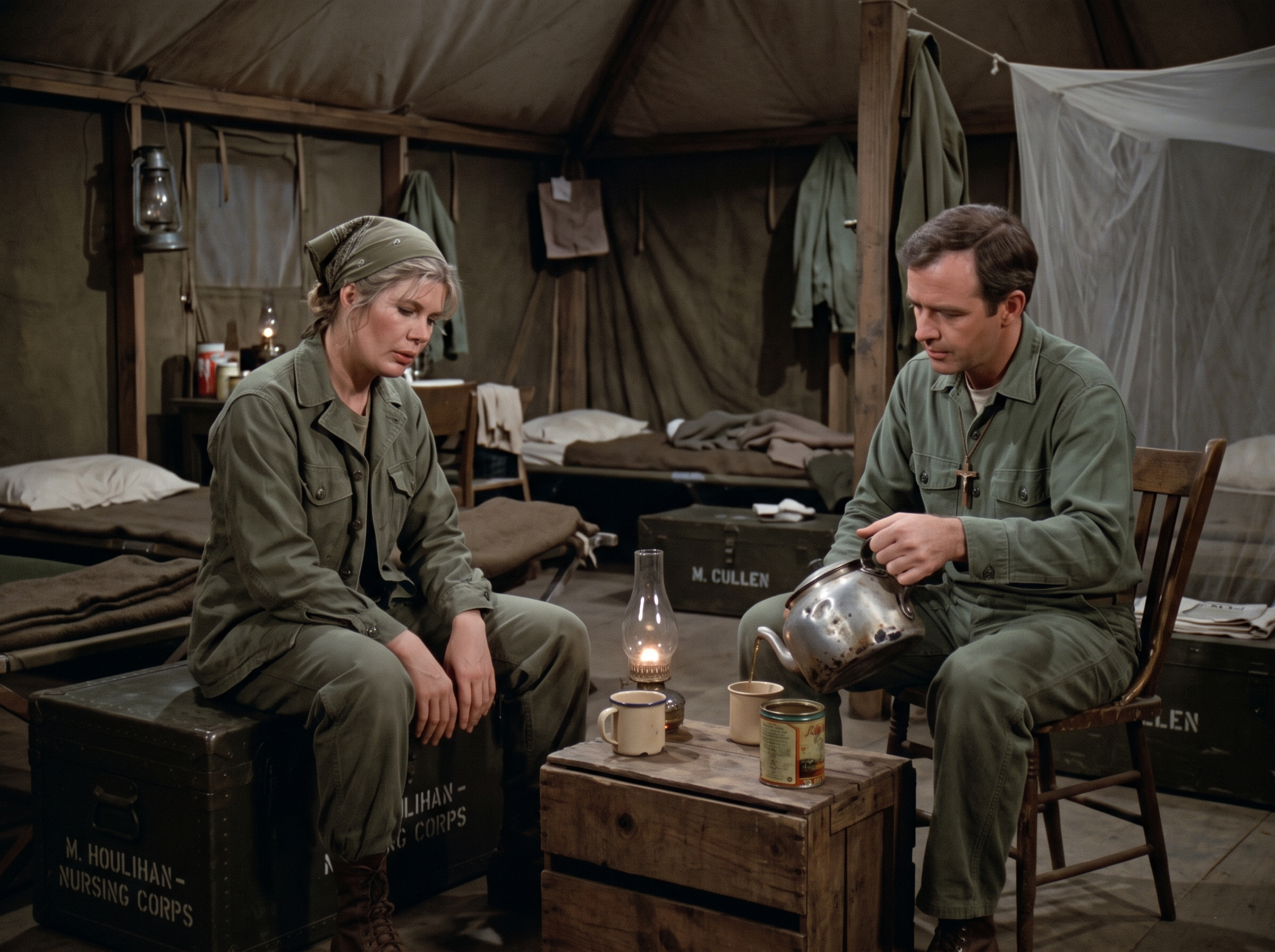
Inside the quiet of the nurses’ quarters, the only sound was the steady, rhythmic ticking of a lantern and the soft metallic *clink* of a tea kettle meeting a tin mug.
Margaret sat on her footlocker, her posture uncharacteristically slumped. Her shoulders, usually held with the rigid precision of a career officer, were heavy, as if burdened by the weight of a long, bruising shift in Pre-Op.
She hadn’t taken off her boots. She hadn’t even really looked up when the tent flap rustled.
Father Mulcahy moved with a grace that belonged in a sanctuary rather than a war zone. He didn’t ask if he could sit; he simply understood that some things in Korea didn’t require permission—like companionship.
He carefully placed the kettle on the makeshift wooden crate that served as their table.
“It’s not quite the Darjeeling the Bishop once sent,” he said, his voice barely rising above the hum of the oil lamp. “But it’s hot, and it’s wet, and at the moment, those are the only two virtues that matter.”
Margaret looked at the steaming mug, then at the small, earnest man sitting across from her. Her eyes were rimmed with red, the professional mask she wore so fiercely beginning to fray at the edges.
“I just can’t seem to stop hearing the monitors, Father,” she whispered, her voice cracking for the first time all day. “Even when it’s quiet, it’s not quiet.”
Mulcahy reached for the pot, his hand steady as he poured. The liquid swirled, dark and rich, reflecting the flickering lantern light.
“You’re carrying enough for the whole unit, Major,” he said gently. “Maybe it’s time you let someone else hold the tray for a while.”
Margaret drew a jagged breath, her hand trembling as she reached for the mug. She didn’t look at him, but her fingers hovered over his, a silent, desperate acknowledgment of the fragility of the moment.
It was then that the silence broke. The tent flap swung open with a frantic, uncoordinated clatter, and the shadow of someone clearly bearing bad news—or perhaps just another request—fell across the floor.
It was only Klinger, holding a stack of forms, his face flushed with the kind of frantic energy that usually preceded a trip to the latrine or a desperate bid for a Section 8.
But seeing the two of them—the nurse and the priest, caught in a moment of pure, weary stillness—he stopped dead. The manic glint in his eye softened into something surprisingly human. He took in the scene, the humble tin crate, the steam rising from the mugs, and the way Margaret looked like she might shatter if someone spoke too loudly.
“Forget it,” Klinger muttered, tucking the papers under his arm. “It’s not that important. I’ll go find Winchester. He likes reading complaints, anyway.”
He backed out, letting the tent flap fall shut with a soft *thwack*, restoring the sanctuary.
Margaret let out a breath she seemed to have been holding for hours, a small, involuntary laugh escaping her.
“Even Klinger knows when to retreat,” she murmured.
Mulcahy smiled, a genuine, warm expression that crinkled the corners of his eyes. “We all have our limits, Margaret. Even the most formidable officers in the 4077th are allowed to be tired.”
He leaned back, his eyes wandering to the bare walls of the tent, the modest belongings, and the simple, rugged life they had carved out in the middle of a nightmare.
“You know,” he added softly, “sometimes the most important surgery we perform isn’t on a patient. It’s the work we do on each other. Listening. Sharing a cup of tea. Just existing in the same space so the silence isn’t so loud.”
Margaret finally took a sip, the heat grounding her. She felt the tension in her neck begin to loosen, just a fraction. For the first time in weeks, the ghost of the hospital ward stopped haunting her peripheral vision.
They sat there for a long time, neither saying much. There was no need for grand speeches or theological comfort. Just the shared understanding of two people who had seen too much, but were still here, finding grace in a tin mug and a wooden box.
The war would be waiting for them in the morning. The casualties would come, the choppers would thump rhythmically against the horizon, and the cycle of survival would begin anew.
But in this small, dim corner of the world, for just a few minutes, the war felt a thousand miles away.
Margaret looked at the priest, a small, grateful smile touching her lips—a rare, unguarded moment of humanity in a place where such things were the only real currency.
“Thank you, Father,” she said, her voice steady again. “For the tea. And for not asking me to be strong for just a little while.”
Mulcahy simply nodded, his own quiet strength anchoring the room.
“Anytime, Major,” he replied. “That’s what neighbors are for.”
Outside, the wind kicked up, rattling the canvas, but inside, the light from the lantern held steady, a tiny beacon in a very long, very dark night.
In the middle of nowhere, the smallest kindnesses are the ones that keep us whole.