The Weight of a Silver Spoon
They say a man can get used to anything if he stays in the mud long enough.
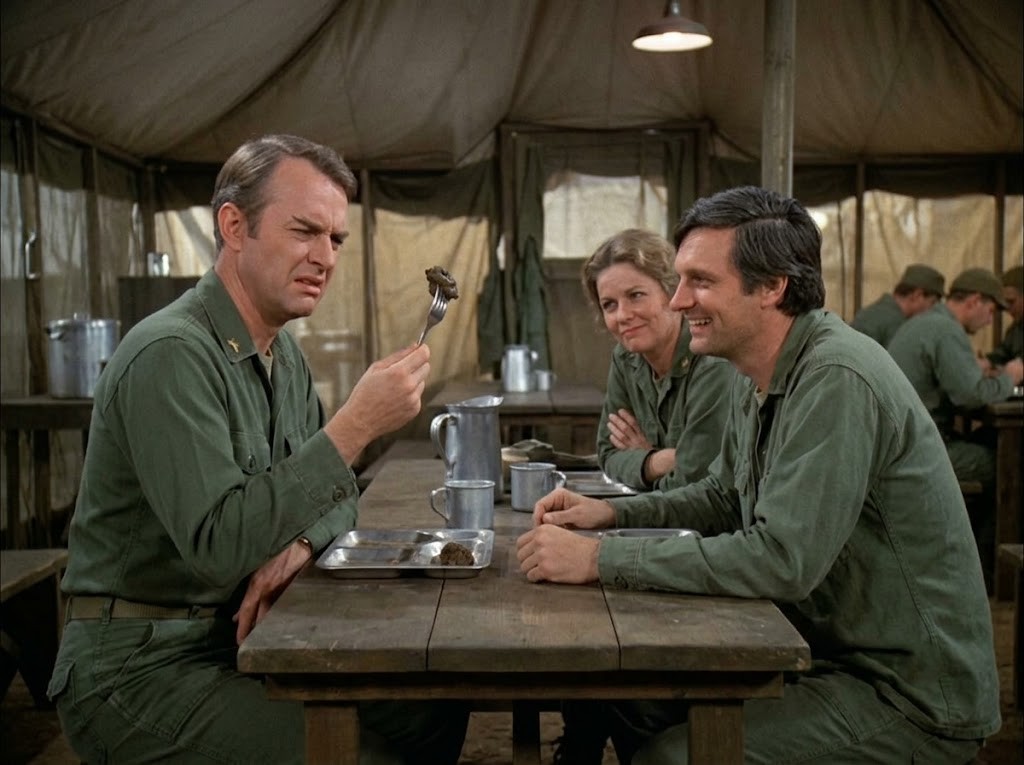
But looking at the gray, unidentifiable lump quivering on the end of his fork, Major Charles Emerson Winchester III was prepared to prove the exception to the rule.
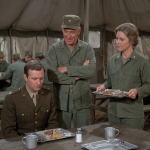
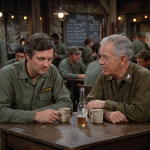
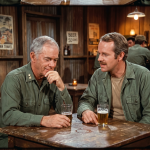
The mess tent at the 4077th was always loud, a chaotic symphony of clattering tin trays, tired complaints, and the distant, rhythmic thumping of incoming choppers. Tonight, however, the noise seemed to fade into a localized, tense silence right at their table.
Charles stared at the meat—or what Igor had claimed was meat—with a look of pure, unadulterated horror. His aristocratic nose was wrinkled so tightly it looked as though it might never un-wrinkle.
Across the rough wooden table, Captain Hawkeye Pierce watched him, a slow, brilliant grin spreading across his face. It was the kind of grin Hawkeye wore when he was exhausted to the bone but refused to let the exhaustion win.
“Come on, Charles,” Hawkeye said, his voice dripping with that familiar, raspy bravado. “Don’t look at it like it’s a medical anomaly. Just close your eyes and think of Boston. Think of it as a very, very tired filet mignon.”
Charles didn’t move a muscle, his arm suspended in mid-air like a statue of a defeated king. “Pierce, if this substance ever saw Boston, it was thrown off the back of a harbor boat during the Tea Party and left to rot on the Atlantic floor.”
Sitting just down the bench, Major Margaret Houlihan let out a soft, genuine laugh. She wasn’t wearing her usual stiff, by-the-book commander mask tonight; her arms were folded on the table, her eyes crinkling with a quiet warmth that only showed up when the camp had survived a particularly grueling forty-eight-hour shift.
The three of them were trapped in that strange, post-op twilight where the adrenaline has completely run out, leaving nothing but raw nerves and a desperate need for a distraction. They had spent two straight days in the swamp of the O.R., knee-deep in the human cost of a war that didn’t care about their sleep schedules.
Charles cleared his throat, his voice dropping into that deep, resonant baritone that usually demanded absolute authority. “There are standards, Pierce. Even in this godforsaken outpost of civilization, there must be a line below which a civilized human being refuses to sink.”
“That line was crossed three miles outside of Seoul, Charles,” Hawkeye replied, leaning forward, his eyes gleaming with a mixture of mischief and deep, hidden fatigue. “And right now, that lump is the only thing standing between your blue blood and total nutritional collapse.”
Charles looked from the fork to Hawkeye, then to Margaret, who was still smiling, watching the two men with an uncharacteristic softness. The tension in the tent seemed to shift, heavy with the weight of everything they had all seen that morning in the operating room.
For a moment, Charles looked genuinely small, the grand illusion of his Boston heritage cracking just enough to reveal the deeply lonely, exhausted man underneath. He raised the fork a fraction of an inch higher, his hand trembling slightly from muscle fatigue.
“If I consume this,” Charles whispered, his sarcasm fading into something frighteningly fragile, “I fear I will lose the last remaining piece of who I was before I arrived here.”
—
Hawkeye’s smile didn’t disappear, but it changed. The sharp, mocking edge melted away, leaving only the quiet solidarity of a fellow doctor who had stood under the same blinding O.R. lights, watching the same young lives slip through their fingers.
“You won’t lose a thing, Charles,” Hawkeye said softly, his voice losing its theatrical volume. “Because we won’t let you.”
Margaret leaned in a little closer, her eyes locked onto Charles. “He’s right, Charles. Eat the food. It’s terrible, it tastes like boiled cardboard, and tomorrow we’ll all complain about it together. But you need to keep your strength up.”
Charles looked down at his tray. The metal was scratched and dull, a far cry from the fine china and polished silver of his family’s dining room on Beacon Hill. He remembered the meals his mother used to arrange—the perfectly roasted duck, the delicate linen napkins, the quiet, predictable dignity of a life untouched by artillery fire.
Here, dignity was a luxury they had to manufacture out of nothing.
“I miss the music,” Charles murmured, almost to himself, his gaze still fixed on the mystery meat. “At home, during dinner, we would have Mozart playing softly in the background. It created a… a barrier against the chaos of the outside world.”
Hawkeye took a slow breath, leaning back against the wooden post of the mess tent. He closed his eyes for a brief second, then opened them, a familiar spark returning to his expression.
“Mozart, huh?” Hawkeye said, tapping his fingers against his tin cup. “Well, we don’t have a record player, and Radar’s currently using the PA system to announce a lost pair of socks, but we can improvise.”
Before Charles could protest, Hawkeye began to hum. It wasn’t perfect, and his pitch was slightly off from sheer exhaustion, but it was unmistakably the opening bars of a classical symphony.
Margaret caught on immediately. She didn’t hum, but she began to gently tap her spoon against her tray, keeping a soft, steady rhythm that filled the small space between them.
Charles stared at them, his mouth slightly open in utter disbelief. “Pierce… Major… this is an abomination to the ear.”
“It’s the 4077th Philharmonic, Major,” Hawkeye shot back, his grin returning full force, though his eyes remained incredibly gentle. “We only play for the highest-paying customers. Now, eat your dinner before the maestro loses his tempo.”
A slow, reluctant change passed over Charles’s face. The harsh lines of disgust around his eyes began to soften. He looked at Hawkeye, whose face was lined with the soot and sweat of the O.R., and he looked at Margaret, whose hair was tucked loosely behind her ears, devoid of any military perfection.
These were the people who saw him at his worst. These were the people who knew exactly how much he missed home, because they missed it just as much.
With a dramatic, heavy sigh that belonged on a Broadway stage, Charles closed his eyes, opened his mouth, and finally took the bite.
Hawkeye and Margaret stopped their makeshift symphony, watching him with bated breath as he chewed, his face contorting into an expression of profound misery.
“Well?” Hawkeye asked, leaning over the table. “Is it an insult to the Winchester lineage?”
Charles swallowed with a visible effort, wiping his mouth with a rough paper napkin as if he were trying to erase the very memory of the taste. He opened his eyes, looking directly at Hawkeye.
“It is, without a doubt, the most offensive thing I have ever introduced to my palate,” Charles declared, his voice returning to its full, pompous grandeur. “However… the accompaniment was surprisingly adequate.”
Hawkeye let out a loud, barking laugh, slapping his hand against the table, and Margaret’s laughter followed, bright and clear, lifting the heavy air of the mess tent like a sudden breeze.
Charles allowed himself a very small, very brief smile, before his face returned to its aristocratic mask. He picked up his fork again, looking at the rest of his tray with a resigned, quiet acceptance.
They were thousands of miles from home, surrounded by mud, misery, and the constant reminder of human frailty. But sitting at that scarred wooden table, under the dim light of a single hanging bulb, they had each other. And for tonight, that was more than enough to keep the darkness at bay.
Sometimes, the only way to survive the mud is to find a little bit of magic in the mess.