The Weight of an Empty Wooden Box
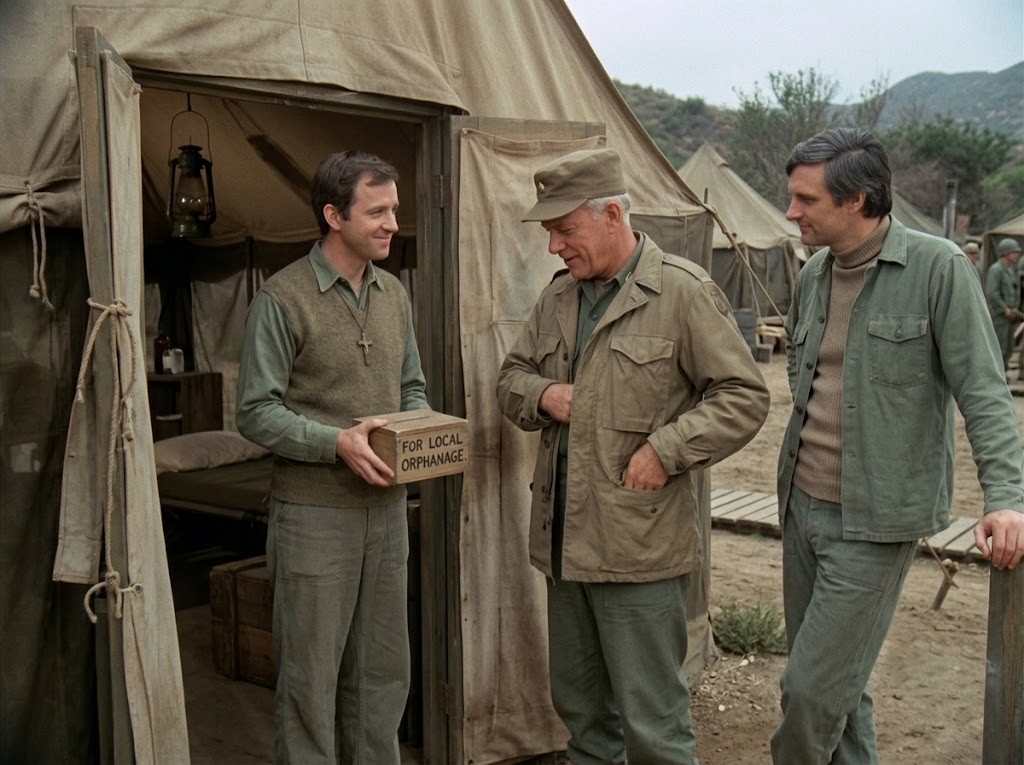
Sometimes, the heaviest things we carry in Korea aren’t the duffel bags, the stretchers, or even the surgical instruments. Sometimes, it’s a simple, hollow wooden box with a slit carved into the top and four words hand-painted on the front: “FOR LOCAL ORPHANAGE.”
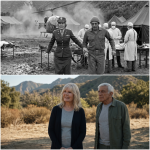
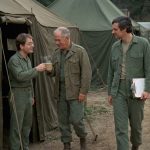
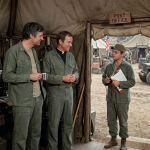
Father Mulcahy stood just outside the flap of the hospital tent, cradling the small box in both hands. A gentle, hopeful smile graced his face, the kind of smile that somehow survived the relentless mud, the freezing winters, and the endless incoming choppers of the 4077th.
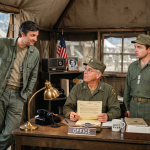
Colonel Potter was right there beside him, reaching into his heavy olive-drab field jacket. His seasoned face bore the expression of a tired but deeply devoted father figure, his fingers searching his deep pockets for whatever spare scrip or military payment certificates he could unearth.
Leaning against a wooden post nearby was Hawkeye, his hands resting easily on his hips, watching the exchange with an affectionate, slightly weary gaze. He wore his familiar brown turtleneck under his open fatigue shirt, a classic shield against the chill of the Uijeongbu valley, but his eyes held that unmistakable mixture of dry wit and profound tenderness.
“I must admit, Colonel,” Father Mulcahy said softly, his voice a calm harbor in the midst of the bustling camp. “The children at the sanctuary are facing an especially difficult winter. Clothing is scarce, and food is even scarcer.”
Potter patted his pockets, pulling out a small crinkled handful of bills. “Say no more, Father. It’s not a king’s ransom, but it ought to buy a few blankets or at least a decent crate of apples. Lord knows those kids deserve a break from this circus.”
Hawkeye shifted his weight, a faint, lopsided smirk playing on his lips. “You know, Father, if you let me take that box into the Swamp during our next poker game, I could probably guarantee you enough cash to build those kids a brand-new wing. Of course, Winchester might lose his gold watch in the process, but it’s all for a higher power, right?”
Mulcahy let out a soft, appreciative chuckle, shaking his head. “While I appreciate your creative fundraising methods, Captain, I prefer to keep our donations entirely above board. No poker debts on the angels’ ledger, please.”
“Suit yourself,” Hawkeye smiled, stepping closer to look at the box. “But remember, a straight flush beats a collection plate any day of the week.”
Just then, Radar came scurrying across the compound, his boots kicking up dust, holding an official-looking clipboard. His eyes were wide behind his glasses, and he looked thoroughly out of breath, his usual nervous energy preceding him by ten yards.
“Colonel! Colonel Potter, sir!” Radar gasped, stopping just short of the trio and nearly dropping his pencil.
Potter didn’t even look up from smoothing out his donation bills. “Take a breath, Radar. Did the generator give out again, or did Klinger find a new way to coordinate a chiffon gown with combat boots?”
“No, sir, it’s not Klinger,” Radar said, his voice dropping into a tense, worried whisper as he glanced back toward the main road. “It’s the local orphanage, Father. I just got word on the radio from the supply depot down the road. A transport truck carrying their winter rations and clothing was forced to reroute due to artillery fire near the pass. They had to dump the cargo to get out safely. The kids have nothing left for the storm coming tonight.”
The casual warmth of the morning vanished in an instant, leaving a cold, heavy silence hanging in the air outside the tent.
—
Father Mulcahy’s smile faded, his fingers tightening around the edges of the wooden box as if trying to hold onto the hope it represented. He looked down at the empty slot on top, the physical emptiness of the box suddenly mirroring the desperate situation of the children just a few miles away.
Colonel Potter’s jaw set into a firm, rigid line, the easy-going grandfather instantly replaced by the commanding officer who had seen far too much hardship in his lifetime. He jammed his hands back into his jacket pockets, his mind clearly racing for a solution.
“Confound it,” Potter muttered, his voice low and gravelly. “That storm is supposed to drop six inches of snow by midnight. Those kids won’t last the week without those supplies.”
Hawkeye’s sarcastic demeanor evaporated completely, replaced by the sharp, intense focus he usually reserved for the operating table. He looked at the box, then at the sky, and finally at Potter. “Colonel, we have to have something in the supply tents. Extra blankets, canned goods, anything.”
“The supply sergeant at the depot says everything is locked down tight for winter reserves, Hawkeye,” Radar said quietly, looking down at his clipboard with a heavy heart. “We’re already running on a tight margin ourselves.”
“Then we make our own margin,” a sharp, aristocratic voice rang out. Major Charles Emerson Winchester III stepped out from behind a nearby tent, his arms crossed, his nose slightly in the air but his expression uncharacteristically somber. “While I find the administrative incompetence of the United States Army to be thoroughly exhausting, I will not sit by while children freeze. I happen to have a substantial cache of imported wool socks and sweaters sent by my mother from Boston. I suppose… I could part with a few.”
Before anyone could thank him, B.J. Hunnicutt walked up, a gentle, understanding smile on his face, holding a large cardboard box filled with extra canned fruit and condensed milk he’d been saving from his own care packages. “Count me in, Charles. Peg sent me more shortbread and canned peaches than I can eat anyway. The kids need the calories more than I do.”
From around the corner of the tent, Margaret Houlihan appeared, her hair neatly pinned, her posture rigid but her eyes shining with quiet determination. “The nursing staff has extra sheets and surplus thermal underwear we haven’t touched yet, Colonel. I’ll personally audit the supply room. If the sergeant gives me any trouble, he’ll be answering to me.”
“That’s the spirit, Major,” Potter said, a spark of pride returning to his eyes. He turned to Father Mulcahy, who was watching his makeshift family rally together with a look of profound gratitude. “Father, take Klinger and the jeep. Gather up everything these folks can pull together. If anyone asks, tell ’em it’s a mandatory medical redistribution.”
Within an hour, the compound of the 4077th was a beehive of quiet, determined activity. No one complained about giving up their personal comforts. Even Klinger, dressed in a remarkably sensible olive-drab coat for once, was happily lifting heavy crates into the back of the jeep, his theatrical complaints entirely absent.
As the jeep finally sputtered to life, loaded to the brim with blankets, clothing, and food, Father Mulcahy climbed into the passenger seat, still holding his small wooden box, which was now overflowing with crumpled military scrip and handwritten notes of encouragement from the staff.
Hawkeye walked over to the side of the jeep, leaning against the frame with a soft smirk. “Hey, Father. Don’t forget to tell them the peaches are from B.J., the wool is from Boston, and the sheer willpower is from the rest of us.”
Mulcahy looked at Hawkeye, his eyes warm and shining with a deep, unspoken affection for the cynical surgeon who cared so much. “I’ll tell them they were visited by angels, Hawkeye. Even the ones in mud-splattered turtlenecks.”
“Keep talking like that, Father, and you’ll ruin my reputation,” Hawkeye chuckled, patting the side of the jeep as Klinger shifted into gear and drove out of the compound, leaving a trail of dust in the chilly afternoon air.
Colonel Potter stood by Hawkeye’s side, watching the jeep disappear down the dirt road toward the hills. He took a deep breath of the crisp air and shook his head with a wistful smile. “You know, Pierce, sometimes this place drives me absolutely crazy.”
“Me too, Colonel,” Hawkeye said quietly, his voice filled with a gentle, bittersweet nostalgia as he watched the dust settle. “But every now and then, the human race puts on a pretty good show.”
—
In a place surrounded by the darkness of war, the 4077th always found a way to keep the light burning for those who needed it most.