A Simple Offering in the Heart of the 4077th
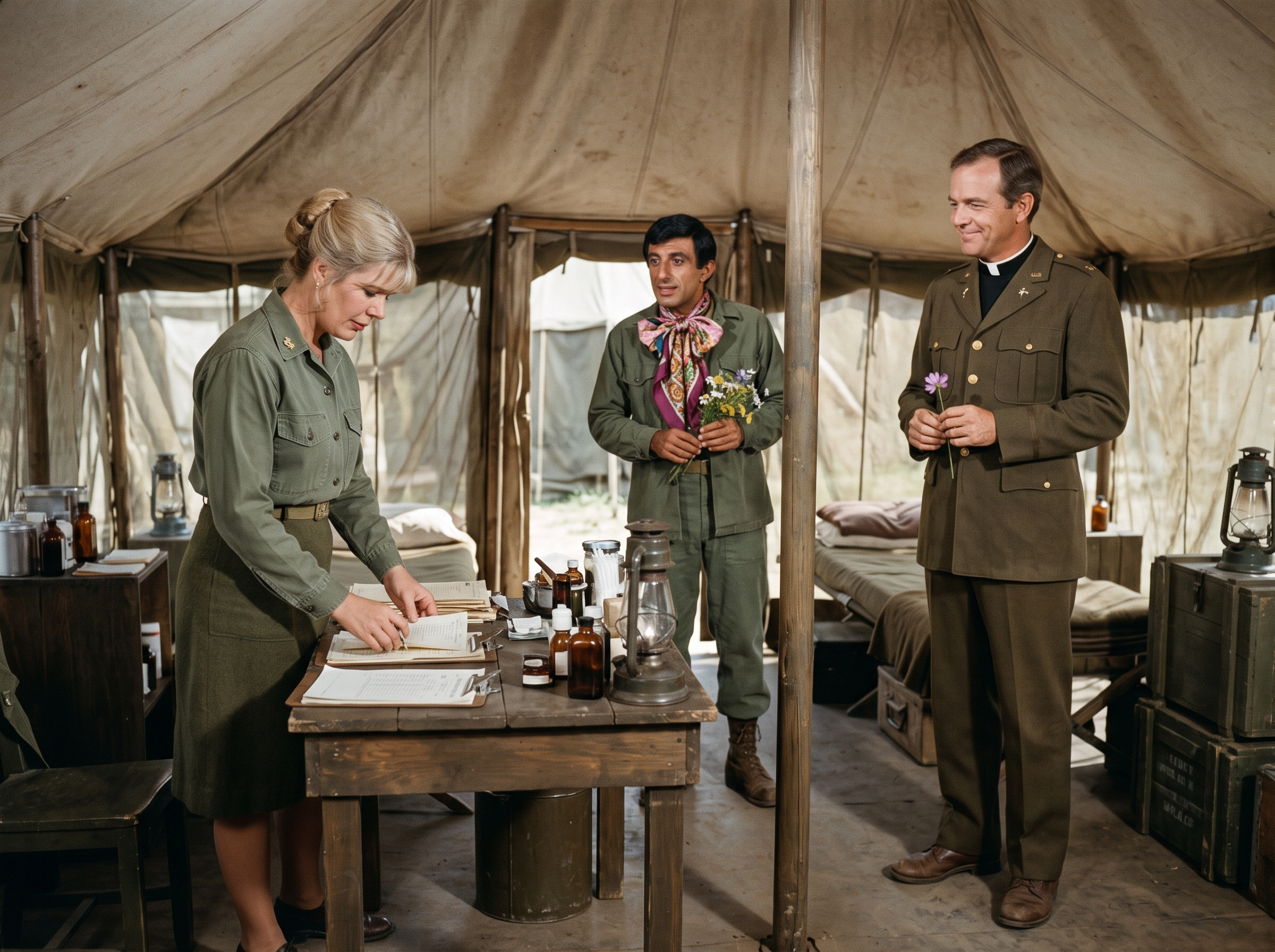
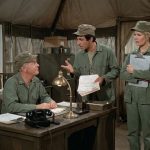
The dust of Korea had a way of settling into everything—your boots, your lungs, and most annoyingly, the charts Margaret Houlihan was trying to organize in the pre-op tent. It was one of those rare, quiet afternoons where the distant rumble of the front line felt like a fading memory rather than a looming threat.
The tent flaps were drawn back, inviting in a sliver of sunlight that caught the motes of dust dancing in the stale air. Margaret stood at the makeshift desk, her brow furrowed with the kind of focus that suggested the war would be won or lost based on the neatness of her surgical supply logs.
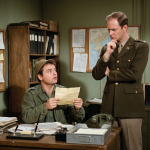
She was so absorbed in the paperwork that she didn’t hear the soft rustle of movement until a shadow fell across the wooden desk. She looked up, expecting a nurse with an update or perhaps Potter looking for a misplaced file.
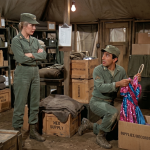
Instead, she found Corporal Klinger standing there, looking uncharacteristically sheepish. He wasn’t wearing one of his usual extravagant outfits; just his standard fatigue shirt, though he had added a rather loud, floral silk scarf knotted jauntily at his neck.
In his hands, he held a haphazard, messy bouquet of wild, spindly Korean mountain flowers—weeds, really—snapped hastily from the hillside.
“Ma’am,” Klinger started, his voice losing its usual theatrical edge. “I, uh… I found these by the creek. I thought the place looked a little too sterile. A little too grey.”
Before Margaret could even muster a retort about the impropriety of bringing botany into a sterile environment, Father Mulcahy stepped into the tent. He was holding a single, solitary purple wildflower, looking at it with the gentle reverence one might afford a stained-glass window.
“He’s right, Margaret,” Mulcahy said softly, his voice a warm hum. “The world has been awfully hard on the eyes lately. I thought perhaps a bit of color might remind us that nature still has a sense of humor.”
Margaret blinked, the stern line of her mouth softening just a fraction. She looked from Klinger’s chaotic weeds to the Father’s single blossom, and for a moment, the weight of the last twenty-four hours seemed to shift.
Then, the sudden, sharp roar of a helicopter approaching the camp shattered the silence. The transition was instant; the air in the tent grew heavy with impending work, and the casual warmth of the moment evaporated, leaving them frozen in a sudden, desperate realization of what was coming next.
The rhythmic thrum of the chopper blades grew louder, vibrating through the wooden floorboards of the tent. The peace had ended. It always did.
Margaret instinctively moved toward the medical supplies, her hands steadying, but her eyes flickered back to the flowers. She saw Klinger look at his bouquet—a useless thing in the face of an incoming chopper—and then at Father Mulcahy, who was already tucking his single flower into the breast pocket of his uniform, as if to keep it safe from the chaos to come.
“Duty calls,” Klinger murmured, the humor draining from his face, replaced by that quiet, seasoned resilience that defined the men of the 4077th. He turned to leave, his boots heavy on the dirt floor.
“Wait,” Margaret said, her voice sharp but not unkind.
She reached out and took a small, amber glass bottle from the desk—one that had been empty for days—and filled it with a splash of water from her canteen. With surprising gentleness, she took Klinger’s handful of weeds and arranged them, along with the Father’s single purple bloom, inside the glass.
She placed the makeshift vase on the corner of the surgical table, right where the light would hit it.
“It’s not regulation,” she said, finally letting a small, tired smile touch her lips. “But it will stay put. And it will be here when we’re done.”
The Father smiled, a look of profound gratitude crossing his face. “It’s a small mercy, Margaret. Sometimes, that’s all we can offer.”
They didn’t have time for another word. The sirens began to wail, a mournful, demanding sound that beckoned them out into the bright, harsh glare of the compound. The tent was no longer a place for quiet reflection; it was a theater of war, and they were the actors, scrubbed and ready to play their parts.
Hours later, long after the sun had dipped below the jagged Korean hills and the adrenaline had faded into a bone-deep, aching fatigue, the three of them found themselves back in the tent. The night air was cool, smelling of damp earth and exhaustion.
The surgery had been long, the wounds difficult, the outcome mercifully better than they had feared.
They were caked in the grime of the OR, their uniforms rumpled and stained. As they stood there in the dim light of a single lantern, the weight of the day pressing down on their shoulders, Margaret’s eyes drifted to the corner of the table.
There, in the amber bottle, the flowers still stood. They looked a little weary, perhaps a little bowed by the heat, but they were still vibrant. They were still there.
Klinger, still wearing that ridiculous scarf, let out a long, shuddering breath. “Well,” he whispered, looking at the little splash of color. “Still standing. Must be tough customers.”
Mulcahy leaned against the post, his face etched with a quiet, holy exhaustion. “Like everything else in this camp, Corporal. We bend, but we don’t break.”
Margaret didn’t say anything. She simply reached out and touched the rim of the glass, a private acknowledgment of a moment shared in the middle of a nightmare. They were just people—tired, scared, and far from home—but for a heartbeat, they had allowed themselves the luxury of being human.
They would sleep for a few hours, wake up to the same siren, and do it all again. But as they turned to head to their respective cots, the room felt just a little bit lighter. The war was still outside the canvas walls, but inside, they had carved out a tiny sanctuary.
It wasn’t much. It was just a few weeds in a bottle. But in the 4077th, a little bit of color was the greatest victory of all.
We survive because we choose to see the flowers, even in the middle of the mud.