The Medicine in the Madness
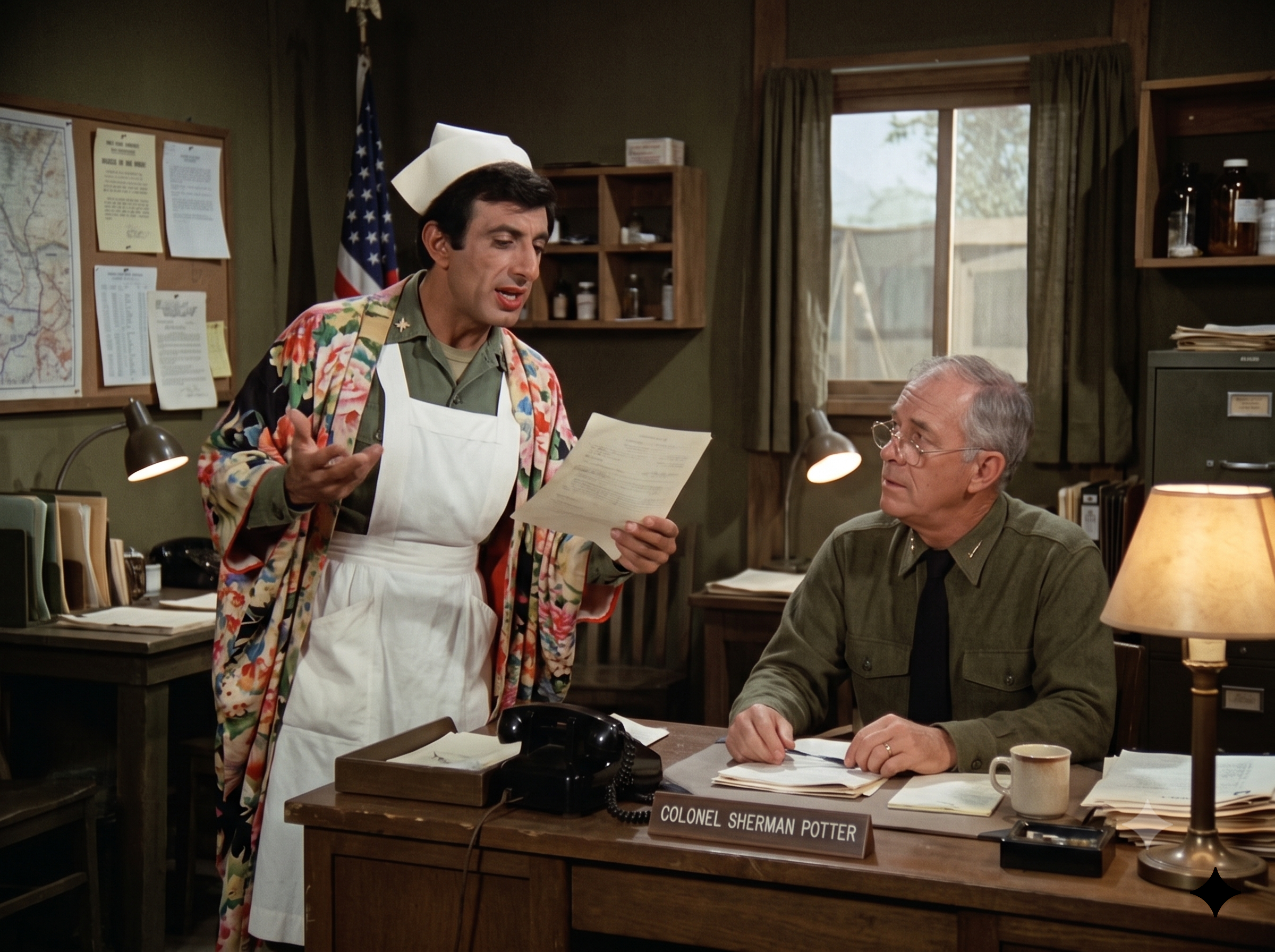
The 4077th only ever offered two kinds of quiet. There was the heavy, exhausted silence that followed a marathon session in the OR, and there was the nervous, ticking-clock silence that meant Corporal Klinger was plotting his next move.
On a stifling Tuesday afternoon, Colonel Sherman T. Potter was trying desperately to enjoy the latter.
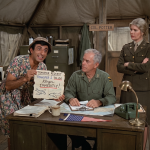
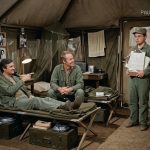
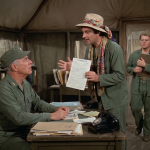
The morning’s stack of requisition forms had finally been whittled down to a manageable pile. Potter sat behind his wooden desk, bathed in the soft, warm glow of his practical office lamp. The olive drab of his uniform and the warm brown palettes of the room offered a familiar, grounded comfort. He leaned forward, pen in hand, savoring a rare moment of administrative peace.
Then, the door swung open.
Corporal Maxwell Q. Klinger made his entrance. He didn’t just walk into the room; he arrived.
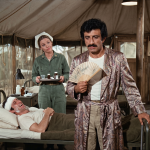
He was wearing a standard-issue Army green shirt, but that was where the military protocol abruptly ended. Draped magnificently over his shoulders was a brilliant, blooming floral kimono. Over that, a pristine, starched white nurse’s apron was tied tightly at his waist. Pinned carefully to his thick, dark hair was a white nurse’s cap, sitting at a perfectly rakish angle.
Klinger stood before the desk, his posture a theatrical masterpiece of wounded dignity and comic pride. In his left hand, he held a piece of official Army stationery, while his right hand gestured broadly, as if he were delivering a tragic monologue on a Broadway stage.
“I implore you, Colonel, to look upon this tragedy!” Klinger declared, his voice trembling with manufactured grief. “It is an outrage! A direct insult to my delicate sensibilities and my noble profession!”
Colonel Potter did not flinch. He did not drop his pen. He merely sat back, leaning slightly forward with a dryly amused, fatherly exasperation. He looked at the floral silk, the starched apron, and the hairy legs protruding from beneath the hem, anchoring the room with calm control.
“What is it this time, Klinger?” Potter asked, his voice a gravelly drawl. “Did the supply depot in Seoul run out of matching pumps? Or did General MacArthur himself deny your request for a transfer to the Ziegfeld Follies?”
“Worse, sir!” Klinger gasped, placing a hand over his heart. “They are depriving a dedicated woman of healing of her necessary tools! It’s a targeted attack on my department!”
“Your department is a typewriter and a filing cabinet, son.”
“I am a volunteer candy striper in spirit, Colonel!” Klinger stepped closer, thrusting the paper forward with a dramatic flourish. “And I refuse to stand idly by while I Corps treats this hospital like a backwater clinic! Read it and weep, sir. Read it and weep.”
Potter sighed, a long, weary sound that carried the weight of thirty years in the Army. He reached out and took the paper from Klinger’s trembling fingers.
He expected another forged letter from a fictitious uncle in Toledo. He expected a requisition form for a sequined evening gown.
Instead, he saw a standard supply manifest for three crates of surgical penicillin and a gross of sterile bandages. Across the front, stamped in heavy red ink, was the word: DENIED.
Potter frowned. He adjusted his wire-rimmed glasses and looked closer. Beneath the stamp, scribbled in hurried pencil, was a note from Sparky down at I Corps supply.
Potter read the handwritten words. The dry amusement vanished from his face, replaced by a sudden, heavy stillness. The quiet in the small wooden office deepened.
Potter slowly took off his glasses. “Max,” he said, his voice dropping its dry humor, turning uncharacteristically sharp and quiet. “Where exactly did you get this?”
Klinger’s hand froze mid-gesture. His theatrical posture evaporated in an instant.
The comic tension vanished from the room, replaced by something entirely real and deeply uncomfortable. Klinger lowered his arms. The floral kimono suddenly looked less like a costume and more like a heavy, awkward blanket.
“Sparky sent it over the horn, sir,” Klinger admitted, his voice dropping an octave, losing all its theatrical flourish. He stood squarely on his feet, looking every bit the weary soldier beneath the lace and silk. “He owed me a favor for that case of salami I smuggled him in April.”
Potter looked back down at the paper, his thumb tracing the penciled note. “This isn’t a standard bureaucratic denial. Sparky says the supply convoy was hit on the main supply route. The penicillin wasn’t redirected. It’s gone. Burned up on the road.”
The harsh reality of the war crept beneath the doorframe, filling the warm, wooden office with a sudden chill.
Klinger looked down at his white nurse’s apron, his hands fidgeting with the crisp pockets. “I know, sir. Sparky told me the whole story.”
Potter looked up, his eyes narrowing, studying his company clerk. “Then why the floor show, Corporal? Why burst in here dressed like the Queen of the May, demanding justice from the supply gods, if you already knew the medicine was at the bottom of a ditch?”
Klinger shifted his weight. For a moment, the wounded dignity returned to his face, but this time, it wasn’t an act. It was quiet, resilient, and intensely loyal.
“Well, Colonel,” Klinger started softly, looking at the map on the wall instead of his commanding officer. “I figured… a commanding officer has a lot to worry about. He’s got wounded coming in, he’s got doctors running on fumes, and he takes every missing bandage to heart.”
Potter stayed silent, letting the younger man speak.
“If I just walk in here,” Klinger continued, his voice barely above a whisper, “and hand you a piece of paper that says we lost our penicillin to a mortar shell… you’re gonna spend the rest of the night staring at the wall. You’re going to carry it. You’re going to blame yourself for a war you didn’t start.”
Klinger finally met Potter’s eyes. There was a profound, aching tenderness in the corporal’s gaze.
“But,” Klinger said, a faint, sad smile touching the corners of his mouth, “if I come in here dressed like a rejected extra from a Broadway musical, screaming about my delicate sensibilities…”
“…Then I just get mad at my crazy company clerk,” Potter finished, his voice thick with sudden emotion.
“Exactly,” Klinger nodded slowly. “I figured it’s a lot easier to be annoyed at a guy in a floral bathrobe than it is to be angry at a war.”
Potter stared at him. The sheer, ridiculous, beautiful lengths these people would go to in order to protect each other never failed to humble him. Beneath the dresses, the schemes, and the relentless pursuit of a Section 8, Maxwell Klinger possessed a heart as big as Toledo. He had wrapped a piece of genuine tragedy in a clown suit, just to soften the blow for the old man.
Potter cleared his throat. He looked down at his desk, carefully placed his glasses back on his face, and picked up his pen.
He wasn’t going to mention Klinger’s admission. He was going to play the game, because out here, the game was the only thing keeping them human.
“Corporal,” Potter barked, his voice returning to its familiar, dry, gravelly authority.
Klinger snapped to attention, the floral silk swishing around his knees. “Yes, sir?”
“This denial is entirely unacceptable,” Potter said, tapping the paper with his pen. “As a highly decorated, perfectly accessorized member of our ‘nursing staff,’ you cannot be expected to work under these deprived conditions.”
Klinger’s eyes lit up. The script was back on. The heavy burden of the real world was pushed back, just for a little while. “My thoughts exactly, Colonel! It’s a travesty! A medical miscarriage of justice!”
Potter reached out and grabbed the receiver of the field phone on his desk. “Get me Sparky at I Corps. Tell him Colonel Potter wants to know why a vital member of my hospital is being denied basic necessities. And tell him if he doesn’t scrounge up three crates of penicillin from another unit by tomorrow morning, I am sending you down there to sit on his desk until he does.”
Klinger beamed, a genuine, warm smile breaking through the greasepaint. He gave a crisp, snappy salute, hindered only slightly by the kimono sleeves. “You got it, sir. And Colonel?”
“What is it, Klinger?”
“If he gives you any static, tell him I’ll wear the pink taffeta. The one with the sequins. It gives him terrible migraines.”
Potter chuckled softly, the tension fully leaving his shoulders. “Noted. Dismissed, Corporal.”
Klinger turned and marched out of the office, his head held high, portraying absolute, dignified outrage. The door clicked shut behind him.
Potter sat alone in the warm, practical light of his desk lamp. He looked down at the denied requisition form. The war was still out there. The medicine was still gone, and he would have to figure out how to stretch what they had left. But as he listened to the sound of Klinger’s heavy combat boots clicking down the wooden hallway, the weight on his chest felt just a little bit lighter.
In a place surrounded by madness, sometimes a floral dress was the only armor that truly worked.