THE REPAIRMAN’S GIN
Sometimes, the loudest sounds in Korea were the ones that weren’t there. The O.R. had finally fallen silent, leaving behind an ache that extended right into the marrow.
Outside the Swamp, the generator hummed its weary, broken-hearted tune. It was the only soundtrack to another sleepless night in 1953.
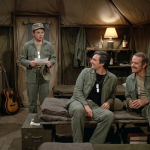
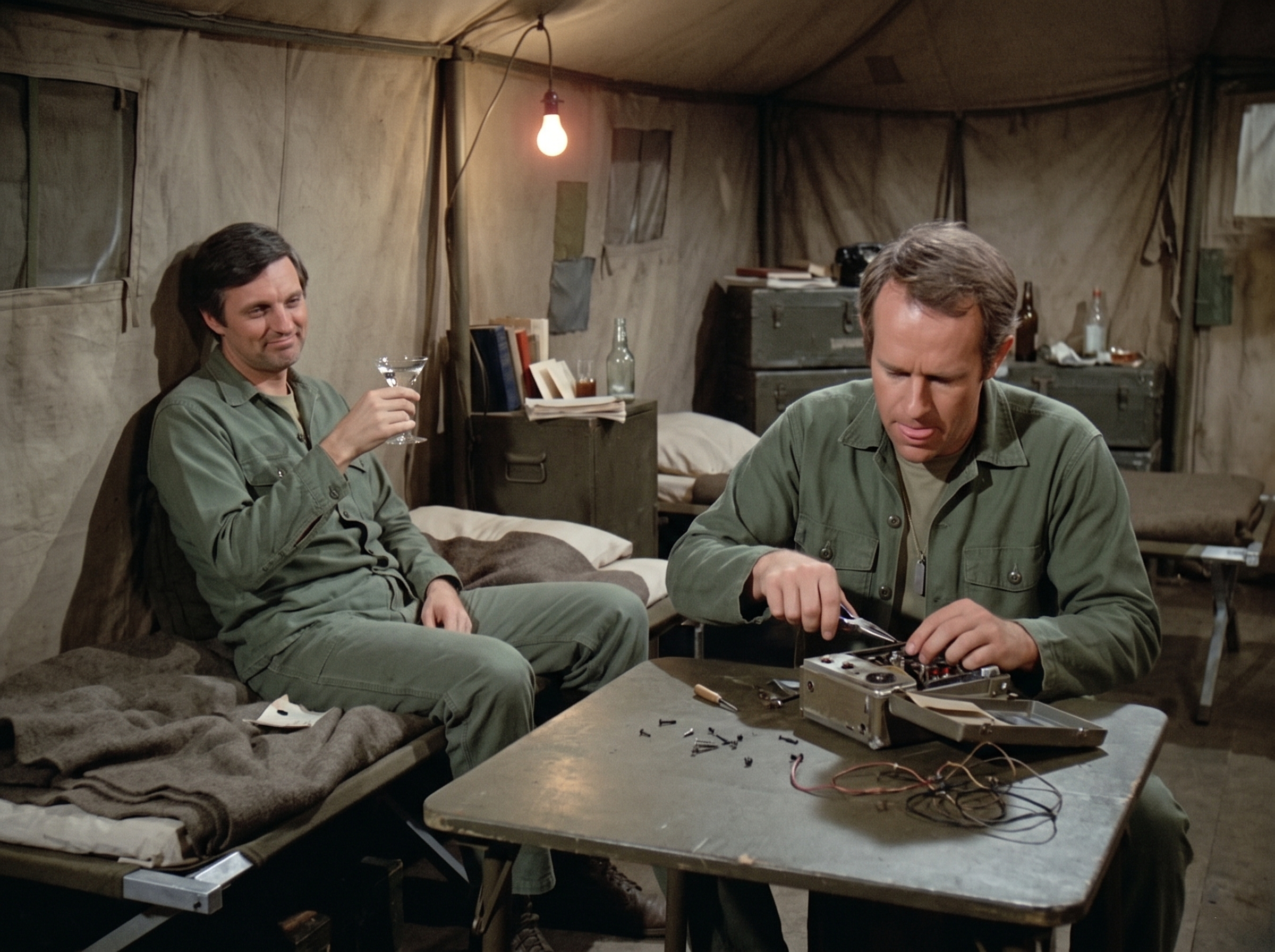
Hawkeye Pierce had retreated to his sanctuary of green canvas and blankets, propped against his pillow. He looked at B.J. with that special, tired grin only his best friend could decipher.
He raised a full martini glass, the clear liquid catching the weak glow of the single bulb. “To surgical skill,” he toasted quietly, “and to the miraculous endurance of human machinery.”
Across the small metal table, B.J. Hunnicutt didn’t even look up. His brow was furrowed, his entire focus poured into a silver box.
He was using a small screwdriver and a pair of pliers like delicate surgical tools. The guts of the camp’s main field radio were spilled across the scratched table.
Tangled wires, tiny screws, and a few miscellaneous metal pieces were arranged neatly beside the chassis. He was fighting a war against bad solder and loose connections.
Hawkeye took a slow sip. “You know, Beej, I’m pretty sure the Geneva Convention has a specific clause against torture via meticulous radio repair.”
B.J. just grunted, his tongue slightly stuck between his teeth. He made a minute adjustment with the pliers.
“Heard that new nurse, Lt. Walsh, is looking for a handyman,” Hawkeye tried again, the grin widening slightly. “Says her heart has a loose wire. Care to apply?”
B.J. finally glanced up, giving Hawkeye a quick, playful glare. He blew a breath of frustration.
“It’s not for her,” he said, his voice softer than the joking tone required. “It’s for Radar.”
Hawkeye stopped swirling the gin. The playful edge in his eyes softened.
Radar’s prized possession, the only connection to home that didn’t involve letters and waiting weeks, was silent. His tiny radio, the one he listened to baseball games on, was dead.
B.J. hadn’t been fixing the *camp’s* radio. He was fixing *Radar’s* world. He had taken it on like a surgical case, and it wasn’t going well.
A sharp snap echoed in the quiet tent. B.J. froze, his hand trembling slightly.
“What was that?” Hawkeye asked, setting his martini glass down, the humor vanishing completely.
B.J. didn’t answer immediately. He looked at the tip of his pliers, which were holding a microscopic wire that was now very much severed from its post.
He slumped back, dropping his head into his hands. “Oh, brilliant. Just… brilliant.”
Hawkeye moved to the edge of his cot. “What happened? Talk to me, Beej.”
B.J. ran a hand through his hair, exasperation written across his tired face. “The antenna coil. I just snapped the lead. It’s too fine. I can’t solder that, Hawkeye. Not with these instruments.”
His gaze fell back to the disassembled radio, which now looked less like a potential repair and more like a permanent casualty.
“Radar was so hopeful,” B.J. whispered. “He’s been waiting all day. He thought it was just a loose screw. I told him I’d have it humming by morning.”
Hawkeye stood up, the weariness forgotten. He walked over and clapped a firm, comforting hand on B.J.’s shoulder.
He looked closely at the tiny components. “Alright, so it’s broken. We’re doctors, right? This is just orthopedics for metal.”
“No, Hawk. That wire is dead. It’s a closed fracture that just became compound.” B.J. gestured hopelessly. “I don’t have a spare. The supply sergeant in Seoul won’t even know what a 3A4 tube is, let alone this specific coil.”
They sat in silence for a few long moments. The disappointment on B.J.’s face was palpable.
This wasn’t just a broken radio. It was a failure of the care they all tried so hard to build in this hostile place. B.J. felt he had broken a little piece of the 4077th’s collective heart.
Hawkeye looked from the broken coil to his martini glass. A slow, mischievous, distinctly Pierce-ian thought began to take hold.
“B.J., remember that time Klinger tried to mail himself home in a box labeled ‘C-Rations’?”
B.J. frowned, wondering where this was going. “Yeah? He forgot air holes. We nearly lost him.”
Hawkeye gestured broadly with his hands. “Precisely. We needed a creative solution for Klinger, and we found one. We are the masters of improvisation.”
He pointed at the radio. “Where does this antenna wire *go*, when it’s not being difficult?”
B.J. sighed. “It just snakes inside the case. It needs to be a certain length to pick up the signal. Without that coil, it can’t boost it. The whole thing needs specific impedence.”
“Specific impedence,” Hawkeye repeated, tasting the words. “And what material is this specific wire?”
“Copper,” B.J. said.
Hawkeye was already moving. He crossed to his footlocker and began digging frantically.
“I’m pretty sure,” Hawkeye muttered, “that when I arrived in this paradise, a fellow gave me a truly terrible, incredibly fine, *copper* chain that his grandmother swore was a cure for gout.”
He triumphantly pulled out a tangle of thin, delicate metal links. “It’s too small for jewelry and too thin for anything practical. Perfect!”
B.J. stared. “You’re not serious. We need a precision coil, not a gout remedy.”
Hawkeye sat at the table and carefully picked up the fine chain. He used B.J.’s pliers.
“Look, Beej. We can’t build the coil. But we *can* find the equivalent *length* of wire. And I can wrap it, right here.” He tapped the table.
For the next two hours, the O.R. of the Swamp was fully operational. Hawkeye painstakingly wrapped a section of the copper chain around a thin screwdriver shaft to mimic the broken coil, while B.J. held the frame steady with the precision of an anesthesian holding a airway.
It was tense work. Every snap of metal felt monumental. They traded places, shared the pliers, and spoke only in brief, focused instruction.
Finally, the new, handmade copper chain substitute was in place. B.J. soldered the last connection with a hot poker he heated over the small stove, Hawkeye holding the wire steady with the tweezers from his surgical kit.
The radio looked exactly the same, yet fundamentally different. It was an awkward, delicate, slightly ludicrous repair.
B.J. plugged it in. Hawkeye took a breath and held it.
B.J. clicked the dial. A static hum filled the tent. He gently turned the knob.
Static. More static. The sound of atmospheric pressure and distance.
Then, faint at first, then growing slightly clearer: “*…and the pitch is low and inside, ball one…*”
The signal was weak. It cracked and popped. The announcer’s voice sounded like it was coming from the bottom of a well.
But it was baseball. It was *home*.
B.J. let out a breath that sounded like a small victory cry. He looked at Hawkeye, and that quiet, steady smile returned.
Hawkeye just lifted his refilled martini glass, pointing it toward the weak sound. “To the improvisation that separates us from the apes. And for giving a kid from Iowa a reason to dream again.”
When Radar came by the next morning, B.J. handed him the radio.
Radar’s face lit up as the weak baseball signal crackled to life. “Wow, you did it, Captain B.J.! It’s… it’s better than ever.” He hugged the tiny metal box like a lost friend.
As Radar left, Hawkeye looked at B.J. with knowing warmth. “I think he only needs a strong signal, Beej. The finest copper chain this side of Seoul will do just fine.”
B.J. just smiled and reached for the screwdriver. He had some other small components to tidy up.
Because sometimes, in the whole mess of a war, the smallest connection is the most important one.