A Dash of Color in the Mud
Sometimes, the gray mud of Korea settles so deeply into your bones that you forget what a Tuesday looks like. You forget the taste of fresh milk, the sound of traffic on a paved street, and the simple comfort of a dry pair of socks.
That was the kind of week it had been at the 4077th—a endless blur of rain, cold coffee, and the distant, rhythmic thud of artillery echoing through the hills.
In the middle of the mess tent, the air smelled of wet canvas, boiled cabbage, and shared exhaustion. Soldiers sat in slumped clusters, their shoulders heavy with the weight of another double shift in post-op.
Hawkeye was somewhere asleep with his boots on, and Colonel Potter was in his office, fiercely debating a supply sergeant over the telephone about a missing shipment of penicillin.
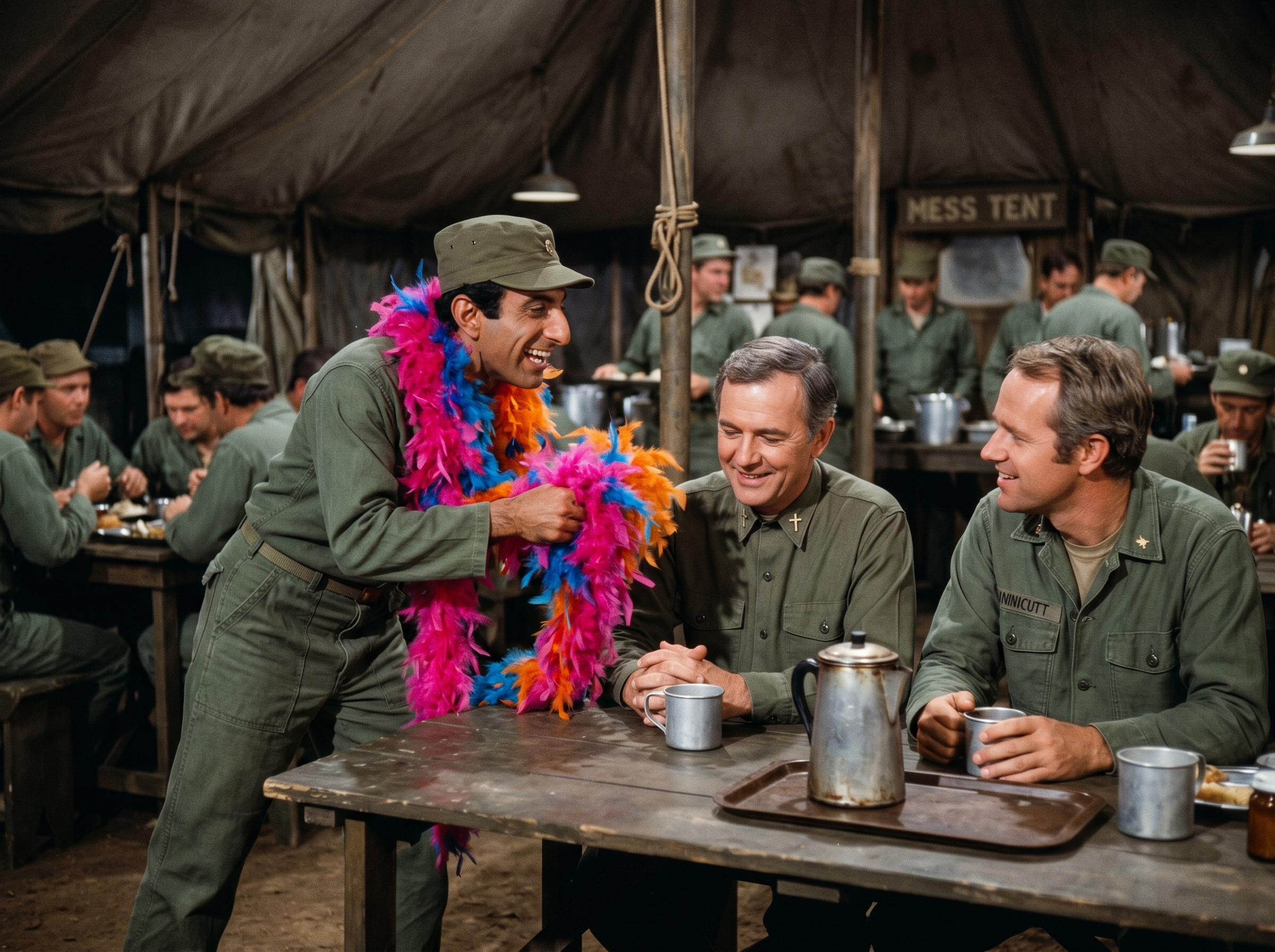
At one of the long, scarred wooden tables, Father Mulcahy and B.J. Hunnicutt sat quietly, staring into their tin cups. The coffee was lukewarm and bitter, but it was something warm to hold against the damp chill that always seemed to find its way under their fatigues.
B.J. rubbed the bridge of his nose, his eyes traced with red lines. He was thinking of San Francisco, of Peg, and of a daughter who was growing up in photographs taped to a canvas wall.
Father Mulcahy offered a gentle, tired smile, trying to lift the silence. “The rain is supposed to clear by tomorrow evening, B.J. Or so Radar tells me. He claims his ankles are stopped aching.”
“I’ll believe it when I see a dry patch of dirt, Father,” B.J. sighed, his voice raspy. “Right now, I think my soul is growing moss.”
Then, the flap of the mess tent swung open, letting in a sharp gust of wind and an unexpected explosion of pure, unapologetic color.
Max Klinger stepped inside, his face lit up with a grin that could have guided a rescue chopper through a fog bank.
Draped over his standard-issue olive drab uniform was a massive, impossibly bright feather boa. It was a chaotic cascade of hot pink, electric blue, and vibrant orange, looking entirely absurd against the drab background of the tent.
The entire room seemed to pause. A dozen tired pairs of eyes looked up from their tin plates, blinking in disbelief at the sudden intrusion of neon feathers in a combat zone.
Klinger didn’t care about the stares. He strutted over to B.J. and Father Mulcahy’s table with the grace of a runway model, the boa rustling softly with every step.
“Gentlemen,” Klinger announced, leaning over the table and holding out a handful of the brilliant feathers like a prized catch. “Straight from Toledo. My Aunt Louise sent it. She thought I needed something ‘festive’ for the winter wardrobe.”
B.J. looked up, a slow grin breaking through his exhaustion. “Klinger, if the Chinese see you in that, they won’t even need flares. You’re a walking neon sign.”
“Laugh all you want, Captain,” Klinger shot back, his eyes dancing with theatrical pride. “But in a world of olive drab, a man’s got to maintain his artistic integrity. Feel the quality of these feathers, Father! That’s genuine imitation marabou!”
Father Mulcahy looked at the pink and orange fluff hovering near his coffee pot. A soft, genuine laugh escaped him, his shoulders dropping some of the tension they’d carried all day.
For a second, the ridiculousness of the moment pushed the war right out of the room. It was funny, it was warm, and it was uniquely, beautifully Klinger.
But just as B.J. reached out to touch the ridiculous fringe, the distant sound of a siren began to wail across the compound, its rising shriek cutting through the laughter like a knife.
The laughter vanished from the mess tent in a fraction of a second. The familiar, hollow dread settled right back into everyone’s chests as the loudspeaker crackled to life with Radar’s urgent voice: *”Incoming wounded. All shifts to OR. Choppers landing in three minutes.”*
Tables scraped against the dirt floor as soldiers stood up, their fatigue forgotten, replaced instantly by adrenaline. B.J. was on his feet before the announcement even finished, his face tightening into his professional surgeon’s mask. Father Mulcahy reached for his cap, his gentle eyes instantly shifting to a quiet, prayerful focus.
Klinger didn’t hesitate either. In a flash, the theatrical performer disappeared, and the efficient, dedicated corpsman took over. He grabbed the bright feather boa from around his neck, stuffed it unceremoniously into a corner of the wooden bench, and began running toward the triage door, already pulling on his rubber apron.
The next five hours were a blur of steam, blood, and the sharp smell of antiseptic. The 4077th did what it always did—they fought the grim reaper in a crowded room, working side by side until their arms data-shook from exhaustion and their eyes burned under the harsh surgical lamps.
Hawkeye crackled with frantic, defensive wit; Winchester barked orders for standard procedures; Margaret moved with flawless, steady precision; and Colonel Potter guided them all like an old, reliable anchor.
By the time the last stitch was put in and the blankets were tucked around the sleeping patients in post-op, the sky outside had turned a deep, bruised violet. The rain had finally stopped, leaving behind a cold, quiet mist.
B.J. walked out of the operating room, his hands raw from scrubbing, his back aching fiercely. He stumbled back into the mess tent, looking for nothing more than a corner to collapse into.
The tent was mostly empty now, save for a few lanterns burning low. He walked back to the table he had left hours ago.
There, sitting quietly under the dim yellow light, was Father Mulcahy, sipping a fresh cup of tea. And right next to him on the table sat the bright, ridiculous pink and orange feather boa, looking slightly deflated but still stubbornly colorful.
Klinger was sitting across from the priest, his sleeves rolled up, his face lined with dark circles of pure exhaustion. He wasn’t trying to get a Section 8 discharge right now. He was just a tired kid from Ohio who had spent the night carrying stretchers through the mud.
“You left your scarf behind, Klinger,” B.J. said quietly, sliding onto the bench next to them.
Klinger looked at the boa, then up at B.J., a small, modest smile on his face. “I thought about throwing it in the incinerator, Captain. It feels a little silly after a night like that.”
Father Mulcahy reached out, his hand gently touching the bright pink feathers. “Don’t do that, Max. When you walked in here earlier, you gave us something we desperately needed. You reminded us that there is a world outside of this mud—a world with color, light, and laughter.”
B.J. nodded, picking up a stray pink feather that had fallen onto the table. He looked at it closely, a warm, nostalgic wave hitting him.
“The Father’s right, Klinger,” B.J. said softly, his voice thick with emotion. “In a place like this, a little bit of silly is what keeps us sane. Don’t ever lose your colors.”
Klinger looked between the two men, his chest swelling with a quiet, dignified pride that had nothing to do with theater and everything to do with family. He picked up the boa and draped it loosely over his shoulder again, the bright pink against his stained fatigues looking less like a joke and more like a badge of resilience.
The three of them sat together in the quiet tent, sharing a pot of stale coffee as the morning light began to break through the canvas, safe in the warm, bittersweet sanctuary of the 4077th.
Because in the darkest corners of the world, sometimes it takes a few pink feathers to remind us of the humanity we are fighting to keep alive.