The Silent Victory at Table Four
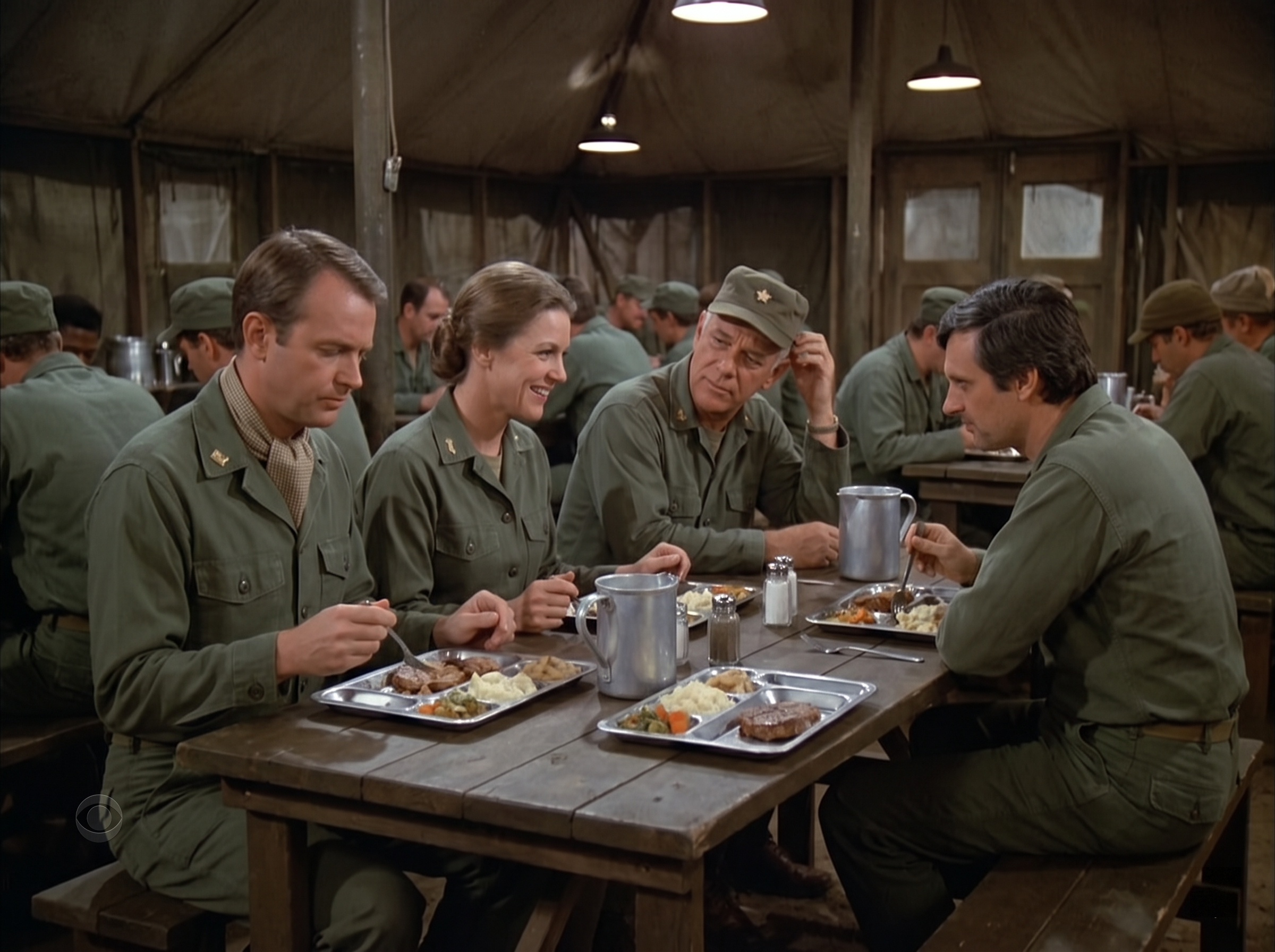
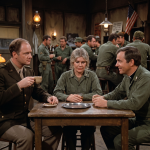
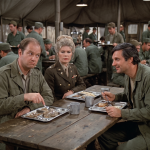
The rain pounded the mess tent, a relentless drumroll on canvas that drowned out the generators and the rumble of the distant front. Inside, the humid air smelled of diesel, stale coffee, and something the cook called beef but the surgeons knew was a mystery of military logistics. They sat together at the long wooden table, five souls adrift in a sea of fatigue, tethered only by shared exhaustion and the comfort of found family.
On the far left, Dr. Grant, a young anesthetist still green around the gills, methodically pushed his peas. He didn’t eat, but he made a precise formation with the green spheres, a desperate attempt to find order in the chaos.
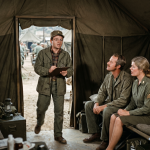
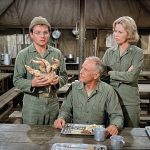
Next to him sat Major Charles Emerson Winchester III, as visualised on the left of our image, the visual surrogate for a refined sense of taste and cutting wit. Charles, hands folded, stared at his segmented metal tray with a look of utter desolation. It was a scowl of intellectual superiority and hidden heartbreak, a mask for the horror he felt that this was a dinner.
“I believe this beef, if one could label it such, has passed through the five stages of grief and is currently in a state of advanced decomposition,” Charles sneered, though his voice lacked its usual bite. He looked over to the center-left.
Major Margaret Houlihan, her uniform visualised on the screen, looked at him with a tired, professional smile. “It has protein, Major. At this point, I don’t ask if it’s delicious; I just ask if it keeps us alive long enough to save another.” It was her armor, her optimism, holding her up even as her shoulders slumped.
To her right, as seen in the center-right of our visual reference, Colonel Sherman Potter sat with a cap pushed back, his right hand absently scratching his temple. He didn’t look angry; he looked old, older than usual after a twelve-hour shift that had gone sideways twice. He stared past his tray, past his companions, lost in a memory of a time when the only sound in the rain was the wind through the horses’ tails.
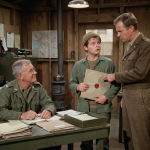
Across from him sat the surrogate for quick wit and shared laughter, a quick-witted captain on the right of the image, the visual focus of Potter’s gaze. He was looking at Potter, having just delivered a joke about how the mess tent was the only place where ‘mystery’ was on the menu every day. But the witty retort hung in the air, heavy and unresolved.
“The potatoes, Colonel. At least the potatoes are white, which means they are either edible or they’ve just seen the enemy,” the visual surrogate continued, trying to bridge the silence. He made eye contact with Potter, his eyes visualising the concern they all felt for their leader.
Potter didn’t laugh. He didn’t answer. He froze, his hand still on his cap, a strange, distant vacancy in his eyes that terrified them more than any mortar round. Total silence descended on table four, a quiet victory for the creeping despair they all fought every single day, and the young anesthetist on the far left stopped moving his peas, a sudden, cold sense of dread tightening in his chest.
The silence stretched, a vacuum of sound that seemed to pull the warmth from the air. The rain outside was now the only sound, each beat on the canvas a countdown to something they couldn’t name. Margaret stopped smiling. Charles, visualised on the left, looked from his tray to Potter, the sarcasm dying on his lips. He saw not a CO, but a man who was bending, and if Sherman Potter bent, the rest of them would break.
1 second. 5 seconds. The witty captain on the right of the image, who had been joking moments before, visualised the change. His grin vanished, replaced by a expression of raw vulnerability, his gaze locked on Potter, holding a breath he didn’t realize he was taking. This was the terrifing pause, the moment before a good man gives up the fight, the invisible casualty that never showed up in the O.R.
Then, Potter’s hand dropped. It was a small movement, but it felt momentous. He let out a slow, rattling sigh that seemed to last forever. He looked away from the vacancy and into the eyes of the visual surrogate across the table, visualised on the right.
“Good point, Captain,” Potter said, his voice quiet but steady, the dry, fatherly exasperation returning like an old friend. “Potatoes, at least, are faithful.” He looked around the table. At Margaret, offering a reassurance of strength. At Charles, visualised on the left, who sat a little straighter, his secret compassion now visible as a slight nod of relief. At the young Dr. Grant, who slowly picked up his fork.
It wasn’t about the beef, and it wasn’t about the joke. It was about checking in. They were making sure everyone was still ‘alive’ inside. Potter had looked into the abyss for a moment, the abyss of futility that claimed so many, and he had come back. His presence at the table, visualised in the center-right, was the victory.
The silence that followed was different now. It was the companionable quiet of shared understanding. The silver pitchers went around. The conversation resumed, muted but human, touching on the absurdities of life and the hopes for a quiet night. They finished their miserable dinner, not because it was good, but because they were together, and that was the only nourishment that mattered.
As they left the mess tent, the rain visualised outside still falling, they walked as a bonded unit, a cluster of olive-drab against the night, lanterns casting a warm glow. They were far from home, in a place that didn’t make sense, but at that table, in that shared moment, they had found the only peace they could. It was the found family of the 4077th, a small group of doctors and nurses visualised in this humble moment of grace.
In this impossible place, the greatest victory wasn’t the battles they won, but the family they found along the way.