A Blue Crayon Blueprint of Home
The 4077th had only two speeds: utter, deafening chaos, and a silence so heavy it actually made your ears ring.
Right now, the camp was suspended in the latter.
It was 0300 hours in the Post-Op Ward, and the war was finally taking a nap.
Captain B.J. Hunnicutt was doing his level best to join it while keeping his eyes wide open.
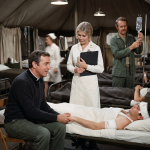
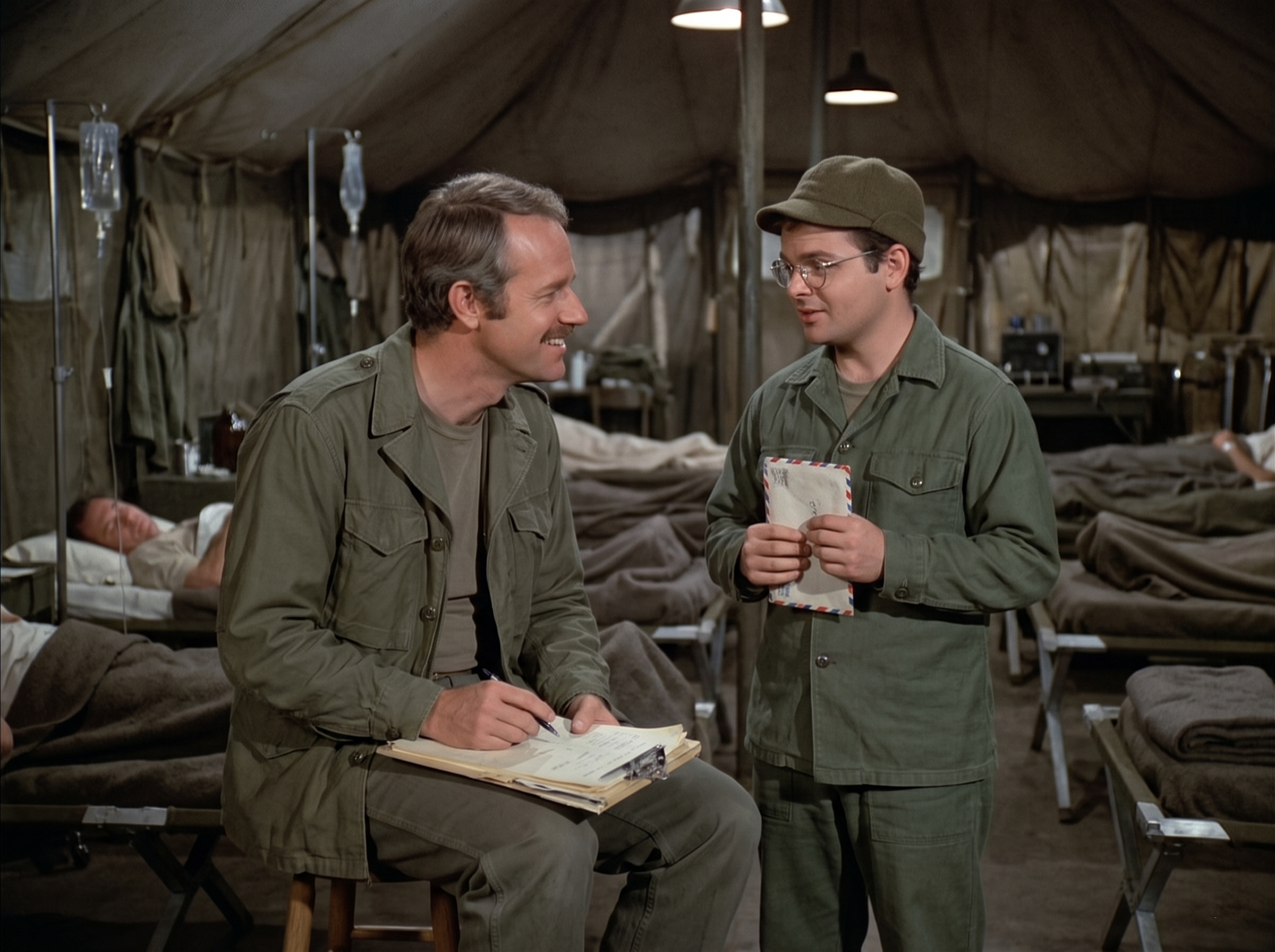
He sat on a small wooden stool beside the third cot in the second row, a metal medical chart resting heavy on his knee.
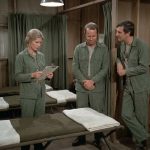
The soft overhead lights cast a muted, golden glow across the canvas walls, painting the ward in exhausted shades of white and beige.
All around him was the rhythmic, steady breathing of young men who had survived the worst day of their lives.
B.J. rubbed the bridge of his nose, feeling the grit of a thirty-hour shift ground into his skin.
He was wearing his standard issue, worn olive drab.
His posture was completely practical, lived-in, and slumped with the specific kind of fatigue that only front-line surgeons ever really understood.
He looked at the chart again, double-checking a medication dosage, when the canvas flaps of the ward parted with a soft rustle.
Corporal Walter “Radar” O’Reilly slipped inside.
As always, Radar moved with the quiet stealth of a boy who spent his childhood tracking deer through the Iowa snow.
He stepped up beside B.J.’s stool, standing at attention in that modest, slightly unsure way he always did when he was interrupting an officer.
But B.J. wasn’t just an officer. He was a friend.
B.J. looked up from the chart, turning to the young clerk.
He didn’t bark. He didn’t sigh.
Instead, B.J.’s face softened into a calm, quiet, deeply empathetic smile.
“What’s on your mind, Radar?” B.J. asked softly, keeping his voice down so as not to wake the sleeping soldier nearby.
“Sorry to bother you, Captain Hunnicutt, sir,” Radar whispered back.
Radar was clutching a battered manila envelope in front of his chest with both hands.
His knuckles were slightly white, gripping the paper as if a strong gust of wind might rip it away.
He looked down at B.J. with wide-eyed earnestness, offering a nervous, innocent smile that didn’t quite hide how seriously he was taking this mission.
“I know you’re technically off duty, sir,” Radar continued, his eyes darting to the sleeping patients before returning to B.J.
“But I was down at the communication tent. Doing some… unofficial checking on the mail manifests.”
B.J. tilted his head slightly, his supportive smile never wavering. “Unofficial checking?”
“Well, yes, sir. I was listening in on a spark-gap transmission from Kimpo.”
Radar swallowed hard, taking a half-step closer.
“This bag got lost three months ago, Captain. It got routed to Okinawa by mistake, and then somebody marked it ‘Return to Sender’.”
Radar held the envelope out just an inch further.
“But I caught it, sir. I caught it just before they put it on a transport back to San Francisco.”
B.J. looked down at the envelope in Radar’s hands, seeing the familiar, elegant handwriting of his wife, Peg.
But it was the red ink stamped heavily across the front that made B.J.’s heart suddenly pound in his chest, freezing him entirely in place.
The red stamp read: UNDELIVERABLE – DESTROY OR RETURN.
B.J. stared at those harsh military letters.
To the United States Army, this envelope was just three ounces of misplaced cargo.
To B.J. Hunnicutt, it was a lifeline that had almost been severed.
He slowly reached out, carefully taking the envelope from Radar’s tight, two-handed grip.
The paper was incredibly soft, worn down by thousands of miles of travel, rough handling, and the damp air of the Pacific.
“Thank you, Radar,” B.J. whispered, his voice thicker than it had been a moment ago.
“I didn’t open it, Captain,” Radar said quickly, his nervous smile turning into a look of absolute, earnest loyalty.
“But it feels kind of… lumpy. Not like a regular letter. I figured it was important. I mean, all mail is important, but this one felt like it needed to get here tonight.”
B.J. set his medical chart quietly on the floor.
He peeled back the heavy brown tape that had been hastily applied by some unknown postal clerk in Tokyo.
His fingers were remarkably steady, the same steady hands that had spent the last two days stitching broken boys back together.
Inside the envelope was a folded piece of thick, pale yellow construction paper.
B.J. carefully pulled it out, opening it under the soft, muted light of the surgical tent.
There, pressed flat against the yellow page, was the tracing of a child’s hand.
It was drawn in heavy, waxy blue crayon.
Beside it, in Peg’s neat handwriting, were the words: Erin’s hand. 18 months old. She reaches for your picture every single day.
B.J. stopped breathing.
He just sat there, staring at the uneven blue lines on the yellow paper.
He could almost smell the crayons. He could almost hear the sound of his daughter’s laugh echoing in their kitchen in Mill Valley.
The war completely vanished.
The smell of iodine, the rows of white blankets, the buzzing overhead lights—all of it faded into nothingness.
For ten glorious, agonizing seconds, Captain Hunnicutt was home.
He traced the outline of the blue crayon with his thumb, marveling at how big the hand had gotten since he last held it.
A single, hot tear escaped his right eye, tracking a slow path down his tired cheek.
Radar stood beside him, watching the quiet devastation and profound joy wash over the surgeon’s face.
The young clerk didn’t look away.
Instead, his innocent, nervous smile slowly returned, softening into genuine, heartfelt warmth.
“She’s got a nice hand, Captain,” Radar whispered gently, breaking the silence.
B.J. let out a short, wet chuckle, quickly wiping his cheek with the back of his wrist.
“Yeah, she does, Walter,” B.J. replied, his voice trembling just a little.
“She’s got a beautiful hand.”
“Looks like a good hand for holding onto things,” Radar observed astutely, shifting his weight. “Like a baseball. Or… or a stethoscope, maybe.”
B.J. smiled, a real, radiant smile that reached all the way to his tired eyes.
He looked up at the young corporal, profoundly grateful for the boy’s endless capacity to care.
“How did you actually get them to reroute this from Kimpo, Radar?” B.J. asked. “Okinawa isn’t exactly next door.”
Radar looked down at his boots, shuffling slightly in his oversized uniform.
“Well, sir, it turns out the dispatcher in Seoul has a brother who really likes canned peaches.”
Radar looked up, his eyes wide and completely serious.
“And I happened to know where a case of peaches was mysteriously taking up space in Colonel Potter’s supply tent. Sir.”
B.J. let out a soft laugh, shaking his head.
“You traded a whole case of peaches for one letter?”
“It wasn’t just a letter, Captain,” Radar said softly, his voice full of quiet wisdom that seemed far older than his young face.
“It was your mail. That makes it a medical necessity.”
B.J. carefully folded the yellow paper, placing it gently into the breast pocket of his uniform, right over his heart.
He reached out and placed a firm, deeply affectionate hand on Radar’s shoulder.
They didn’t need to say anything else.
In a place built on blood, mud, and endless fatigue, it was these quiet, stolen moments that kept their humanity intact.
They were just two men, thousands of miles away from everything they loved, relying on each other to survive the emotional cost of being so terribly far from home.
B.J. picked his medical chart back up from the floor, feeling just a little bit lighter.
Radar offered one last crisp, slightly awkward salute, before turning and slipping silently back through the canvas flaps, disappearing into the Korean night.
B.J. leaned back on his stool, letting the quiet hum of the ward wash over him again, the blue crayon blueprint of his daughter keeping him warm in the dark.
In a war that took everything, the greatest victories were the tiny pieces of home they managed to save for each other.