The Day the Mail Came Late to Radar’s Office
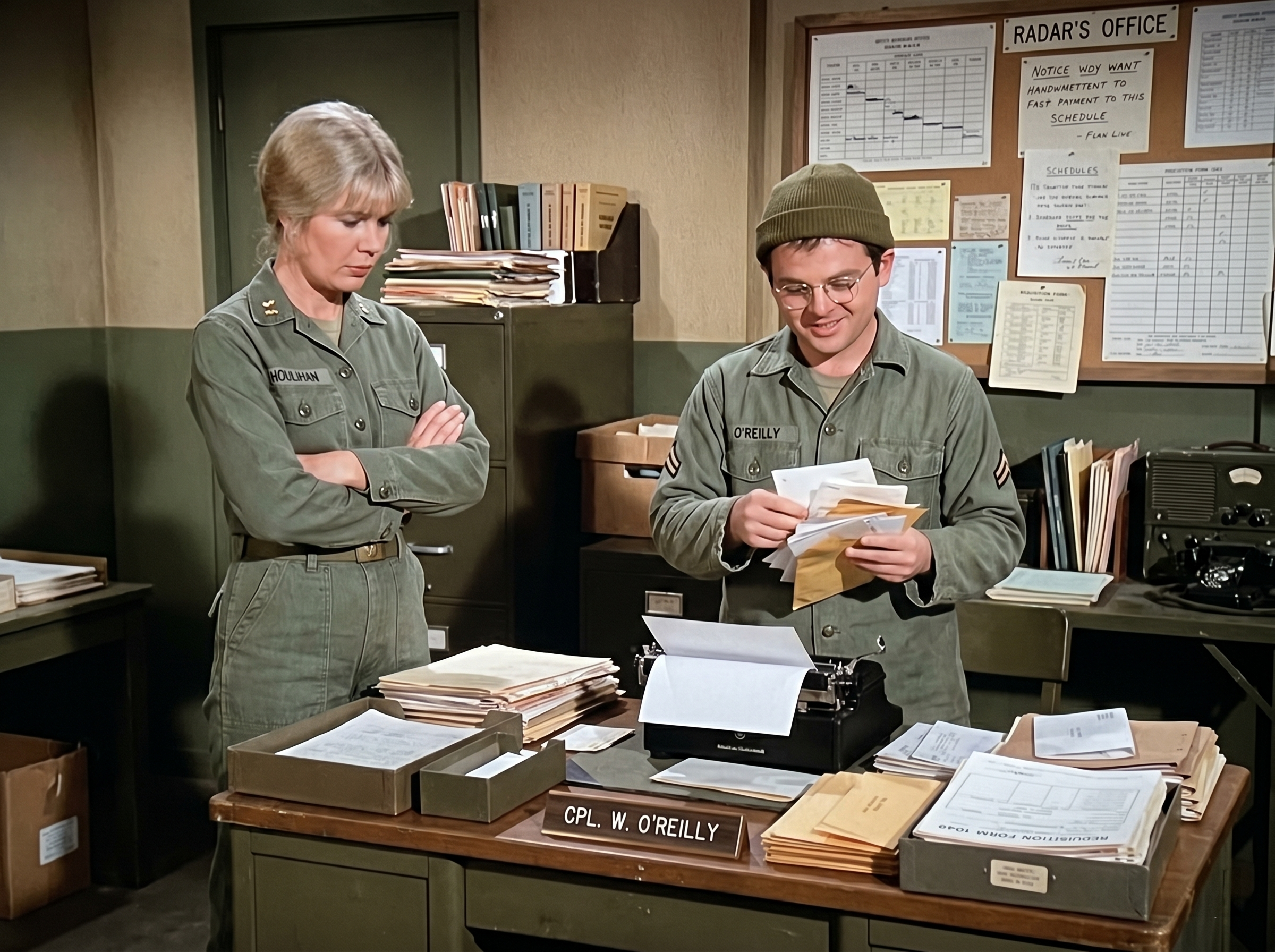
The silence in the cramped corner office was heavier than a wet army blanket.
It wasn’t the kind of quiet that meant the operating room was empty and the wounded had all been patched up.
It was the heavy silence that only accumulated around Corporal Walter O’Reilly’s desk on Mail Day, just before the first sack was emptied.
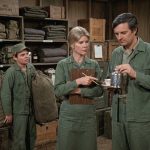
Margaret stood beside the green metal filing cabinet, her posture military-rigid, arms crossed defensively over her chest.
Her blonde hair was tucked back, the professional armor of Major Houlihan firmly in place.
She looked down at the desk, her expression a careful mixture of authority and carefully controlled exhaustion.
Radar didn’t seem to notice.
He was focused on the task that gave him more joy than anything else in Korea.
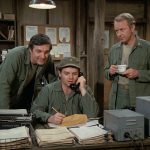
He sat behind the desk, his distinctive beanie pushed back, glasses perched on his nose, and a soft, simple smile gracing his face.
He was meticulously sorting a small stack of letters.
A few were destined for the tents of the surgeons, others for the nursing staff, and a precious few for the local Korean staff who worked in the camp.
To Radar, each letter was a tangible connection to a home that felt thousands of miles away.
Margaret was not here for the mail.
She was here for “Acquisition Form 1049.“
It was a standard-issue form, but the bureaucratic supply chain of the 4077th ran through this very office, and the form she needed was essential for replacement surgical scissors.
She had filled it out, but now, naturally, it was missing from the small inbox tray.
Her patience, usually paper-thin when dealing with the administrative chaos, was eroding rapidly.
“Corporal,” she said, her voice a quiet command.
Radar looked up, his smile unwavering. “Yes, Major?”
“The 1049. I left it here this morning.”
Radar blinked, his gaze returning to the letters. “Oh, that form. I saw it somewhere.”
“‘Somewhere’ is not a filing system, Corporal.”
Her tone sharpened slightly. She had a list of things to do, and the missing scissors were holding up the next sterilizer rotation.
“Gee, Major,” Radar said, his fingers still tracing the outlines of the envelopes. “I was just sorting the personal mail. These letters are the only thing that keeps morale up.”
“I am perfectly aware of morale, Corporal,” she snapped, “and proper surgical equipment is also necessary for morale. And survival.”
Radar hesitated, the simple smile faltering.
He finally put down the stack of mail, leaving the typewriter keys momentarily silent.
He looked around the chaotic surface of his desk, pushing a stray field manual aside and shifting a box of paper clips.
Margaret watched, her eyes tracking every movement. Her patience was a ticking clock.
“I was sure it was right here… with the 1048s,” Radar mumbled.
“I have patients waiting, Corporal. The 4077th cannot afford to be disorganized.”
He looked up at her, a flicker of nervous energy in his eyes.
He picked up the small stack of sorted mail again, almost defensively.
“Major, these aren’t just pieces of paper. They’re families. They’re loved ones.”
Margaret stared down at him. For a brief second, the Major’s mask slipped, and a flicker of deep, underlying fatigue showed in her eyes.
She wasn’t angry at him. She was tired. They were all tired.
But the form mattered. “Corporal,” she said, her voice dropping to a dangerous whisper, “if that form is not found within sixty seconds, I will personally reorganize this entire office. And you may not like the results.“
The simple, easy friendship that sometimes bloomed in this office evaporated, replaced by a tense professional standoff.
Radar looked at her, his innocent face showing true concern for the first time.
The typewriter was silent, the telephone wasn’t ringing, and the rotary-operator board behind him was still.
The only sound was the rustle of paper as Radar, with slightly shaking hands, resumed fumbling with the mail.
The simple joy was gone. A moment of peaceful connection had become a battle of bureaucracies.
Radar scrambled.
He set down the sorted mail, then stood up and pulled open a drawer of the green filing cabinet with a rattle that seemed far too loud in the quiet room.
Papers shifted. Standard Operating Procedures clashed with supply catalogs.
Margaret didn’t move. She just watched, a human clock counting down the seconds.
“I remember… I put it with the requisitions from Captain McIntyre… no, wait… it was Captain Pierce.”
Radar’s voice was high-pitched with stress.
“The form, Corporal,” she said, her voice steady.
He moved a box of envelopes. He peeked under the base of the manual typewriter.
He even looked under his beanie, which he removed, his hair messy underneath.
“Nothing,” he whispered.
He looked at her, his eyes magnified behind his glasses, showing genuine, small-town fear.
Margaret took a long, steady breath, her arms still folded tightly.
Her gaze swept over the messy desk.
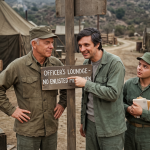
The typed notices on the bulletin board seemed to mock her need for structure: “RADAR’S OFFICE,” “NOTICE.“
She looked back at Radar, who was standing still, looking like a lost boy waiting to be scolded.
And in that moment, seeing the genuine worry on his face, something shifted.
The authority didn’t disappear, but the steel core softened slightly.
She knew she couldn’t blame him for the chaos. They were in a war, not an accounting firm.
And Radar… Radar was the innocent center of this universe. He was the kid they all looked after, even when they were frustrated by him.
“Radar,” she said, her voice dropping the Major’s sharp edge.
He looked up, surprised.
“The form. Just… check one more time. Where else might it be?”
Radar looked around his corner, and his eyes landed on a stack of unopened medical journals he had pushed aside earlier.
“Gee, Major… maybe…”
He moved the journals.
Beneath them, mixed in with a stack of bland, grey military instruction manuals, was a single, slightly crumpled pink sheet.
“Acquisition Form 1049,” he read, his voice filling with relief.
He pulled it out, trying to smooth the creases.
Margaret exhaled. A genuine sigh of relief.
She took the form from his hand, and for a silent second, they just stood there.
The bureaucratic tension had broken.
“Thank you, Corporal,” she said, her tone professional but the sharpness gone.
“You’re welcome, Major,” he said, the timidity still there but the simple smile returning.
He went back to the sorted mail on the desk, his focus shifting.
But he didn’t just pick up a generic letter.
He reached into the stack he was sorting earlier and held up a thin, light-blue envelope.
“This one came in late with the journals, Major.”
He looked up at her, and his smile wasn’t innocent or happy. It was full of understanding.
Margaret paused.
“Who is it for?” she asked, though she already knew the answer.
“You,” he said. “It’s from your mother.”
He extended the letter towards her, and his eyes met hers.
In that simple exchange, the entire war seemed to fall away.
They were no longer Major and Corporal. They were just two people, caught in a shared moment of simple human vulnerability.
Radar, with his innate sensitivity, had found the real source of her tension.
It wasn’t the missing scissors or the inefficient office.
It was the waiting. The constant, crushing waiting for news from home.
She took the letter slowly, her rigid posture finally dissolving.
Her hand lightly brushed his, and the touch, small and brief, carried a quiet acknowledgment.
“Thank you, Radar,” she said, her voice thick with emotion she rarely showed.
“Gee, Major,” he whispered, “I’m glad we found the form, too.”
Margaret turned and walked out of the office, the requisition and the letter from home clutched tightly in her hand.
Radar went back to his desk and sat down.
The office noise slowly returned. The manual typewriter keys clattered. The telephone operator board buzzed.
Radar resumed sorting the mail, his simple, empathetic smile back in place.
He put the other sorted letters into their respective bins.
Because even in the midst of the mud and the pain, these small, human connections, these routine acts of family and found-family, were the only things that truly mattered at the 4077th.
They found strength in the paperwork, and comfort in the small kindnesses.
They found strength in the paperwork, and comfort in the small kindnesses.