A Grand Entrance on a Dusty Path
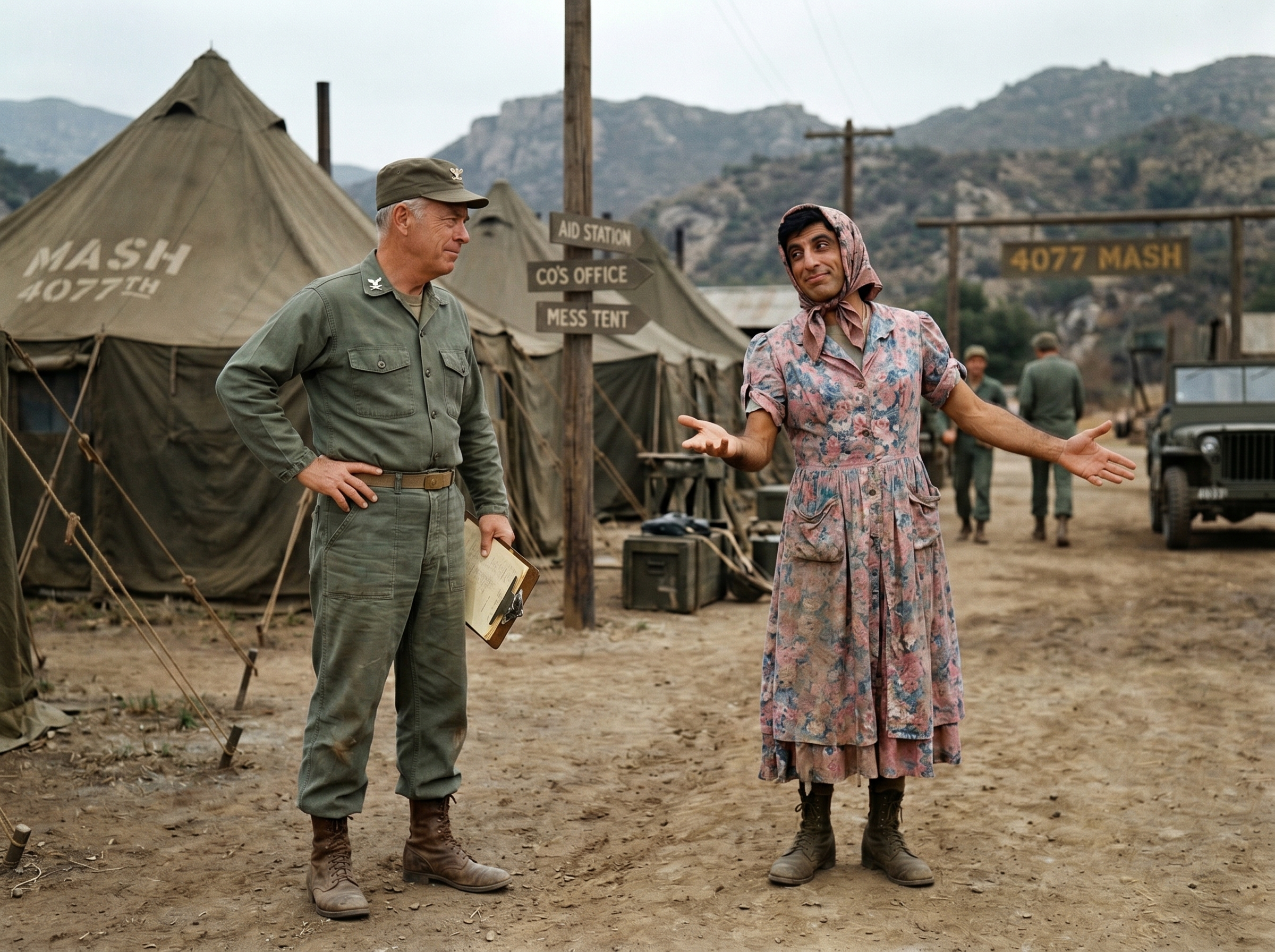
The dust at the 4077th had a way of settling into absolutely everything, especially a man’s patience.
It coated the olive-drab canvas of the hospital tents, clung to the weathered wood of the mileage signposts, and settled deep into the weary faces of people just trying to make it through another day.
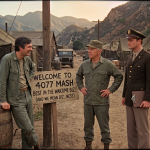
Colonel Sherman T. Potter was attempting something almost impossible in this chaotic corner of Korea: a quiet, routine, by-the-book camp inspection.
With a clipboard tucked firmly under his arm, the old cavalryman walked the dirt path outside the main compound. The late afternoon sun cast a soft, muted light over the outdoor staging area. For once, the camp was relatively still. There were no choppers roaring over the hills. There were no sirens wailing from the PA system.
It was just a tired commander enjoying a rare moment of peace, trying to make sure the tent pegs were secure and the pathways were clear of debris.
Then, the fragile silence was completely shattered.
“Make way! Make way for the tragically afflicted!”
Potter stopped dead in his tracks. He let out a long, slow breath through his nose, his mustache twitching just slightly. He didn’t even need to turn around to know who was disrupting his quiet afternoon.
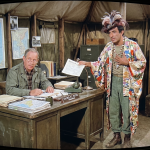
Down the center of the dusty thoroughfare, stepping right past the wooden signpost that pointed the impossible distance to Toledo, came Corporal Maxwell Q. Klinger.
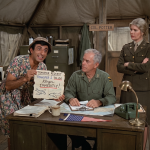
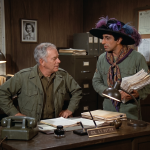
It wasn’t just a walk. It was a carefully choreographed, highly dramatic theatrical entrance. Klinger had seemingly materialized out of thin air, looking like an eccentric aristocrat from a forgotten stage play.
He strode forward with his hands thrown up in a grand, expressive gesture. His fingers were splayed wide, reaching for an invisible spotlight. His face was twisted into a masterpiece of dramatic, tortured suffering, though his dark eyes betrayed a very familiar, sparkling glimmer of sly, desperate hope.
“It’s no use, Colonel!” Klinger announced, projecting his voice so loudly that half the nursing staff could hear him. “My mind has finally snapped! It has broken like a dry twig in a harsh Ohio winter! The delusions are fully taking over my sensory perception!”
Potter turned slowly to face the spectacle. He didn’t yell. He didn’t reach for his sidearm. He didn’t even sigh.
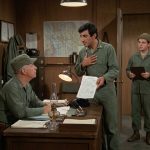
Instead, the Colonel simply planted his boots firmly in the dry Korean dirt. He squared his shoulders, his compact, solid posture radiating a lifetime of unshakeable military discipline. Slowly, deliberately, he placed both of his hands heavily on his hips.
Potter’s face was a perfect study in dryly amused, fatherly exasperation.
He looked his company clerk up and down, taking in the sheer, brazen absurdity of the performance standing right in the middle of a mobile army surgical hospital.
“Is that a medical fact, Klinger?” Potter asked, his voice low, steady, and dangerously calm.
“A certified medical fact, sir!” Klinger took a dramatic step closer, clasping his hands passionately against his chest. “I am seeing things! Hearing things! Just twenty minutes ago, the ghost of my Uncle Habib appeared to me in the mess tent. He strictly demanded I return home at once for my own psychological safety!”
Potter just stared. The entire outdoor compound seemed to freeze in place around them.
A few nurses paused on the duckboards, exchanging amused glances. A couple of passing corpsmen stopped pushing a heavy supply cart, leaning against it to see how the old man would handle this latest, desperate assault on military protocol.
Klinger held his breath, leaning forward slightly. This was it. He was giving the performance of his career. His entire body practically begged for a Section 8 psychiatric discharge.
Potter’s eyes narrowed under the brim of his cap. His jaw set into a firm, unreadable line.
For one long, incredibly tense moment under the pale daylight, it looked as though the Colonel might actually lose his temper and blow his top.
The silence stretched out, thick and heavy, filled only by the faint flapping of canvas in the gentle afternoon breeze.
Potter kept his hands firmly planted on his hips. His eyes bored directly into Klinger, who remained frozen in his tragic, pleading pose upon the dusty path.
Finally, the corners of Potter’s mustache gave a slight, betraying twitch.
“Your Uncle Habib,” Potter repeated, his tone perfectly flat, devoid of any visible emotion.
“Yes, sir!” Klinger nodded eagerly, sensing a tiny opening in the old man’s armor. “A very wise man, Uncle Habib. God rest his soul. He specifically told me to pack my duffel bag, commandeer the next Jeep to Seoul, and await immediate transport back to Toledo.”
“And did this… spectral Uncle Habib happen to mention the current condition of the camp latrines?” Potter asked, not missing a single beat.
Klinger blinked. His dramatic, expressive hands dropped about an inch. “Sir?”
“Because as I was just walking past them on my inspection,” Potter continued, his voice taking on a calm, folksy, authoritative rhythm, “it seemed to me that they were lacking a certain spit and polish. Now, I’m no psychiatrist, son. But I find it highly suspicious that a ghost would travel all the way from Toledo, Ohio, just to give you psychiatric advice, but completely ignore a major sanitation violation.”
Klinger’s shoulders slumped. The theatrical wind left his sails.
The sly, desperate hope in his dark eyes began to dim, slowly replaced by the familiar, exhausted reality of his surroundings.
“With all due respect, Colonel, Uncle Habib was a haberdasher,” Klinger muttered, his grand voice shrinking back down to a normal, tired volume. “He didn’t know much about military plumbing.”
Potter let out a soft, dry chuckle. It was a sound that carried no malice, only a surprising amount of quiet warmth.
He let his arms drop from his hips and took a slow step toward his clerk. The visual comedy of the moment was fading, making room for the tender humanity that kept the 4077th running.
The performance was over. They both knew it.
“You’re a fine actor, Klinger,” Potter said, his voice softening just a fraction, losing the sharp edge of command. “And you’ve got more stubborn determination than a Missouri mule with a mouthful of thistles. I’ll give you that.”
Klinger dropped his hands completely to his sides. The grand illusion he had projected across the compound melted away entirely.
Standing there on the dirt path was no longer a theatrical madman. It was just a tired, frightened young man who was thousands of miles away from everything he loved.
“I just want to go home, Colonel,” Klinger said quietly. The humor was gone. It was just an honest, simple, heartbreaking truth.
Potter stopped right in front of him. The dry amusement in the old cavalryman’s eyes shifted into something much deeper and much older.
It was the look of a father who had seen far too many young men sent far too far from home. He understood. More than Klinger would ever know, Sherman Potter understood the bone-deep, soul-crushing ache of missing your own front porch.
Potter reached out and placed a steady, calloused hand on Klinger’s shoulder.
It was a small, modest gesture. But in the dusty, chaotic, blood-soaked world of a mobile army surgical hospital, it meant absolutely everything.
“I know you do, son,” Potter said softly. “We all do. There isn’t a single soul in this camp who doesn’t wake up every morning wishing to God they were somewhere else.”
Klinger looked down at his scuffed, dusty boots. “It just feels like this miserable war is never going to end, sir.”
“It will,” Potter said firmly, giving Klinger’s shoulder a strong, reassuring squeeze. “Wars always do. Even the ones that feel like they’re going to drag on into the next century. One day, they just stop.”
Potter stepped back. He adjusted his posture, slipping back into the necessary role of the commanding officer, but the gentle, fatherly edge remained in his voice.
“But until that day comes,” Potter said, his eyes meeting Klinger’s, “we have a job to do here. I need my company clerk. I need the man who can scrounge up a case of penicillin from thin air. I need the man who keeps my office running when the world outside goes crazy.”
Klinger looked up. A small, genuine, incredibly tired smile tugged at the corner of his mouth. He straightened his back, a little bit of his natural dignity returning to his stance.
“I am pretty good at scrounging, sir.”
“You’re the finest I’ve ever seen,” Potter agreed with a nod. “Now. I suggest you tell the ghost of Uncle Habib to take a hike back to Ohio. And then, I suggest you grab a mop and show those latrines what a dedicated soldier can actually do.”
Klinger snapped a surprisingly crisp, perfect salute. “Yes, sir.”
Potter returned the salute with the practiced ease of a career soldier. “Carry on, Corporal.”
As Klinger turned and began the dusty walk back toward the center of the outdoor compound, Potter stood still and watched him go.
The Colonel shook his head, a fond, exasperated smile finally breaking freely across his weathered face. He picked up his clipboard, looking back at the neat rows of canvas tents and the wooden signposts pointing to places so impossibly far away.
It was an absurd way to live. It was an absurd, terrible war.
But as Sherman Potter resumed his quiet afternoon inspection, he knew one thing for certain. As long as they were all stuck in this dirty, frightening place together, they were going to look out for each other.
They were a family. A strange, loud, completely exhausted family.
And that, more than anything else, was exactly what was going to get them home.
In the middle of a war that made no sense, the greatest medicine they had was each other.