The Supply Tent Tango: Accountability and a Stolen moment of Sanity at the 4077th
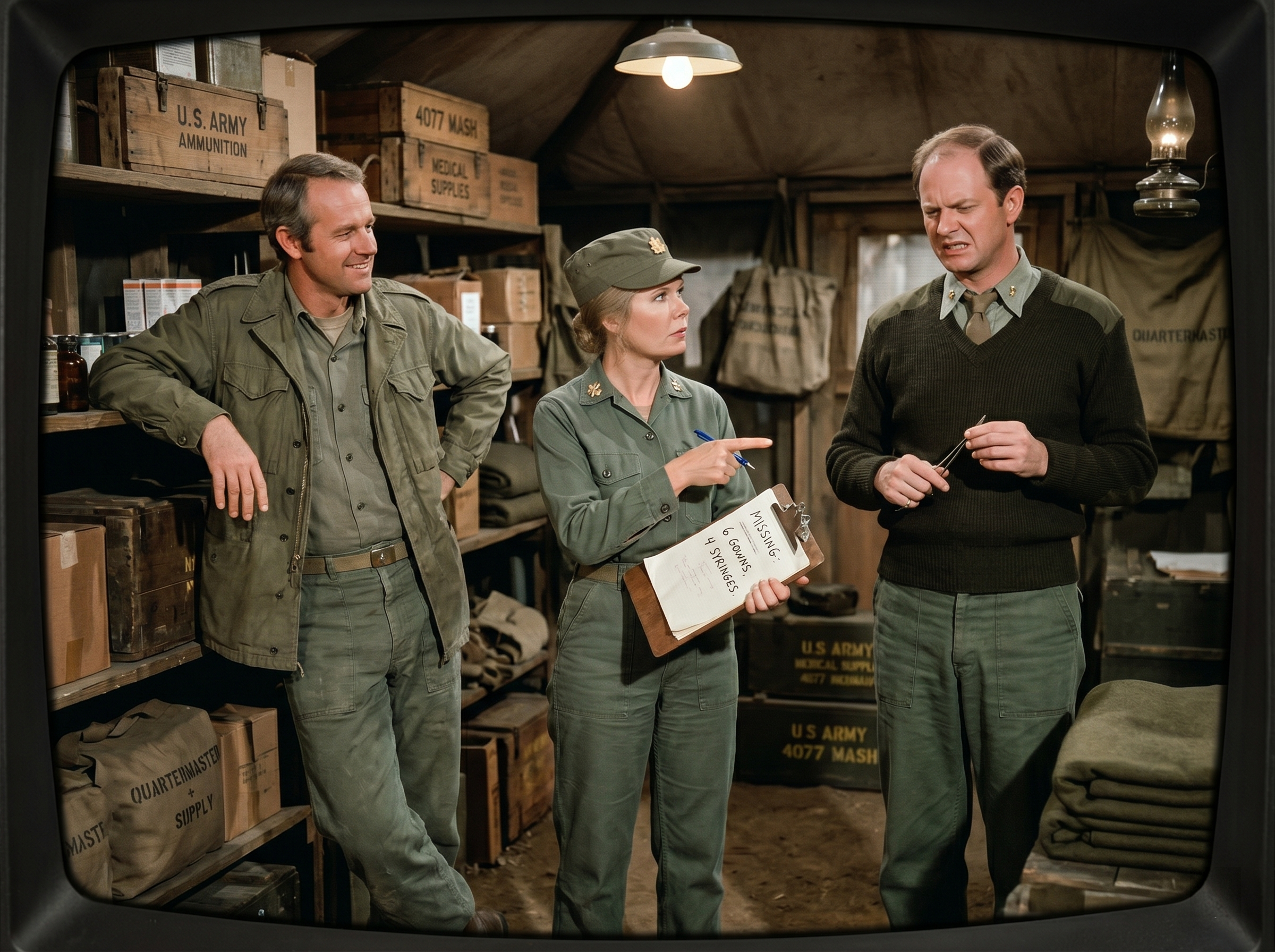
The air in the 4077th supply tent was always heavy, a thick cocktail of canvas, dust, and the sharp tang of antiseptic that clung to everything. It wasn’t just the smell that weighed it down; it was the persistent bureaucratic chaos.
They were missing gowns. Six of them, to be exact. And four syringes. In the grand tapestry of the Korean War, this was a thread so small it shouldn’t matter, but in Major Margaret Houlihan’s carefully constructed world of military efficiency, it was an insufferable frayed edge.
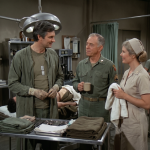
“I cannot, and I will not, sign off on a deficit, Major Winchester. The numbers must tally.” Margaret’s voice was crisp, cutting through the usual morning tent sounds like a scalpel. She held the clipboard like a shield, her index finger resting on the damning evidence.
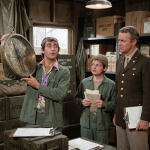
Captain B.J. Hunnicutt, leaning against a shelf packed with medical supply crates, watched the unfolding drama with a quiet, observant smile. He was dressed in his fatigues, arms folded, the typical easygoing aura about him, providing a passive counterpart to the high-ranking tension.
Major Charles Emerson Winchester III, cornered, recoiled slightly. He was holding a pair of surgical scissors, fiddling with them, the delicate silver tools looking out of place in his irritated grasp. His refined features were twisted in a grimace of dry superiority and controlled irritation.
“My dear Margaret, ‘tallies’ are for green grocers and those lacking any true surgical purpose. I deal in results.” His sarcastic baritone was dripping with disdain.
Margaret didn’t even blink. “You were the last person to request this specific supply list, Charles. And now they are gone. Absent. AWOL. Do I make myself clear?”
B.J. shifted his weight, still smiling, finding amusement in how easily they fell into this practiced dance. “Maybe the syringes ran off with the missing gowns and started their own, very sterile, little family,” he offered, his dry humor a subtle balm.
Margaret ignored him. “You are the officer responsible. The signature is on this manifest. And since the items are not here, I can only assume gross negligence, or perhaps… deliberate misplacement.”
Charles stopped the scissors in his hands. The implication hung heavy in the warm, stagnant air. His expression was a perfect portrait of offended disbelief.
“Deliberate misplacement?” He echoed, his voice dropping a full octave in dangerous, refined offence. “Are you accusing me, Major Houlihan, of having… appropriated the gowns? And the syringes? For what possible end, might I inquire? To make a slightly more absorbent smoking jacket?”
The silence that followed was dense, the soft background hum of camp life intensifying the quiet in the supply tent, pushing the minor comedic conflict into a genuinely awkward, emotional moment. B.J.’s smile faded slightly as he realized this was getting personal.
The silence stretched, thicker than the medical gauze stacked beside B.J.’s head. Charles stared at Margaret with wounded elegance, a man utterly insulted but maintaining his rigid posture. Margaret, her professional resolve as impenetrable as steel, refused to back down, her gaze locked onto him. B.J. watched them both, the easy smile from Part 1 completely gone, replaced by a expression of genuine concern.
“Well?” Charles demanded, the single word echoing in the tent.
“No, Charles,” Margaret said, her voice softening just a fraction, though her grip on the clipboard remained tight. “I am not accusing you of theft. I am accusing you of being… human.”
Winchester’s eyes narrowed. “I beg your pardon?”
“This place,” she said, gesturing vaguely at the chaotic camp beyond the canvas wall. “It wears on all of us. Even you. We get tired. We forget a signature. We put a gown in a different stack. The pressure to be perfect in the O.R. means something else slips in the supply chain.”
B.J. finally uncrossed his arms. He stepped away from the shelf, his presence a stabilizing weight between them. “Exactly. And if we lose the paper trail, we lose the supplies, and if we lose the supplies…”
“We lose patients,” Charles finished, his voice unusually quiet, the arrogance temporarily suppressed by a profound, human truth. He lowered his hand holding the scissors, the anger draining from him.
“And my paperwork is my patients,” Margaret stated simply. “I can’t let it slip. None of us can.”
The tension evaporated, leaving only a shared exhaustion and understanding. They weren’t arguing over gowns and syringes; they were fighting to maintain a semblance of order in an world built for chaos. They were clinging to bureaucratic rules because it gave them a sense of control over a situation that was entirely out of their hands.
B.J. looked between the two, seeing the fatigue etched beneath the authority of Margaret and the superiority of Winchester. Found-family dynamics at the 4077th were complicated and messy, but they were real.
“Well,” B.J. said, clapping his hands together with false energy. “Since we’ve established that none of us are infallible, let’s solve the great caper of the missing gowns and syringes, shall we?”
Charles let out a long, dramatic sigh. “Oh, very well. I suppose a modicum of assistance is necessary to pacify the bureaucracy. What is the manifest number?”
“A-407-7,” Margaret replied, handing him the clipboard, her professional mask sliding back into place, but there was a quiet tenderness beneath her firm instructions.
B.J. pointed towards a stack of supply bags. “You know, I did see Radar struggling with a very large bundle of laundry yesterday. Maybe he mislabeled a bag.”
They moved towards the supplies, their movements synchronized and efficient. The moment of conflict was over, but the resonance of it—the shared burden of their work, the need to support each other even while clashing, the quiet understanding of how close they all were to breaking—remained. They were found family, enduring a conflict they didn’t understand, through humor, bureaucracy, and unwavering loyalty.
Later, as they worked through the supplies, finding the missing items misfiled under surgical masks, B.J. looked at his colleagues—the rigid, capable nurse and the eccentric, brilliant surgeon. He knew that for all their quirks, and for all their clashes, they would always be there, holding the fraying ends of the world together, gown by gown and syringe by syringe.
They may argue over accountability, but when the chopper sounds, the only thing that matters is that they are all there, side-by-side, holding on for another day.