The Last Toast at Rosie’s: A Story of Found Family
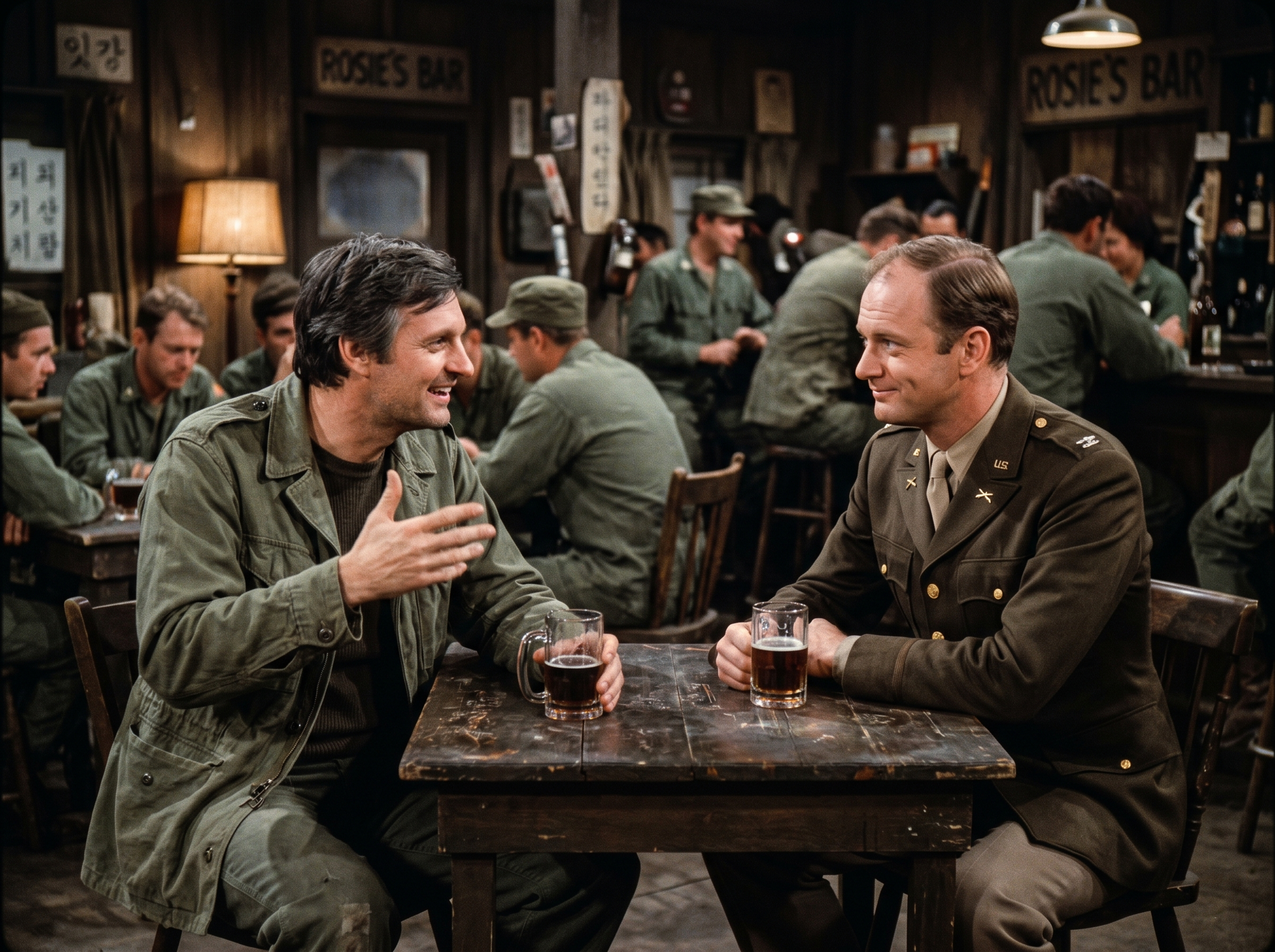
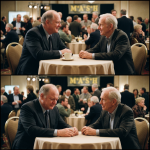
The wooden door creaked open, admitting a gust of cool, dusty wind and the two surgeons. It was just a Tuesday, but in this corner of Korea, that meant they’d just completed a thirty-six-hour rotation without sleep, holding life in their hands, feeling it slip away as often as it stayed. Rosie’s Bar wasn’t much—just plywood, hanging single-bulb lights, and a floor of stamped dirt. But tonight, it felt like the only sanctuary left on earth.
Hawkeye Pierce, in his rumpled green fatigues, and B.J. Hunnicutt, looking impossibly neat in his Class A uniform, found their usual small, scarred table near the center. For a moment, the silence between them was heavy, the residual ghosts of the O.R. echoing in the space where jokes usually landed. It was the longest rotation they’d had in weeks. It wasn’t just the sheer number of wounded; it was the proximity to the front, the visual reality of the line drawn on the map.
They hadn’t spoken. The weight of the fatigue, the shared loss of one young patient, pressed down. Hawk needed to deflect, to use the wit that usually protected him, but the reservoir was dry. He just looked at Beej, at the crisp lapels of that uniform that didn’t belong here, and felt a profound, almost desperate gratitude. This man, from California, a place where oceans were crossed for holidays, not wars, understood. He knew that the joke was just the valve releasing the pressure.
B.J. caught the look. He knew Hawk was close to breaking. He reached for his glass, a simple, warm-colored amber, and gestured with his head toward the bar. Rosie, as efficient as she was formidable, slid two freshly pulled beers onto the table. The glasses sweated. The condensation mirrored the silent tension. Hawk picked up his glass, not quite looking at B.J., and cleared his throat. It was the only sound besides the distant rumble of artillery, a low, constant vibration that they had learned to tune out, except when it stopped.
The gesture was simple. Hawkeye lifted his glass, and in that small arc, all the unspoken things from the last day and a half hung suspended. The loss. The frustration. The absurdity of it all. He didn’t want to make a grand speech. He wanted to acknowledge the shared burden, the understanding that only another surgeon, another friend, could truly have.
“To not being them,” Hawkeye finally said, his voice quiet. He didn’t need to clarify who ‘them’ was—the ones on the tables, the ones they couldn’t save. The ones whose names they would never know, whose letters home would never be delivered.
B.J. met his gaze. He understood. It wasn’t about surviving, not really. It was about finding the strength to keep going, to find humor when there should be none, and to offer comfort when there was none left to give. He clinked his glass gently against Hawk’s. “To found family,” Beej replied, his voice a little thicker. “Even if they drive you crazy.”
A slow, tired smile spread across Hawkeye’s face. The tension broke. He leaned forward, gesturing with one hand as he launched into a story, a typical Hawkeye rant, perhaps about Frank’s latest attempt at authority or the impossibility of getting a decent martini. But the edge was gone, replaced by a deep, quiet warmth.
Behind them, other soldiers, anonymous but all connected by the shared experience, drank and talked. Rosie’s Bar buzzed with the sound of life persisting. It was just a Tuesday in Korea. But here, in this small, dusty room, two friends shared a moment that would sustain them, that would remind them of what was good in the world, even amidst the chaos. The noise of the war was still out there, but for a moment, it was just the clink of glasses and the sound of friendship.
In the end, it was always the small, quiet moments that mattered most, the unexpected warmth in the coldest of places.