A Letter From Maine
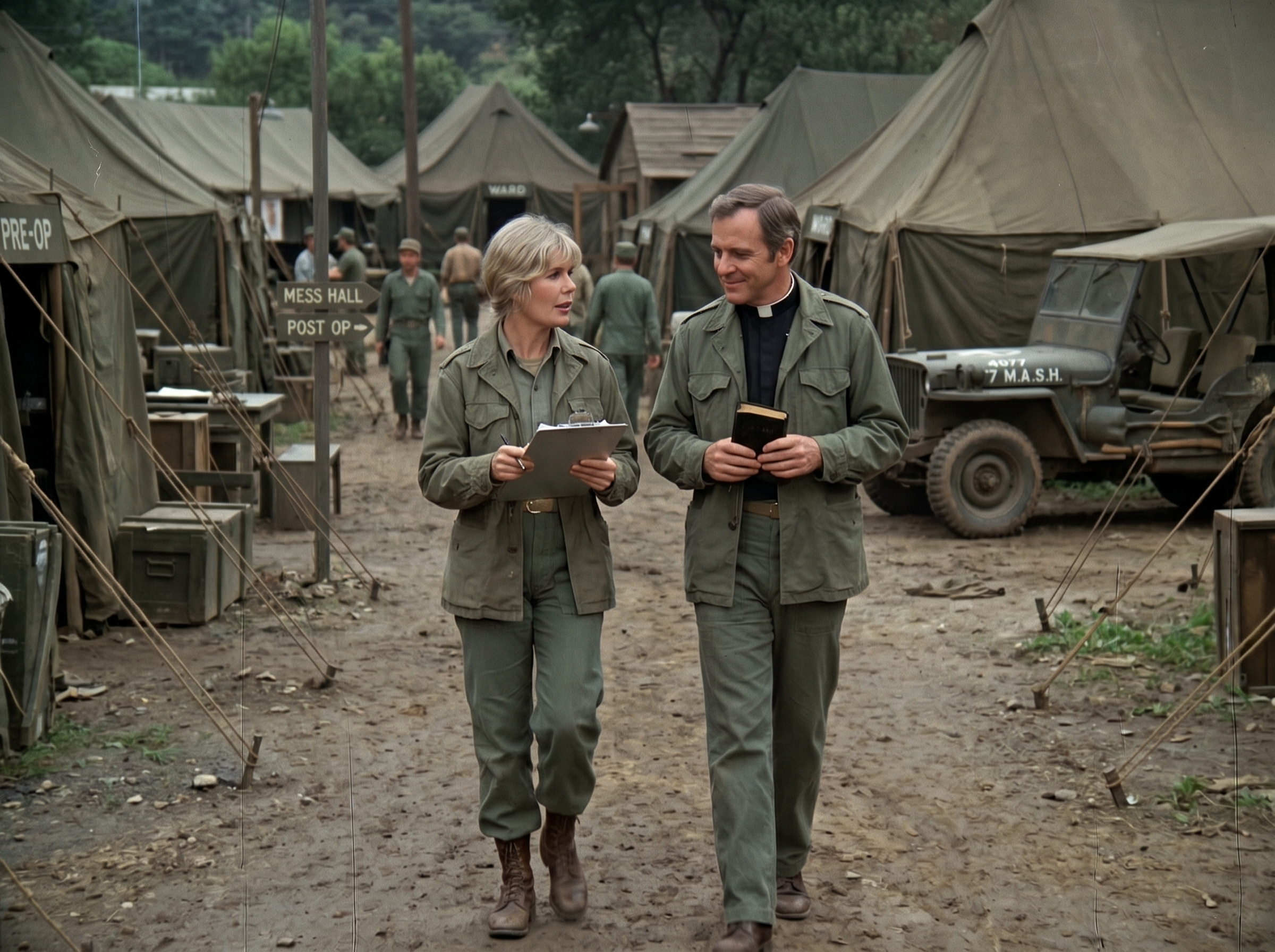
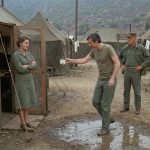
The mud of Korea was a familiar opponent, clinging to boots and tires with equal stubbornness.
This afternoon, however, it seemed a little quieter than usual.
A brief reprieve after a long, endless night of O.R., where the only sounds were the rattle of metal instruments and tired sighs.
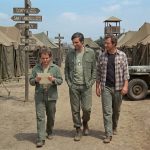
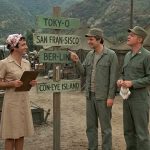
Major Margaret Houlihan, looking precise despite the dust, and Father Mulcahy, with his gentle presence and worn Bible, were making their way down the main compound path.
They had fallen into step naturally, moving towards the mess hall, though probably without much appetite.
The sign pointing towards ‘MESS HALL’ and ‘POST OP’ marked the intersection of their daily struggle.
In his hand, Mulcahy held his small black book, a comfort and a weight he carried with him everywhere.
Margaret clutched a clipboard, her expression unusually soft.
For months, she had been trying to navigate the complex military bureaucracy to locate the family of a young soldier she had bonded with in pre-op.
His name was Jimmy, a farm boy from Iowa who had held her hand with an iron grip before fading under the ether.
He had talked only of his grandmother’s rhubarb pie and how much he missed his brother.
Then, he was gone. And nobody seemed to know where his family was.
Margaret hadn’t let it go. It became a personal mission, a silent battle for respect.
She had badgered superiors, sent cables, and tracked leads through the sheer force of her professional will.
And this morning, she had received the answer.
She had finally found Jimmy’s grandmother, living in a small town in Maine, not Iowa, where his original paperwork had sent her in circles.
Her fingers were now tracing the pen on her clipboard, not for regulations, but for the address of a grieving woman who deserved to know.
She looked at Mulcahy, her blue eyes bright with a mix of relief and profound exhaustion.
“Father,” she began, her voice a little uneven.
The tension of her long, secret project was about to spill over.
Mulcahy looked up from his Bible, his usual quiet smile ready, but he stopped when he saw her face.
It wasn’t the look of frustration he was used to seeing; it was the look of someone carrying a great, silent triumph.
“Major?” he said, his voice lowering with concern.
Margaret stopped, her boots leaving a deep print in the Korean soil.
“Jimmy’s grandmother,” she said, her voice catching.
“I found her, Father. The grandmother.”
The information finally broke free from the bureaucracy and the worry.
Mulcahy stared at her, his smile widening with genuine warmth.
“You found her? In Maine, was it?”
Margaret nodded, tears starting to form in her eyes.
“It took five months, four lost letters, and more than one lecture on proper chain of command, but I found her.”
She didn’t know why it was hitting her so hard right now.
Maybe it was the simple, everyday sight of Mulcahy, a reminder of the quiet moral courage they all needed.
Maybe it was just the fact that she was finally finished.
Mulcahy placed a hand gently on her shoulder.
“Major, you should write that letter. It will mean more than any official notification.”
He didn’t need to ask for details. He knew the importance of closure in a place built on open-ended pain.
Margaret looked at him, her usual composure fractured by this simple, human connection.
The camp was busy around them—soldiers passing, the dusty jeep waiting, the tents providing temporary shelter.
But in this moment, they were just two people honoring the life of one lost boy.
Mulcahy smiled and gently touched her clipboard.
“And you did it, Major. A very tough battle.”
Margaret managed a weak laugh, wiping a tear from her cheek.
“Yes, I did.”
The tension evaporated, replaced by a deep sense of peace.
It wasn’t a military victory. There would be no medals.
But for Jimmy, and his grandmother, and for the tireless heart of the 4077th, it was a victory nonetheless.
And sometimes, in a place like this, the smallest victories were the ones that truly mattered.
They continued their walk toward the mess hall, the mud still deep, but the path a little less lonely.
Because sometimes, the greatest acts of mercy aren’t performed in the operating room.