The Quiet Battle for Corporal Reynolds
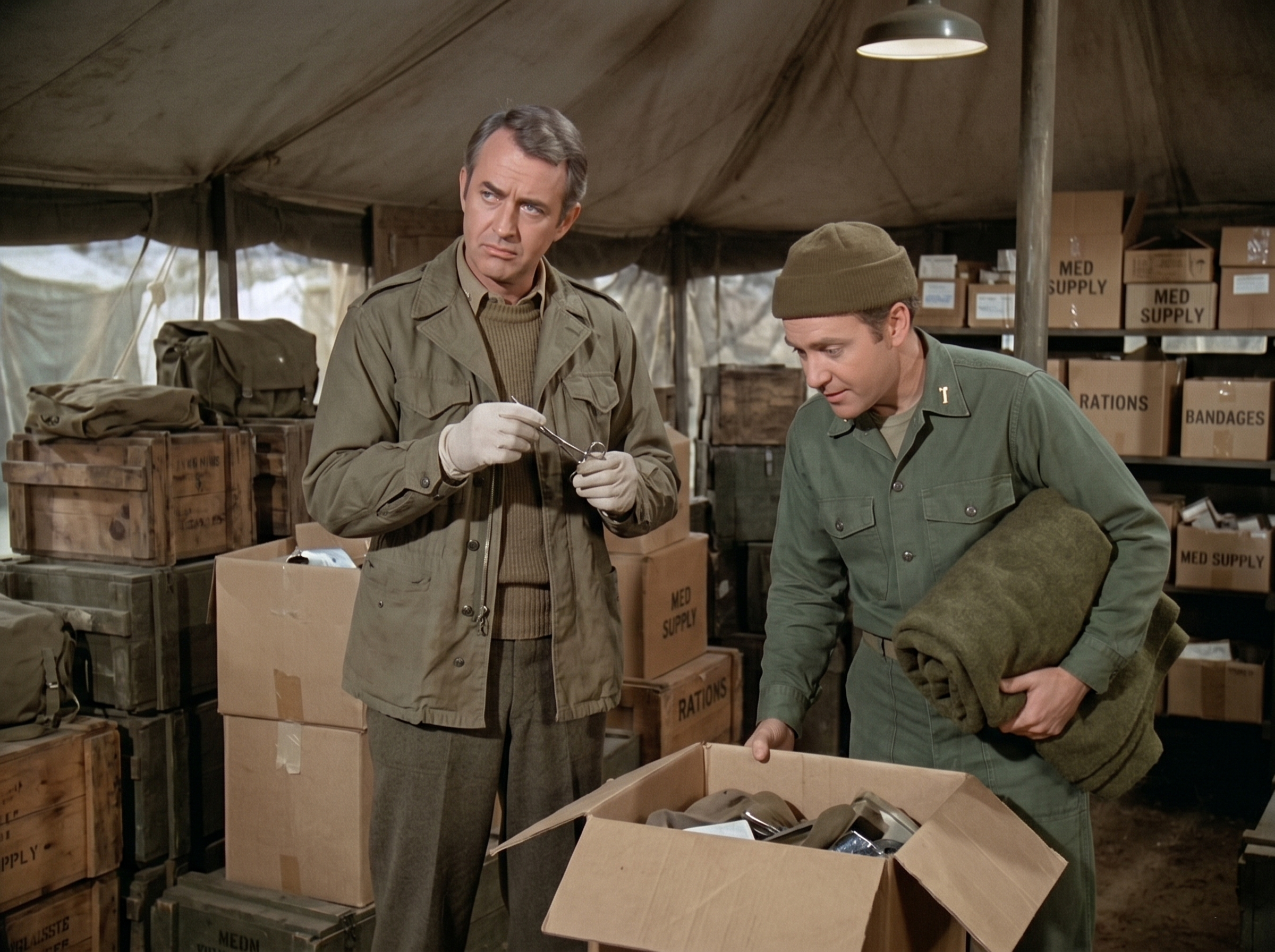
It wasn’t a triage day. Those were the loud days, the bloody days, the days when time ran on adrenaline and despair.
Today was a quiet day. A “rest and resupply” day, which in the 4077th M*A*S*H meant the fatigue was just a different kind of ache, settled deep in your bones.
Father Mulcahy, in his usual knit cap and fatigues, felt it as he stepped into the dim, canvas-walled supply tent. The air in there always smelled like stale canvas, insect repellent, and hopes deferred.
He wasn’t alone. Colonel Potter was already there, still wearing his ribbed sweater under his field jacket against the relentless Korean chill. The old cavalryman was meticulously arranging a set of surgical forceps with gloved hands.
Potter’s face, captured perfectly in z10_clean.jpg, held that characteristic dry, steady gaze—a blend of exhaustion, skepticism, and the stubborn resolve of a man who’d seen too much but refused to look away.
He didn’t need to ask why the priest was there. Their reasons for visiting the supply tent often ran in parallel lines.
“Checking the inventory for the next push, Colonel?” Mulcahy asked softly, his voice barely rising above the rustle of cardboard.
“More like searching for a needle in a haystack of band-aids and rations,” Potter replied, gesturing with the instrument towards the stacked crates.
Mulcahy just nodded. He carried a single, rolled wool blanket under his arm. He hadn’t yet put it into the open cardboard box resting on the floor.
That box, central to the scene in z10_clean.jpg, held the personal belongings of those who would no longer need them. It was a quiet repository of loss, a duty shared by both men.
Today, the box contained the effects of a young private, a farm boy from Iowa who’d talked with Hawkeye about prize-winning hogs while Hawkeye worked to keep him alive.
The pig conversation had ended mid-sentence, the boy’s last thought a world away from this canvas outpost.
Mulcahy looked down at his rolled blanket. Then he looked at the box, hesitating.
“Colonel,” he began, his voice barely a whisper. “The newest patient, Corporal Reynolds. He’s…”
“I know, Father,” Potter interrupted, not looking up from the forceps. “The shrapnel… we got most of it, but there’s the infection now. Winchester and Hunnicutt are doing everything they can.”
A heavy silence stretched between them, thick as the dust in the air.
“It’s his fourth night without sleep,” Mulcahy continued, his fingers gripping the wool blanket more tightly. “He’s cold, but the nurses can’t spare any more blankets. If he doesn’t sleep, Colonel…”
His unspoken fear—the realization that sleep was often the last line of defense—hung over them. And the 4077th was officially out of extra blankets.
Potter paused. His gloved hand, holding the delicate instrument, seemed frozen for a heartbeat. His eyes, fixed on the metal, softened with a flicker of understanding.
The old soldier knew that in this place, sometimes the smallest, most ordinary comfort was worth more than any medal or surgical miracle.
For that brief moment, the stacked boxes of “MED SUPPLY” and “RATIONS” around them in z10_clean.jpg felt like monuments to things that couldn’t save a life on their own.
Potter exhaled, a long, tired breath. He set the forceps down onto the wooden crate, the metal making a tiny, decisive *clink*.
He looked over at Mulcahy, the two men’s gazes locking in a silent, profound understanding.
Slowly, carefully, Potter reached for his *own* wrist.
Mulcahy watched as the Colonel undid the single buckle and pulled off one of his worn leather work gloves.
Then he pulled off the other.
He placed the pair of gloves inside the cuff of his jacket, revealing the hands that had been a surgeon for decades.
With bare, calloused hands, Potter picked up a small, empty ration box and meticulously placed his metal forceps inside it, sliding it deep onto a shelf marked “MED SUPPLY,” out of the line of fire of casual inventory counts.
He turned back to the Father, his face regaining its usual stoic expression.
“I seem to have made a slight clerical error in the supply manifest,” Potter said, his voice unusually low. “It appears I miscounted our reserve blanket allocation.”
Mulcahy looked up, his eyes widening with surprise. The Colonel, stickler for regulations, rarely countenanced supply deviations, especially when it came to medical logistics.
Potter pointed a firm finger at the open box on the floor. “That box, Father… it seems to be *overflowing* with non-essential items. Like, say, an *extra* blanket that somehow materialized from thin air.”
The understanding dawning on Mulcahy’s face was beautiful to see. The tension in his shoulders seemed to evaporate, replaced by a quiet, hopeful radiance.
“The rules are the rules, Colonel,” Mulcahy said, a playful spark returning to his gentle eyes. “We must *strictly* adhere to them. If the manifest *says* there’s an extra blanket…”
Potter nodded once, a brief, conspiratorial movement. “Precisely. Now, if you’ll excuse me, I believe I have some pressing paperwork to misinterpret.”
He turned on his heel and walked towards the tent flap. He paused there, just for a second.
“It’s okay, Father. Make it look like you’re following orders.”
He was gone before Mulcahy could find the right words of gratitude.
For a moment, Mulcahy stood alone in the dim light. He looked at the empty spot where Potter’s gloves had been and then down at the worn wool blanket in his own arms.
It was no longer just a scrap of fabric, a logistical problem, or even a rule broken. It was warmth, it was comfort, it was a silent promise of sleep for a frightened boy. It was hope.
Slowly, almost reverently, Father Mulcahy added the rolled blanket to the contents of the cardboard box.
The box in z10_clean.jpg seemed just a little fuller now, its contents no longer just a catalog of loss, but a quiet testament to shared humanity.
Later that night, as the cold deepened, Mulcahy visited the recovering unit. He didn’t just tuck the extra blanket around the sleeping form of Corporal Reynolds.
He also left an extra rosary, wrapped in a small piece of ration-box cardboard, knowing that some battles were fought in the quietest ways of all.
They weren’t an official unit. They were just people, caught in a bad dream, holding onto each other for as long as they could.
Sometimes the best medicine is a little compassion, a warm blanket, and a slight clerical error in the face of despair.