A Quiet Corner at Rosie’s
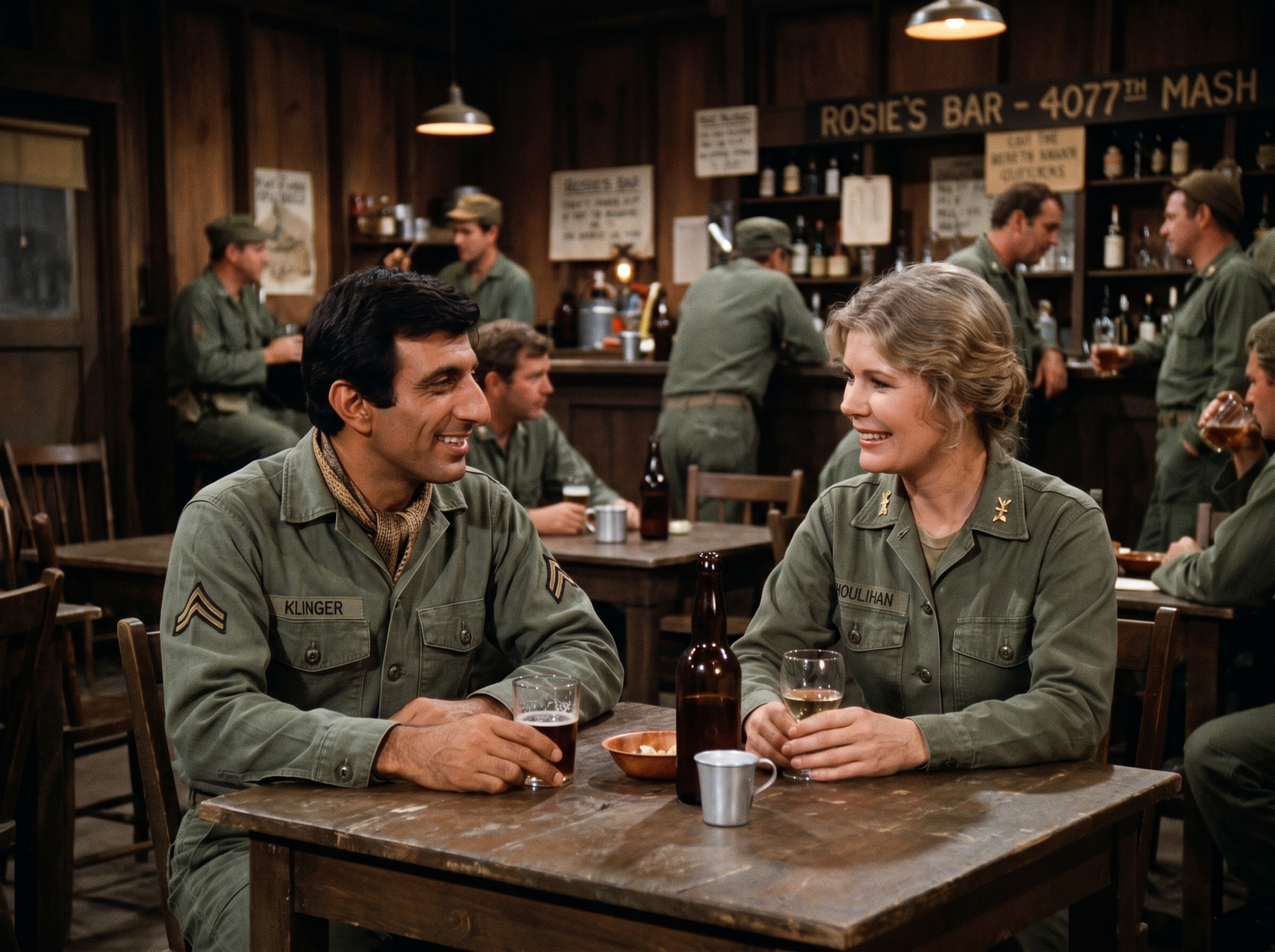
The smell of stale beer, cheap cigars, and damp wool was the closest thing to luxury you could find in Rosie’s Bar.
It wasn’t much of a sanctuary. The wooden counter was scarred with the initials of a hundred different soldiers who had passed through the 4077th. The walls were thin, and the tables were little more than wobbly crates hammered together.
But under the dim, amber glow of the hanging lamps, it was a million miles away from the operating room.
The unit had just survived an eighteen-hour meatgrinder. The kind of shift that left your hands shaking, your ears ringing with the sound of incoming choppers, and your soul feeling like it had been run through a wringer.
Major Margaret Houlihan sat at a small corner table, staring blankly at the chipped rim of her glass.
Usually, Margaret held herself with a rigid, military perfection. Even in the mud of South Korea, she was the picture of authority. But tonight, the starch was gone from her spine.
Her shoulders slumped forward. Her eyes, usually sharp and commanding, were soft and unfocused. She was exhausted down to her bones.
She didn’t even flinch when the chair across from her scraped against the dirt floor.
Maxwell Klinger sat down.
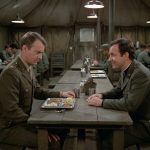
He didn’t say a word at first. He just rested his elbows on the rough wood, nursing a warm beer of his own.
Tonight, there was no theatrical entrance. There was no feather boa, no chiffon gown, no loud complaints about section eight discharges. He just looked like a tired kid from Toledo who had seen too much.
But as he watched Margaret, a familiar, street-smart spark began to dance in his eyes. A sly, gentle hope.
Margaret finally looked up. She expected a joke. She expected a hustle. She expected to have to put her major’s mask back on and bark an order.
Instead, she saw a profound, quiet understanding in Klinger’s expressive face.
“Rough one, Major?” he asked quietly, his voice lacking its usual boisterous pitch.
“They’re all rough, Klinger,” Margaret sighed, too weary to pull rank. She traced the edge of her cup. “But today… today felt longer than the rest.”
Klinger nodded slowly. He glanced around the empty, shadowy room, then leaned in close, as if checking for listening posts.
“You know, Major,” he whispered, a mischievous smile playing at the corners of his mouth. “In times of great despair, a man from Toledo learns to rely on his connections.”
Margaret offered a tired, half-hearted scoff. “I don’t have the energy to confiscate contraband tonight, Max. Whatever it is, just keep it hidden.”
“Oh, this isn’t contraband,” Klinger said, his eyes gleaming in the warm, dim light. “This is medicine.”
Slowly, carefully, Klinger reached into the deep pocket of his olive-drab jacket.
Margaret watched his hand. Despite her exhaustion, she felt a sudden, strange tightening in her chest. She had seen Klinger pull a lot of things out of his pockets—phony letters from his mother, half-eaten salami, ridiculous costume jewelry.
But the way he was moving now was different. It was careful. It was reverent.
He placed his closed fist on the table between them.
“Close your eyes, Major,” he said softly.
Margaret hesitated, her professional instinct warring with a sudden, overwhelming wave of vulnerability.
“Klinger, I swear, if this is one of your exploding cigars…” Margaret started, her voice wavering just a little.
“Major, please,” Klinger said, pressing a hand to his heart. “You wound me. Do I look like the kind of guy who would kick a commanding officer when she’s down?”
Margaret let out a short, breathy chuckle. It was a real, unguarded sound. She closed her eyes.
She heard the soft clink of something metallic touching the wooden table.
“Alright,” Klinger whispered. “Open ’em.”
Margaret opened her eyes. Sitting on the worn wood, catching the amber light of Rosie’s lamps, was a small, pristine, gold-plated tin.
She stared at it, confused. “What is…”
“Go ahead,” Klinger urged, nodding toward the tin.
Margaret reached out. Her fingers were still slightly stained with iodine, her nails cut brutally short. She popped the lid off the small tin.
Instantly, the heavy, stale air of Rosie’s Bar was cut by a sharp, beautiful fragrance.
It was lavender. Real, pure, French lavender soap. Not the harsh, skin-stripping lye they used in the showers. Not the medicinal scrub from the OR. It smelled like a sunny afternoon in a garden miles away from any war.
Margaret inhaled sharply, her eyes widening. The sudden, overwhelming beauty of the scent hit her like a physical blow.
“Klinger…” she breathed, entirely stripped of her rank and armor. “Where on earth did you get this?”
“A gentleman never reveals his sources,” Klinger said, leaning back with a look of immense, satisfied pride. “Let’s just say a certain French liaison officer has a weakness for genuine Toledo Mud Hens baseball caps.”
Margaret looked from the delicate soap to Klinger’s face. The sly hope in his eyes had melted into a warm, genuine smile. He wasn’t trying to scheme his way out of the army right now. He was just trying to take care of her.
“I can’t take this, Max,” she said softly, though her fingers closed protectively around the little tin. “This must have cost you a fortune in trade.”
“Major, look at me,” Klinger said. He gestured to his mud-spattered boots and his worn green fatigues. “What am I gonna do with French lavender soap? If I start smelling too good, Colonel Potter might think I’ve gone sane.”
Margaret laughed. It wasn’t a polite giggle; it was a deep, chest-shaking laugh that brought a sudden sting of tears to her eyes.
She quickly wiped her eye with the back of her hand, suddenly embarrassed by her own emotion. But Klinger gracefully looked away, pretending to be very interested in the bottom of his beer glass, giving her the moment she needed.
“Thank you,” Margaret said, her voice thick with unshed tears. “It’s… it’s the nicest thing anyone has done for me in months.”
“You earned it, Margaret,” Klinger said quietly, using her first name with a gentle, startling respect. “You held us all together in there today. Even Hawk and B.J. were running out of steam. But you didn’t.”
Margaret looked down at the soap. The truth was, she had been running on fumes for hours. She had felt like she was going to shatter into a million pieces.
But sitting here in this dingy bar, across from a man who wore dresses to get out of the army but stayed to save lives, she felt a profound, anchoring warmth.
They weren’t just soldiers. They weren’t just doctors and nurses and clerks. They were a family. A strange, battered, exhausted family, huddled together against the cold and the dark.
Margaret slipped the gold tin into her pocket, keeping her hand wrapped around it. The scent of lavender lingered in the space between them, a tiny rebellion against the smell of the war.
She picked up her cup, holding it up in a silent toast.
Klinger smiled, that sly, street-smart charm returning to his eyes. He tapped his glass against hers.
“To Toledo,” Margaret whispered.
“To Paris,” Klinger replied softly.
They sat together in the dim, amber light of Rosie’s, two weary souls sharing a quiet corner of the world, letting the heavy silence heal them before the choppers came again.
In a place where tomorrow is never promised, the greatest comfort is finding someone willing to carry the weight of today with you.