A Taste of Home in the Dust
The dust of Korea never really settled.
It just waited, a fine, invasive film on every surface, inside every tent.
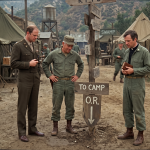
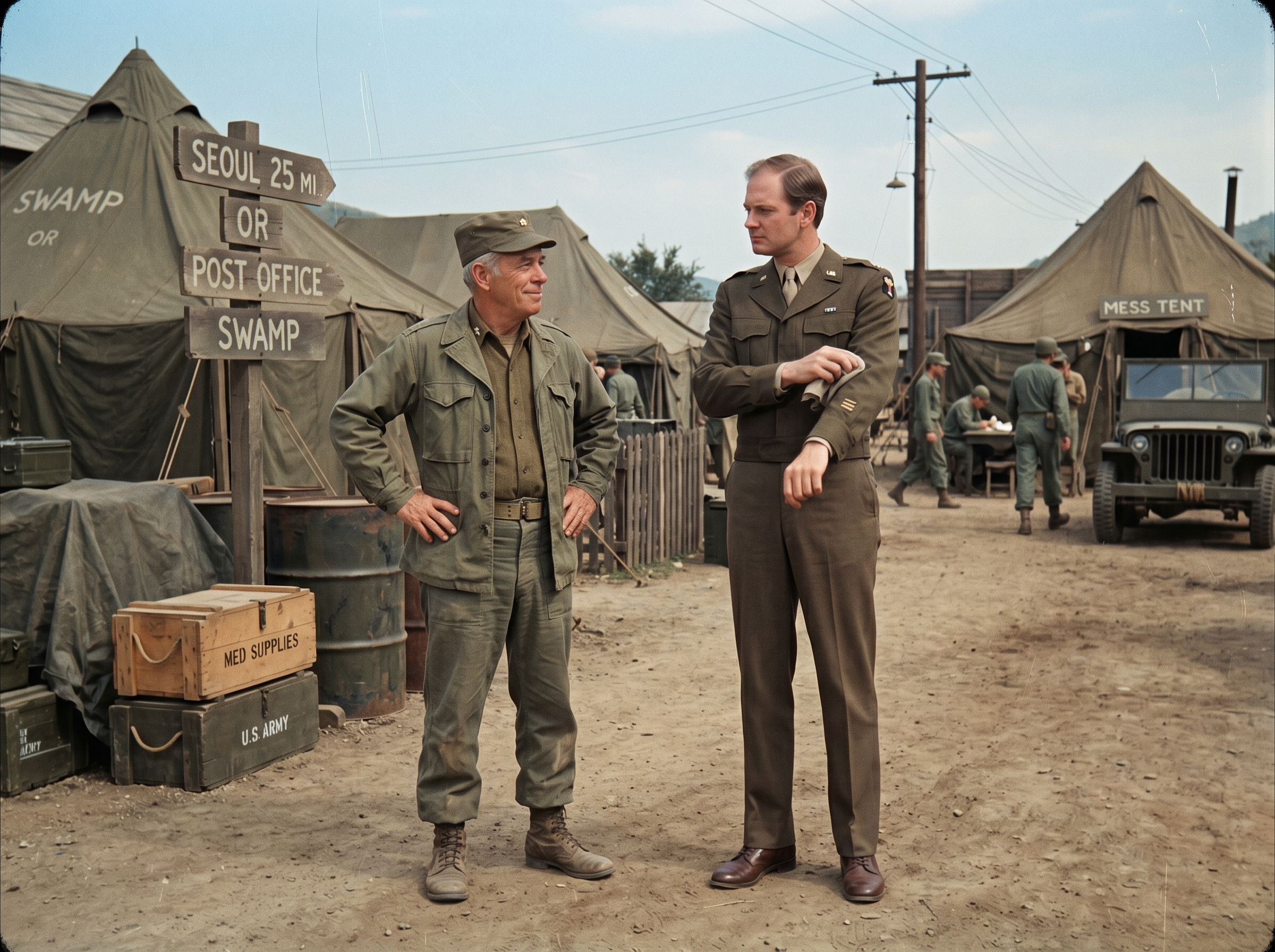
Colonel Sherman Potter and Major Charles Emerson Winchester III stood in the center of the compound, two pillars of contrast against the backdrop of olive-drab canvas and dirt.
n4_clean.jpg captures a rare moment of stillness, though the air was rarely truly quiet here.
Colonel Potter stood with his hands on his hips, his familiar stance of authority mixed with a weary resignation.
His worn fatigues spoke of years of service, and his expression, while steady, held the weight of the war in his eyes.
He had seen things no man should have to see, things that added lines to his face and silver to his hair.
Next to him, Charles was a study in buttoned-up formality.
Even in the middle of a war zone, he managed to maintain an air of immaculate precision.
His officer’s uniform was crisp, his posture rigid.
He was meticulously dusting his sleeve with a silk handkerchief, as if the war could be simply wiped away.
“You know, Charles,” Potter began, his voice a comforting growl, “sometimes I think this dirt has its own postal code. It always seems to find its way back.”
Charles glanced up, a look of mild distaste on his face.
“Indeed, Colonel. It’s a relentless assailant. Back home, dust is something one delegates to the household staff. Here, it’s a constant companion.”
Potter chuckled softly. “Keeps us humble, I suppose. Reminds us where we are.”
Behind them, the camp was humming with its own chaotic life.
Soldiers moved between tents, jeeps parked nearby, and the ever-present signpost pointed stubbornly towards Seoul, or the post office, or simply to ‘Swamp’ – a tongue-in-cheek direction that everyone understood.
The Mess Tent, a sanctuary for weary souls (and occasionally, passable coffee), loomed in the distance.
“Speaking of reminders,” Charles said, slipping his handkerchief back into his pocket, “I received another care package from my dear sister, Honoria.”
Potter’s ears perked up slightly. Packages from Honoria were legendary, often containing the finest delicacies Boston had to offer.
“Anything edible this time?”
“As a matter of fact,” Charles replied, a glint of genuine enthusiasm lighting up his eyes, “she sent a box of the most delectable chocolate truffles. From S.S. Pierce.”
The name itself conjured images of wood-paneled shops and refined tastes, so far removed from this dusty outpost.
Potter whistled low. “Truffles, you say? Now that’s something you don’t see every day in the 4077th. Or any day, for that matter.”
“I was planning on enjoying one this evening,” Charles continued, “perhaps with a drop of sherry I managed to procure.”
Just then, a commotion erupted near the swamp.
Loud shouting, followed by the undeniable sound of Klinger’s voice.
“I want a transfer! I want a Section 8! This isn’t a hospital, it’s a torture chamber!”
Klinger burst onto the scene, his usual flair for the dramatic fully on display. He was clutching a clipboard, a look of mock despair on his face.
“Colonel, you won’t believe what’s happened! Someone’s stolen my latest dress design!”
Potter sighed, rubbing his temples. “Klinger, what are you talking about? Who would steal your dress design?”
“I don’t know!” Klinger exclaimed, flailing his arms. “But it was a masterpiece! A strapless evening gown made entirely of mosquito netting!”
Charles looked as if he might faint. “Good Lord, man. The inhumanity.”
But the drama was just beginning. Klinger was holding a crumpled piece of paper, waving it frantically.
“This is a disgrace! A mockery! I demand justice!”
“Calm down, Klinger,” Potter said, his voice firm but patient. “What is that paper?”
Klinger unfurled it dramatically. It was a note, written in hasty handwriting.
“It says,” Klinger began, reading with theatrical flair, “‘Dear Maxwell, your talent for fashion is truly revolutionary. We would be honored if you would design the new uniforms for the North Korean Army.'”
There was a moment of stunned silence.
Even Charles was momentarily speechless.
“The North Korean Army?” Potter echoed, his eyes narrowing.
“And it’s signed,” Klinger continued, a dramatic pause for effect, “‘General Nam Il.'”
The silence deepened, the implications of the note sinking in.
Suddenly, the trivial drama of a stolen dress design had turned into something else entirely.
Could it be a prank? Or was it something more serious?
The eyes of everyone present were fixed on the crumpled paper, a sudden shadow falling over the dusty compound.
The image captured in n4_clean.jpg, with its quiet moment of shared camaraderie, felt like a distant memory as a new tension simmered in the air.
The war, it seemed, was always close, even in the smallest of ways.
Klinger’s dramatic revelation hung in the air like a heavy curtain. General Nam Il? The very idea was preposterous, yet in this war-torn land, strange things happened all the time. Colonel Potter looked at the crumpled note, his eyes thoughtful. Charles, momentarily distracted from his truffle fantasy, furrowed his brow, the implications of Klinger’s claim sparking a rare moment of concern for someone other than himself.
“General Nam Il,” Potter repeated, his voice quiet. “That’s a big name for a dress design.”
“I know!” Klinger exclaimed, his voice rising in pitch. “He must have seen my ‘Spring in Seoul’ collection! He appreciates my genius!”
“Klinger,” Potter said, fixing him with a steady gaze, “think about this logically. Why would a North Korean General care about your dress designs?”
“To demoralize our troops, of course!” Klinger replied, as if it were the most obvious thing in the world. “Imagine the embarrassment if our soldiers saw the enemy wearing *my* creations!”
The sheer absurdity of Klinger’s theory was almost enough to break the tension. Hawkeye, who had been lingering in the background, nursing a mug of coffee that could double as paint thinner, finally chimed in.
“Klinger, I’ve seen your designs. If the North Korean Army wore them, they wouldn’t be demoralized. They’d be fabulous. And completely visible.”
Potter stifled a grin. “Hawkeye has a point. Your fashion choices are… distinctive.”
” Distinctive? They’re high fashion!” Klinger protested. “This is a real offer! Look, it has his signature and everything!” He waved the paper again, nearly whacking Charles in the nose with it.
“May I see that, please?” Charles said, his voice clipped but containing a hidden layer of curiosity. He took the note from Klinger’s trembling hand and began to examine it closely.
Charles, for all his aristocratic airs, had a surprisingly keen mind for detail. He studied the handwriting, the paper, even the ink. A faint smirk began to tug at the corner of his mouth.
“Colonel,” Charles said, handing the paper back to Potter, “I believe I have solved this little mystery.”
Potter raised an eyebrow. “Is that so, Charles? Care to enlighten us?”
Charles cleared his throat, a small theatrical gesture. “Observe the handwriting. The capital ‘N’ in Nam Il. It has a peculiar flourish, don’t you think?”
Potter squinted at the note. “I suppose so. Looks like a bit of a curlicue.”
“Indeed,” Charles continued. “And the capital ‘G’ in General. It has a similar flourish. And the capital ‘K’ in Klinger, on the envelope I happened to notice… they all share this exact same stylistic choice.”
Potter’s eyes widened slightly as the pieces clicked into place. “A flourish, you say?”
Charles turned to Klinger, his gaze coolly triumphant. “Maxwell, your penmanship is consistent, I’ll give you that.”
Klinger’s jaw dropped. “My… penmanship?”
“You wrote this note yourself, didn’t you, Klinger?” Charles accused, though with a distinct undercurrent of amusement rather than anger.
Klinger’s eyes darted around, looking for an escape route that wasn’t there. He gulped. “I… I…”
“You staged the whole thing,” Potter said, understanding dawning. “The stolen design, the note from Nam Il… all an elaborate scheme for what? More sympathy?”
“No, Colonel! For a transfer!” Klinger confessed, his voice cracking. “I figured if I was being courted by the enemy, you’d *have* to send me home for my own protection!”
The compound was silent for a moment. Even Hawkeye looked slightly impressed by the audacity of the plan. Charles, surprisingly, didn’t look offended. If anything, he looked almost impressed, in a condescending sort of way.
“Well, Klinger,” Potter said, his voice a mix of frustration and weary affection, “you’ve certainly got imagination. But you’re staying right here. The North Korean Army can find their own fashion consultants.”
Klinger slumped against the signpost, deflated. “I should have known. You’re all in on it. All of you.”
Charles watched him with an unreadable expression. Then, he did something that surprised everyone, including himself. He reached into his pocket and pulled out a small, elegantly wrapped box.
“Here, Klinger,” Charles said, extending the box. “Perhaps these will provide some… comfort.”
Klinger took the box cautiously. He unwrapped it to reveal a small collection of dark chocolate truffles.
“Truffles?” Klinger asked, his eyes wide with wonder.
“S.S. Pierce, if you must know,” Charles sniffed, though a small smile played on his lips. “Honoria thought I might need a reminder of what civilized society looks like.”
A genuine, grateful smile bloomed on Klinger’s face. “Truffles… oh, Major Winchester, you are too kind! A true gentleman!” He clasped the box to his chest as if it were a priceless treasure.
Charles cleared his throat, his usual facade sliding back into place. “Don’t get any ideas, Klinger. It’s merely a gesture to ensure you don’t descend into complete barbarism while designing mosquito net evening gowns.”
Potter watched this exchange with a gentle smile. He’d seen a lot of things in this war, but these moments of unexpected connection, of friendship finding its way through the dust and the chaos, were what made it all bearable.
The afternoon wore on, and the dust continued to dance in the light. The memory of the North Korean ‘threat’ faded as Klinger shared his truffles with a few other unsuspecting soldiers (who were pleasantly surprised, if a bit confused), and Charles returned to meticulously dusting his sleeve, a small smile playing on his lips. Colonel Potter stood with his hands on his hips, watching his makeshift family navigate another day in this strange, unforgiving place, and felt a quiet warmth bloom in his chest. In the middle of a war, they had found a way to create their own small, wonderful, slightly chaotic kind of home. The scene in n4_clean.jpg, with its quiet moment of shared existence, felt deeper and more meaningful now, a testament to the resilient human spirit that thrived even here, in the heart of the 4077th.
In the end, it was the small kindnesses that kept the dust from settling on their souls.