Coloring the Canvas: An Afternoon in the 4077th
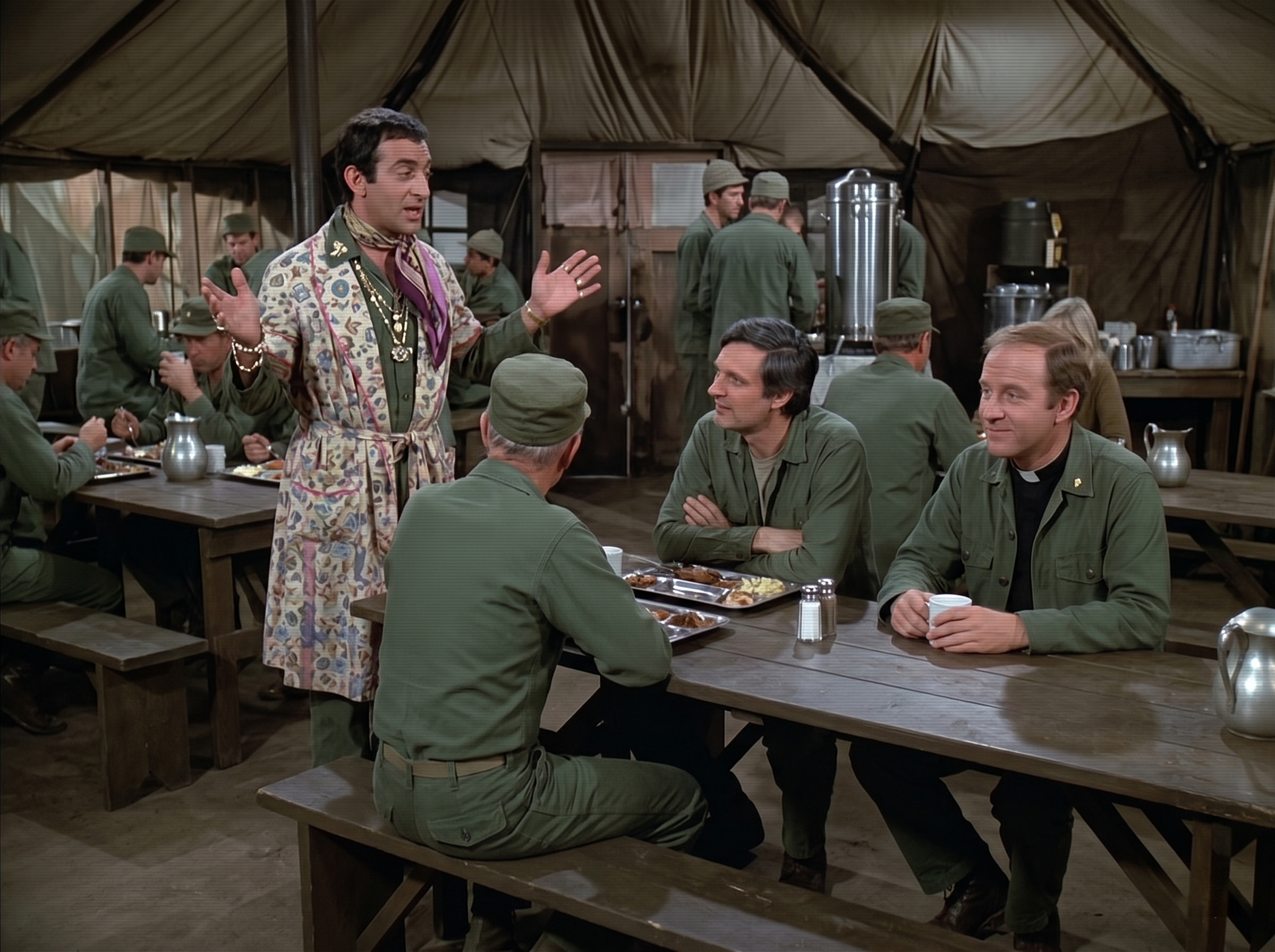
The mess tent was always a place of quiet negotiation, where the taste of gray meat was bartered against the value of human connection. The light filtering through the canvas had the bruised, late-afternoon quality of a shift too long and a war too persistent.
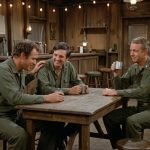
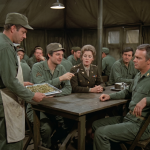
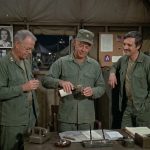
At a center table, Colonel Potter sat with his back to the bustling tent, his shoulders relaxed in the presence of his two doctors and the chaplain. He was a solid presence, a man who had seen too many wars to be surprised by anything, yet who was wise enough to still be curious.
Opposite him, Hawkeye Pierce sat, arms crossed, the usual dry humor that veiled his exhaustion replaced by a softer, more indulgent smirk. He had seen this production many times before, and the tired comfort he felt among his found family in the 4077th made the performance worth watching.
Next to him sat Father Mulcahy, the soul of patience, holding his small white cup and smiling with a gentle, supportive warmth that seemed to reflect the light, however dim.
Then, there was Max Klinger. He wasn’t just standing; he was performing.
The photograph, image_0.png, captures the precise second his latest attempt at a Section 8 discharge, or perhaps something new entirely, reached its dramatic zenith. Klinger wore a magnificent, swirling floral housecoat, a mosaic of muted purples and greens patterned like a lost wallpaper sample, draped over his regular fatigues. Around his neck, a gold chain caught the low light, a shimmering echo of the jewelry that jangled on his wrists. A patterned scarf completed the ensemble.
Klinger had his hands outstretched, palms open to the heavens and to the Colonel, in an ancient gesture of desperate pleading. His posture was a grand question mark, demanding attention. His expression was serious, insistent, and filled with a kind of dignified absurdity that was entirely his own.
“Colonel, I am not merely wearing this beautiful garment for style,” Klinger began, his voice surprisingly soft. “Though I will admit I am a breathtaking sight.”
Hawkeye rolled his eyes slightly, a smile breaking. “Klinger, we’re eating. Don’t make me lose the only five calories I’ve ingested today.”
“Patience, Captain Pierce,” Father Mulcahy whispered, his gentle smile encouraging. “I believe Max has a point to make.”
“Max always has a point,” Hawkeye muttered. “Usually located somewhere in the vicinity of Toledo, Ohio, and involving an imaginary sick grandmother.”
“No grandmothers this time, Sirs,” Klinger said, gesturing to himself and the assembled group, a note of sincere, unexpected humanity creeping into his voice. “I need permission. For an operation.”
Colonel Potter grunted, taking a slow sip of his coffee. “We’re out of beds, Klinger, unless you plan to operate on yourself. Which, given your history, isn’t entirely outside the realm of possibility.”
“Not medical, Sir,” Klinger said, his arms sweeping wider. “This is an operation of the soul.”
He was holding everyone’s attention now. He didn’t seem to be making a demand for freedom. He seemed to be offering something, and the visual absurdity of his floral robe combined with the quiet intensity in his eyes created a unique, captivating stillness at the center of the noisy tent. What was he proposing that required such a visual overture?
He paused, letting the silent anticipation stretch. The tired doctors, the patient chaplain, and the wise Colonel waited.
“What is it, Corporal?” Potter asked, his fatherly tone replacing the dry sarcasm.
Klinger looked at them all, and with a voice that seemed to speak not to them but to the entire fatigued camp, he said, “We have a new patient coming from surgery later, Colonel. Private Miller. He’s going to be in post-op for weeks. And all he will see, all he will feel, is olive drab and canvas.” Klinger’s arms came down slightly, his gesture softer, almost embracing. “He needs this. He needs to know that color exists, outside this place.”
(The story continues directly from Klinger’s statement, “He needs to know that color exists, outside this place.”)
The stillness deepened. The usual clatter of forks on metal trays across the mess tent seemed to fade into a gentle buzz. Klinger had done something remarkable; he had just transformed his signature Section 8 act of defiance into a profound, tender offer of mercy.
Colonel Potter’s face softened completely, the fatherly warmth that defined him showing clearly. He set his cup down slowly. “You aren’t asking for discharge paper, are you, Klinger?”
“No, Sir,” Klinger said, his expression holding a strange new dignity as he smoothed the fabric of his elaborate robe, his arms now resting by his sides but his body still leaning forward. “I am asking for permission to be a ‘Colorful Therapy Unit.’ Private Miller is young, Colonel. He’s sad. When they brought him in, he kept saying everything was… gray. The dirt, the canvas, the doctors.”
“And you think the Sight of Max Klinger in a floral housecoat is the cure?” Hawkeye said. The sarcasm was there, but the bite was gone. His usual weary wit was now defensive, a shield protecting his own fragile emotional space as he processed the sudden sincerity from the man everyone used as the butt of their jokes. His eyes, though smirking in image_0.png, were now reflecting a deep, knowing respect.
“Think about it, Captain Pierce,” Klinger said, his voice quiet. “In the wards, in the OR, everywhere… it’s all the same. We blend. This?” He gestured to the purple and green patterns. “This is a different language. When Private Miller opens his eyes tomorrow, I want the first thing he sees to be something that doesn’t belong to the war.”
Klinger was making sense. Everyone at that table understood that the hardest injuries were often the unseen ones, the sensory deprivation, the loss of self.
“Max has a beautiful heart,” Father Mulcahy said, a quiet warmth filling his gentle smile. He leaned in slightly, his gentle nature radiating supportive tenderness. “It is a true act of Christian mercy to care for the spirit as well as the flesh.” He reached over and lightly placed a hand on Hawkeye’s arm, knowing that even behind the cynical shield, the younger man was moved.
Potter digested it. He knew the cost of war; he saw it every day, etched on the faces of his personnel and written in blood on the operating tables. Klinger wasn’t just offering a show; he was offering a tiny pocket of shared humanity.
“Well, Corporal,” Potter began, his voice dry but colored with deep, human kindness. “Your grandmother may be well, but it appears your head is in the right place. Permission… granted. For one rotation. And only in post-op. If I catch you ‘being a unit’ on the helipad, I’ll personally issue you a standard-issue G.I. mental health evaluation… in the shape of a shovel.”
A genuine smile, broad and open, broke across Klinger’s face. He snapped a surprisingly crisp salute, the beads and gold chains rattling against his wrist. “You won’t regret it, Sir. I’ll make sure Miller sees every color in Toledo.”
The tension broke. The three men at the table shared a collective, tired, human smile. Hawkeye crossed his legs, leaning back with a quiet chuckle. “I suppose, Klinger, if we ever run out of turnip salad, your robe could be a very convincing, slightly confused substitution. You’ve got range.”
Klinger winked and turned to leave the table, the floral fabric swirling around him. As he walked away through the mess tent, his grand, colorful form navigating the sea of identical olive drab, several other weary G.I.s looked up. A tired orderly smiled. A nurse, carrying a stack of trays, chuckled softly.
The messy trays remained on the table, the meat gray, the coffee lukewarm. But as the sound of forks scraping metal resumed, the atmosphere in that small corner of the mess tent was different. They were all tired, yes. The war was still outside the canvas. But for one moment, they weren’t just survivors, but partners in a quiet, absurd, and beautiful experiment. The image captured them in a moment of negotiation, but what they really found was a tiny bloom of shared humanity amidst the endless green.
They all knew the grayness was temporary,