The Quiet Hours Before Dawn
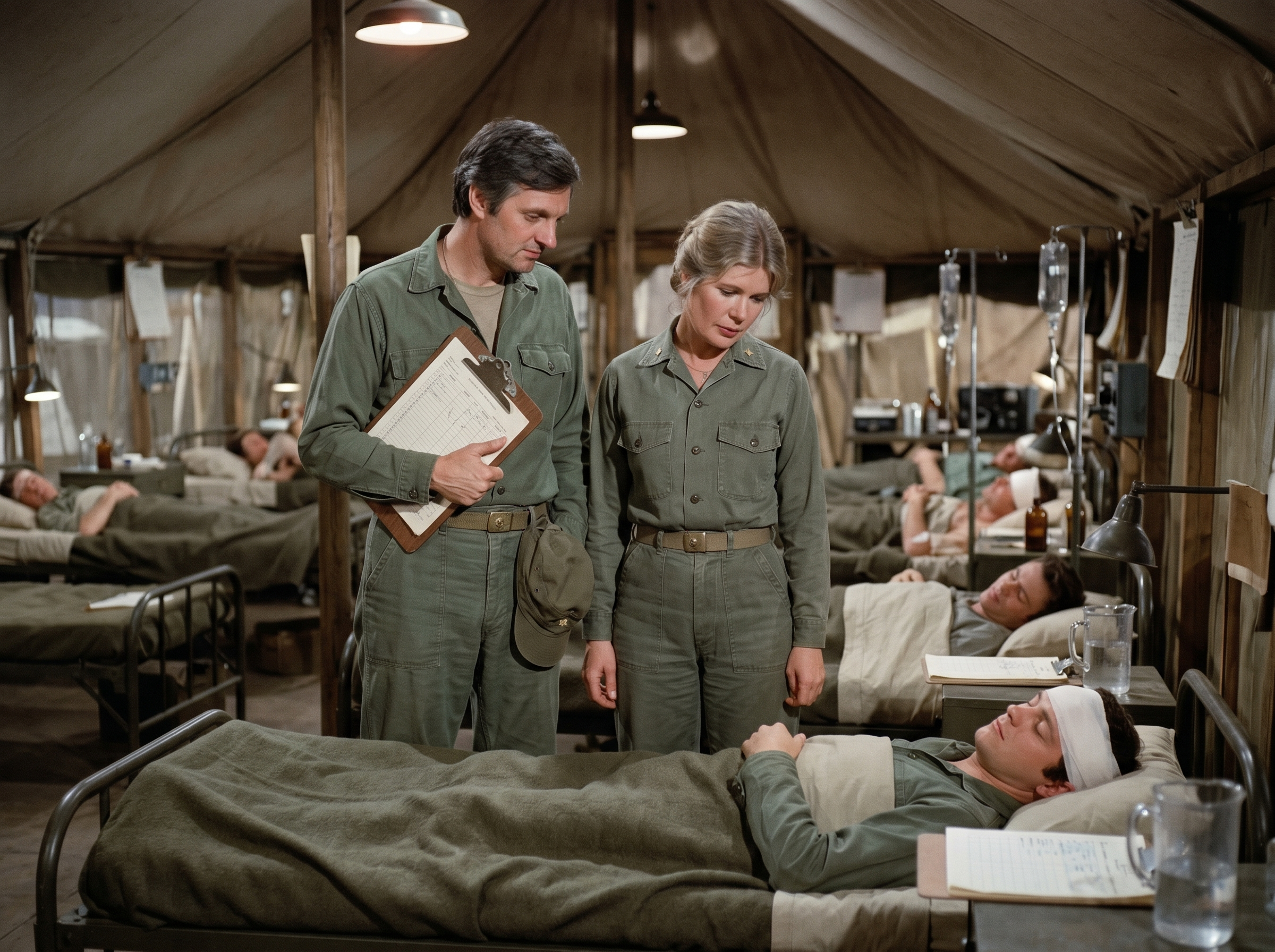
The silence in the Post-Op ward was always louder than the helicopters.
During the day, the 4077th was a chaotic symphony of roaring engines, shouting medics, and the relentless, mechanical hum of the generators. But at three o’clock in the morning, after an eighteen-hour shift in the operating room, the world shrank down to the size of a single canvas tent.
The air was heavy, smelling faintly of antiseptic, damp wool blankets, and the lingering metallic tang of the war they were all trying to pause.
Hawkeye Pierce stood at the foot of a narrow metal cot. He was still wearing his faded, blood-stained scrub shirt, his shoulders slumped beneath the invisible weight of the past two days.
The usual rapid-fire jokes and defensive sarcasm that kept him moving had completely evaporated. Right now, there was no audience to entertain. There was no generals to mock, no brass to infuriate. There was only the quiet, rhythmic breathing of the young men they had spent the entire night fighting to keep alive.
In his hands, Hawkeye held an aluminum medical clipboard. The charts were filled with his own hurried handwriting, the ink smudged from tired fingers and the sweat of the O.R.
He stared at the paper, his expression deeply and thoughtfully concerned. Beneath his exhausted eyes, the quiet wounds of the war were laid bare. He was reading the vitals, but his mind was replaying the moment they almost lost the kid on the table.
Standing just a few feet away, Margaret Houlihan was looking down at the same patient.
She wasn’t standing at attention. The rigid, demanding posture of the head nurse was gone, replaced by something entirely different. In the pale, gentle glow of the practical bedside lamps, she looked undeniably human.
Her uniform was practical, worn, and lived-in. The crispness of her usual daytime appearance had surrendered to the reality of the 4077th.
Margaret’s eyes were sharply focused on the young private’s pale face, but her expression was quietly moved. There was a hidden warmth in the way she stood over him, a fiercely protective tenderness that she rarely let the rest of the camp see.
The boy in the bed couldn’t have been more than nineteen. He had a bandage wrapped thick around his chest, and his breathing was shallow but steady.
Margaret reached out, her movements slow and deliberate. She gently adjusted the muted, olive-drab blanket, pulling it just an inch higher over the boy’s shoulder. It was a small, maternal gesture, completely out of place in a war zone, yet it was the most natural thing in the world.
Hawkeye watched her for a moment. He opened his mouth to say something, to offer a dry quip about the terrible lighting or the lumpy mattresses, but the words wouldn’t come.
His throat felt like it was lined with sandpaper. He looked back down at the clipboard, and suddenly, the neat rows of numbers began to blur together.
The adrenaline that had kept his hands perfectly steady for eighteen hours suddenly abandoned him. His fingers began to tremble against the cold aluminum. He gripped the edges of the clipboard tighter, trying to force the shaking to stop, but the fatigue was too deep.
The weight of every letter he would have to write to the families of the boys who didn’t make it, and the overwhelming, terrifying fragility of the ones who did, came crashing down on him all at once.
He closed his eyes, leaning heavily against the wooden frame of the cot. The clipboard slipped from his fingers, clattering loudly against the dirt floor, the sound echoing like a gunshot in the quiet tent.
Hawkeye flinched at the noise, keeping his eyes squeezed shut, waiting for Margaret to bark an order about protocol or noise discipline.
Instead, there was only the soft rustle of her canvas uniform.
Margaret stepped closer, moving into his line of sight. She didn’t say a word. She smoothly bent down and picked up the fallen clipboard from the dirt. She tapped it against her leg to knock off the dust, her movements calm and entirely devoid of judgment.
She looked at the chart for a long moment, tracing the line of the boy’s falling fever with her eyes.
“His pressure is stabilizing, Pierce,” she said. Her voice was barely a whisper, completely stripped of her usual brassy command. It was soft, grounded, and intensely reassuring.
Hawkeye opened his eyes and looked at her. Really looked at her.
He saw the dark smudges of exhaustion under her eyes, the stray strands of blonde hair that had escaped her usually flawless bun. In this muted, pale green light, they weren’t sparring partners or opposing forces. They were just two tired people holding up the roof of the world.
“I thought we lost him, Margaret,” Hawkeye said, his voice cracking slightly. “When his pressure bottomed out… I thought I was too slow. I thought my hands were too slow.”
Margaret stepped to his side, their shoulders almost touching. The body language between them spoke of years of shared history, of thousands of hours spent standing across from each other over open wounds.
“You weren’t slow,” she said firmly, her eyes never leaving his face. “You were perfect. I was right there. I handed you the clamps. I saw it.”
Hawkeye let out a long, shaky breath, running a hand through his unkempt hair. He offered a weak, crooked smile, trying desperately to find his footing.
“If he survives my sewing, he’s definitely going to need a tetanus shot just from looking at my face,” Hawkeye murmured, the dry wit finally surfacing, though it lacked its usual sting.
Margaret smiled back. It was a real, unguarded smile that reached her eyes. It was the kind of smile she kept locked away from the generals and the visiting brass, reserved only for the people in this muddy valley who actually understood her.
“Your face is a tragedy, Captain, I’ll give you that,” she whispered back affectionately. “But your hands are fine.”
She tapped the clipboard gently against his chest, handing it back to him. He took it, his fingers steady again. The simple, physical reassurance of her presence had anchored him.
“Come on,” Margaret said softly, nodding toward the small nurses’ station at the center of the ward. “Before you fall over and become one of my patients. I think there’s half a pot of something claiming to be coffee left on the burner.”
Hawkeye followed her. They walked slowly down the center aisle, moving between the rows of cots like ghosts keeping watch.
The coffee was exactly as terrible as Hawkeye expected. It tasted like boiled mud and despair, served in dented tin mugs that burned their fingers.
But as they stood near the small wooden desk, sipping the awful brew in comfortable silence, the trembling in Hawkeye’s chest finally stopped.
He looked out over the ward. The pale canvas ceiling seemed to breathe with the wind outside. The soft, analog warmth of the lamps cast long, comforting shadows across the beds.
Margaret stood beside him, holding her mug with both hands, her posture relaxed. She didn’t need to be the iron major right now, and he didn’t need to be the untouchable clown. They were simply bearing witness to the quiet miracle of a peaceful night.
“He asked about his dog,” Margaret said suddenly, her voice barely carrying over the hum of the heater. “Before the anesthesia took him under. He asked if I thought his dog was getting enough to eat back in Ohio.”
Hawkeye looked down into his coffee mug, a familiar ache settling behind his ribs. “What did you tell him?”
“I told him his dog was probably eating better than we are,” she said softly, a hint of a tear shining in the corner of her eye before she blinked it away. “I told him he needed to wake up so he could go home and feed him.”
Hawkeye looked at Margaret. He saw the fierce compassion that fueled everything she did. She was tough because she had to be, because caring this much in a place like this could break a person in half.
He reached out, his knuckles lightly brushing against the sleeve of her uniform in a rare gesture of quiet affection.
“You did good today, Margaret,” he said quietly. “You did real good.”
Margaret looked down at her mug, her cheeks flushing slightly in the dim light. She didn’t brush off the compliment or deliver a sharp retort. She just accepted it, knowing exactly what it cost him to say it, and what it meant to her to hear it.
“So did you, Hawk,” she replied softly. “So did you.”
They turned back to look at the ward. Outside, the pitch black of the Korean night was just beginning to soften into the pale, muted whites of early dawn. The choppers would be coming again soon. The war would wake up, and the madness would start all over again.
But for now, in the quiet sanctuary of Post-Op, the boys were sleeping, the coffee was hot, and they were not alone.
In a place designed for breaking, the only thing that kept them whole was the quiet grace of holding on to each other.