The Weight of a White Envelope
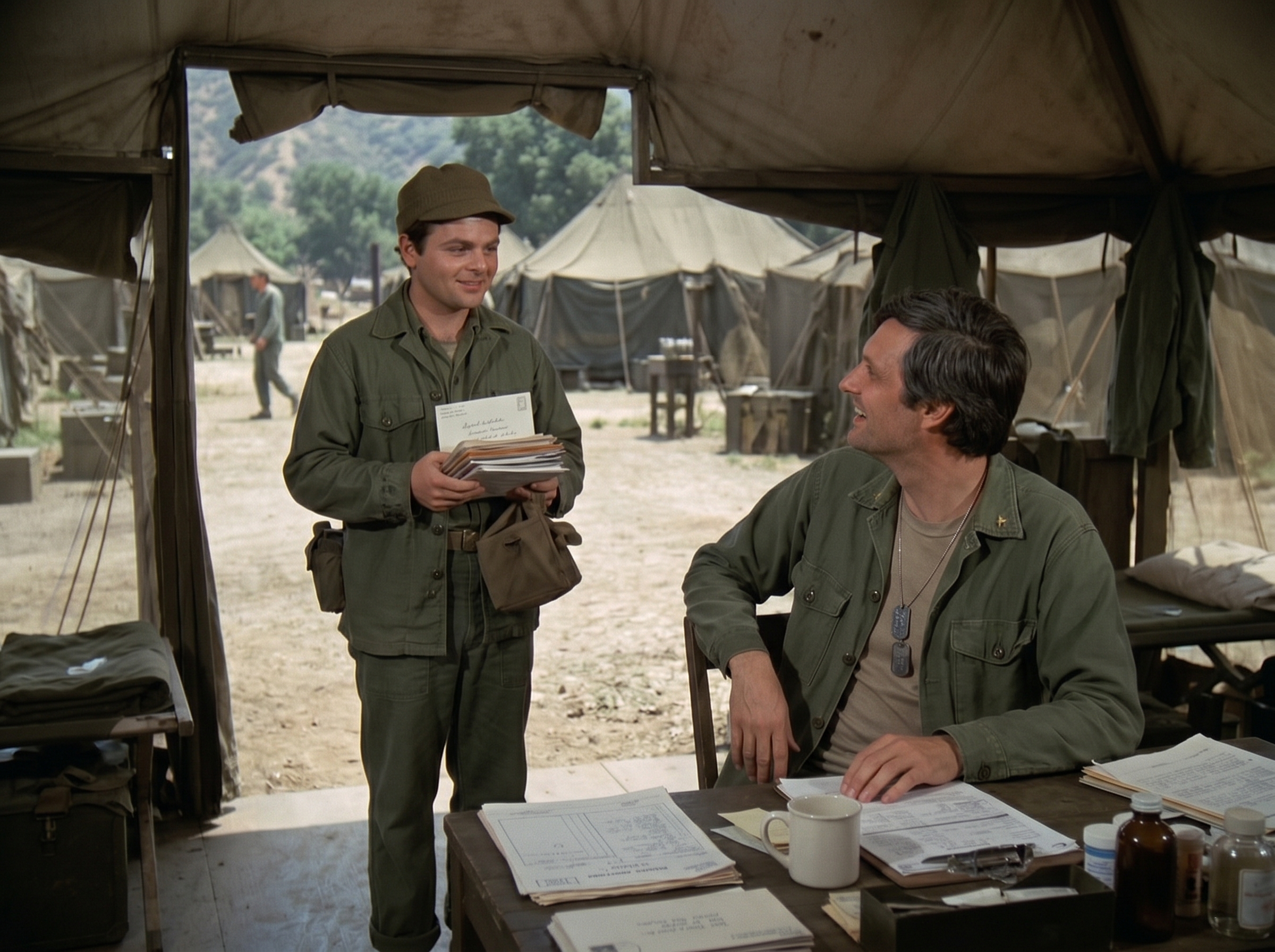
There were days at the 4077th when the dust seemed to settle right into your bones, ignoring the skin entirely. The war wasn’t just out there on the horizon; it was a heavy, olive-drab blanket pressing down on everything, suffocating the air inside the Swamp.
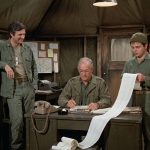
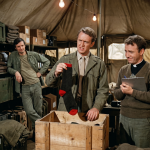
Hawkeye Pierce sat slumped at an improvised table, a wobbly contraption made of a requisitioned supply crate and sheer, stubborn willpower. He was wearing his exhaustion like a second skin.
His uniform was rumpled, his hair uncombed, and his shoulders carried the invisible weight of three consecutive days of endless triage. The soft, muddy indoor light of the tent caught the deep circles under his eyes as he stared at a lukewarm mug of something that only legally qualified as coffee.
He was trying to write a letter home, but the pen felt like it weighed fifty pounds. How do you explain the madness of a mobile army surgical hospital to someone sitting in a peaceful armchair in Maine? He let out a long, ragged sigh, ready to give up and surrender to the narrow comfort of his canvas cot.
Then came the familiar, quiet scrape of a boot against the dirt outside.
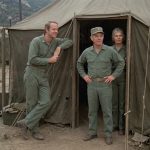
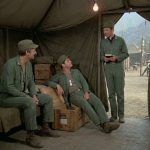
The heavy canvas tent flap pulled back, letting in a sudden, sharp shaft of daylight from the dusty camp path. Standing in the doorway, caught in that transitional space between the blinding reality of the compound and the shadowy refuge of the Swamp, was Radar O’Reilly.
The corporal didn’t barge in. He rarely did. He stood half-entering the space, framed perfectly by the rough green doorway, bringing a gentle shift to the stagnant air.
Radar was holding a thick stack of mail envelopes against his chest like a fragile treasure. He wore that familiar, shy smile—an expression so purely innocent and eager that it almost hurt to look at after a 48-hour session in the operating room.
His oversized glasses caught the reflection of the tent’s interior, and his posture was practically vibrating with quiet anticipation. He looked like a kid who knew a wonderful secret and was just waiting for permission to share it.
Hawkeye looked up from his empty notepad, his face initially locked in that familiar mask of cynical fatigue. “If that’s another directive from General Headquarters telling us to conserve tongue depressors, Radar, I’m going to eat this table.”
“No, sir,” Radar said softly, his voice carrying that distinct, boyish earnestness. “Mail call isn’t officially until fourteen-hundred hours. But I was sorting the bags, and, well…”
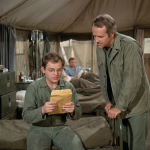
Radar took a half-step further into the tent, the dusty beige light catching the top of the stack. He carefully slid his thumb across the envelopes, separating one distinct, crisp white square from the rest of the olive-drab and manila pile.
He held it out, the front of the envelope catching the soft indoor light.
Hawkeye’s eyes moved from Radar’s eager face down to the handwriting on the paper. In an instant, the cynical, exhausted mask shattered entirely, replaced by something so raw and open it took all the air out of the room.
The shift in Hawkeye’s posture was immediate. The rumpled, bone-tired surgeon vanished, replaced by a sudden, emotionally alert warmth that reached all the way to his eyes.
He sat up straight, the heavy fog of the Korean War lifting from his shoulders in a matter of seconds. He recognized that neat, careful, doctor’s scrawl instantly. It was the handwriting he had been silently, desperately hoping to see for three agonizing weeks.
“Is that…?” Hawkeye started, his voice suddenly thick, losing all its usual sarcastic armor.
“Yes, sir,” Radar beamed, stepping fully into the Swamp now. “From your dad. Postmarked Crabapple Cove. I saw it near the bottom of the sack and figured you wouldn’t want to wait until the official distribution.”
Hawkeye reached out, his hand actually trembling just a fraction of an inch as he took the envelope from Radar’s hands. He held it gently, as if handling a delicate surgical instrument.
He brushed his thumb over the return address. For a moment, the smells of antiseptic, mud, and stale beer vanished. He could swear he smelled pine needles and the salty air of the Atlantic ocean.
“I was starting to think the postal service had forgotten where Maine was,” Hawkeye murmured, a soft, authentic smile breaking across his face.
Radar stood by, shifting his weight slightly from foot to foot, his shy smile widening. He didn’t leave right away. He knew, with that profound, unspoken intuition he possessed, exactly what this specific letter meant. Hawkeye hadn’t heard from his father since a bad storm had reportedly knocked out the coastal power lines back home, and the silence had been quietly eating the chief surgeon alive.
“My Uncle Ed once went a whole month without writing my mom,” Radar offered gently, trying to fill the quiet space. “Turned out he just dropped his glasses in the tractor tiller and couldn’t see the paper. But she was worried sick.”
Hawkeye let out a genuine, quiet laugh, the sound warm and melodic in the cramped tent. “Well, knowing my father, he probably just got into an argument with a stubborn lobster and refused to write until he won.”
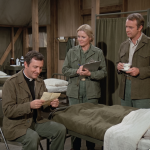
He slid his finger under the flap of the envelope, the sharp crinkle of the tearing paper sounding louder than a jeep engine in the quiet of the Swamp. He pulled out the folded pages, his eyes scanning the first few lines.
The tension he didn’t even know he was holding finally released its grip on his spine. His father was fine. The house was fine. Everything back in the real world was exactly where he had left it.
“He says the tomatoes are coming in nicely,” Hawkeye said softly, almost to himself, though he knew Radar was listening. “And that Mrs. Peterson says hello.”
“That’s real nice, Captain,” Radar said, his voice lowering to a respectful, tender whisper. He knew his job here was done. He had delivered the medicine. “I’ll, uh… I’ll go finish sorting the rest. Got a package for Major Winchester that smells like fancy cheese. Or old socks. Hard to tell.”
“Radar?” Hawkeye called out just as the corporal turned back toward the bright, dusty opening of the tent.
Radar paused, looking back over his shoulder. “Yes, sir?”
Hawkeye looked up from the letter, his eyes shining with a profound, unspoken gratitude. There was no joke this time. No sharp wit to deflect the emotion. Just two men standing in the middle of a war zone, anchored by the simple grace of a delivered promise.
“Thank you,” Hawkeye said quietly. “For not making me wait.”
“You’re welcome, Hawkeye,” Radar smiled softly, the innocent eagerness settling into a deep, mutual understanding.
Radar slipped out through the canvas flap, the heavy material falling back into place and sealing off the bright, harsh world of the compound.
Alone again in the Swamp, Hawkeye leaned back against his cot. He didn’t feel the heat anymore. He didn’t feel the exhaustion in his bones. He just held the letter in both hands, letting the words carry him thousands of miles away, back to a porch in Maine where the tomatoes were coming in nicely.
For the next ten minutes, there was no war. There was only the quiet, beautiful humanity of a voice from home, wrapped in a simple white envelope.
In a place built on the machinery of war, the strongest armor they had was the quiet, enduring love carried in the hands of a friend.