The Coffee, the Mud, and the Silent Alliance
Some mornings in Korea don’t begin with a bugle or a mortar blast. They begin with the heavy, unyielding silence of a 14-hour session in the Operating Room.
When the last stitch is finally tied and the heavy rubber aprons are peeled off, the silence doesn’t leave you. It follows you right out into the compound, settling deep into your bones like the dust from the road to Seoul.
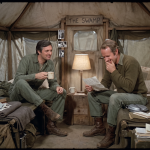
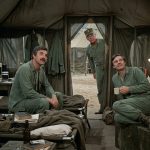
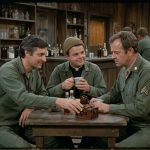
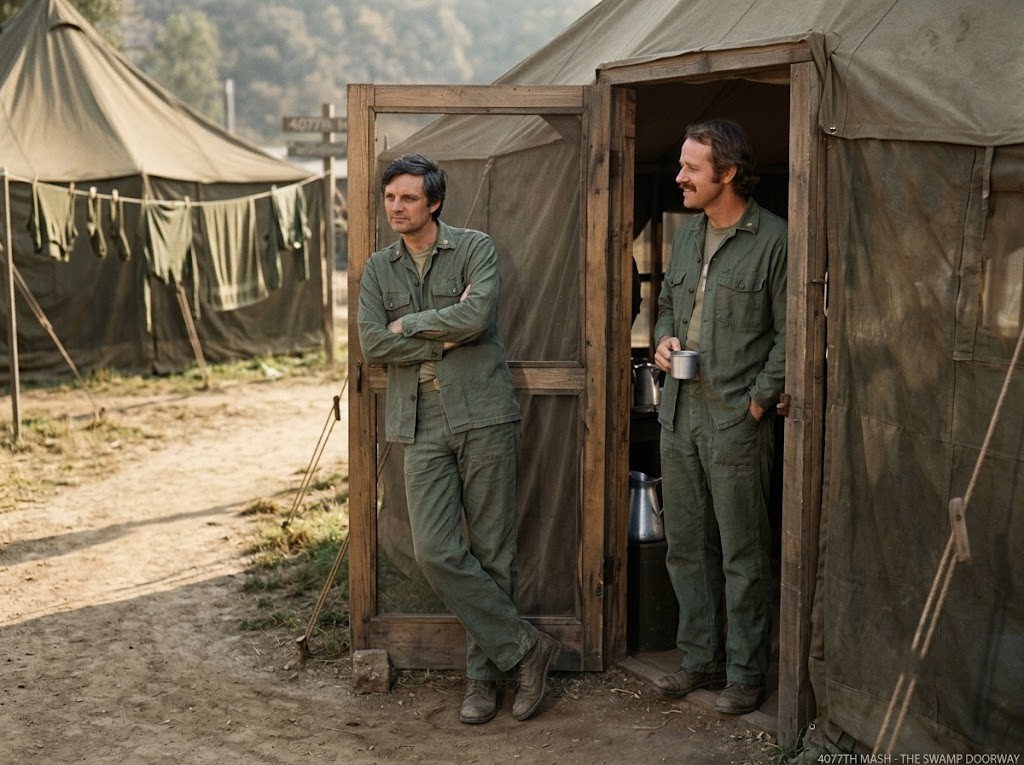
Hawkeye Pierce leaned his shoulder against the weathered frame of the Swamp’s screen door, his arms tightly crossed over his faded green fatigues. He didn’t look at the sky, and he didn’t look at the graveyard of empty coffee cans near the door. He just stared out into the middle distance, past the clothesline where a row of olive-drab socks hung limp in the morning air. His face was a map of exhaustion, his dark hair disheveled, his jaw set in that quiet, intense way that usually meant his mind was still fixing a bleeder that had already been saved.
Right behind him, lingering just inside the doorway, B.J. Hunnicutt held a battered metal mug of Army coffee. A faint, tired smile touched the edges of his mustache, though his eyes carried the exact same weight as his bunkmate’s. He kept one hand tucked carelessly into his pocket, offering a posture of relaxed comfort that he didn’t entirely feel, serving as the steady anchor Hawkeye so desperately needed after a rough night.
They had been standing there for ten minutes without exchanging a single word. They didn’t need to; the shared ache in their shoulders and the smell of antiseptic clinging to their skin spoke loudly enough.
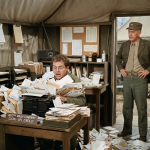
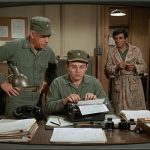
The compound around them was just waking up, the pale morning light casting long shadows across the dirt. In the distance, the faint, unmistakable sound of a clipboard scraping against a desk echoed from the administrative tent. Radar O’Reilly was already at it, his oversized cap tilted forward as he moved silently between tents, trying not to wake the sleeping doctors but clearly carrying a piece of news that couldn’t wait.
Hawkeye didn’t move an inch as Radar approached, but his eyes narrowed slightly. “If that’s another casualty report, Radar, tell them we’ve closed up shop and moved to San Francisco,” he murmured, his voice dry and scratchy.
Radar stopped a few feet away, clutching his clipboard like a shield. He looked at Hawkeye, then glanced nervously past him to B.J., his young face tight with an anxiety that went beyond the usual paperwork stress.
“It’s not a report, Captain,” Radar said softly, his voice dropping to a conspiratorial whisper. “It’s Colonel Potter. He’s inside his office, and… well, he’s just sitting there. He won’t look at the roster, and he won’t drink his tea. He told me to leave him alone, but he said it… he said it real quiet-like.”
B.J. took a slow sip of his lukewarm coffee, his smile fading into a look of genuine concern. A quiet Colonel Potter was far more dangerous, and far more heartbreaking, than a shouting one.
“Did something happen in post-op?” B.J. asked, leaning forward slightly against the doorframe.
“No, sir,” Radar whispered, his eyes darting toward the administrative tent. “It’s a letter from home. It came in the midnight pouch. He’s been in there by himself ever since.”
Hawkeye shifted his weight, his arms tightening across his chest as a cold dread settled over the small group. In the 4077th, a letter that kept a man up all night in total silence was the one thing no scalpel could ever fix.
The screen door creaked slightly as Hawkeye finally uncrossed his arms, the lazy posture vanishing. He exchanged a long, meaningful look with B.J., the silent shorthand of their friendship doing the work of a dozen sentences.
Before either of them could step out into the mud, the door to the office tent swung open. Colonel Potter stepped out, his posture stiff, his shoulders squared in that old cavalry manner that refused to give in to fatigue. But his eyes were red-rimmed, and his usual fierce demeanor was replaced by a fragile, transparent dignity. He held a crumpled piece of paper tightly in his right hand.
From across the compound, Major Margaret Houlihan was marching toward the administrative tent with a stack of supply logs. She stopped in her tracks when she saw the Colonel’s face. The sharp, professional reprimand she had been preparing for a lazy orderly died on her lips. Instead, her chin softened, and a look of deep, maternal protectiveness crossed her features. She quietly set her logs down on a nearby crate and moved closer, her presence a silent offering of support.
Even Major Charles Winchester, who had been grumbling loudly as he stepped out of his own tent to complain about the quality of the morning air, caught the sudden shift in the compound’s atmosphere. He paused, adjusting his pristine uniform jacket, his sarcastic remark fading into a rare, solemn silence. He didn’t approach, but he remained standing nearby, his arms folded, watching with an unusually soft expression that betrayed his aristocratic reserve.
Colonel Potter walked slowly toward the Swamp, his boots kicking up small puffs of dust. He stopped just a few feet from Hawkeye and B.J., looking up at the two younger surgeons. He looked at the metal mug in B.J.’s hand, then down at the dirt, swallowing hard.
“Mildred’s brother,” Potter said, his voice a low, gravelly rasp that lacked its usual bark. “The young one. Just a boy, really. Went into the VA hospital in Indiana last week. Didn’t make it out. Pneumonia.”
The silence that followed was heavy, filled only by the distant hum of a generator and the flapping of the canvas tents in the morning breeze.
Hawkeye took a step down from the wooden stoop, his boots sinking into the dirt. He didn’t offer a grand speech or a philosophical joke. He just extended a hand and gently placed it on the old man’s shoulder, his grip firm and steady. It was the same hand that had spent the night fighting for the lives of strangers, now offering whatever warmth it had left to the man who kept them all together.
“I’m sorry, Sherman,” Hawkeye said quietly, using the Colonel’s first name with a rare, tender reverence that bypassed all military protocol.
B.J. stepped down beside them, extending his mug. “It’s freshly stolen from the mess hall, Colonel. Black as sin and twice as hot. Just the way you hate it.”
A tiny, breathless laugh escaped Potter’s lips, a small crack in the armor of his grief. He reached out and took the mug, his gnarled hand brushing against B.J.’s. He took a long sip, wincing slightly at the bitter taste, but he didn’t let go of the cup.
“Tastes like battery acid,” Potter muttered, though his eyes shone with a deep, profound gratitude. He looked around the small circle—at Radar standing guard with his clipboard, at Margaret watching with fierce loyalty, at Charles offering his silent respect from a distance, and at the two tired bastions of wit standing right beside him.
Father Mulcahy appeared from around the corner of the chapel tent, having observed the quiet gathering. He didn’t intrude with prayers or sermons; he simply offered a small, comforting nod, his gentle presence reassuring them that even in this forgotten corner of the world, grace could still be found in the mud.
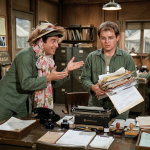
Klinger, who had been walking by in a vibrant, oversized sun hat, quietly took the hat off and held it against his chest, standing perfectly still out of respect for the old man’s sorrow.
Potter took another sip of the terrible coffee, his shoulders relaxing just a fraction. The grief wasn’t gone—it would stay with him through the next triage, the next helicopter arrival, and the next long night—but the weight of it had changed. It was no longer his alone to carry. It was distributed evenly among the family he had found in the middle of a war zone.
“Well,” Potter said, clearing his throat roughly and handing the mug back to B.J. “The day isn’t getting any younger, and the army isn’t getting any smarter. Let’s get to work.”
He turned and walked back toward his office, his stride a little lighter, his head held a little higher. Margaret immediately moved to follow him, falling into step as his faithful second-in-command, while Radar scampered ahead to open the door.
Hawkeye climbed back onto the wooden stoop of the Swamp, returning to his spot against the doorframe. B.J. stood beside him, looking down at the remaining coffee in his mug. The morning sun was fully up now, warming the canvas tents and casting a bright, golden glow over the camp.
“You know,” Hawkeye said, his wit returning like a familiar old coat, “if we don’t find a way to get better coffee around here, the tragedy won’t be from the war. It’ll be from the bean.”
B.J. smiled, taking a sip. “To the bean, Pierce. And to the family.”
They stood there together for a few more minutes, leaning against the screen door, watching the 4077th move into the rhythm of another long day, bound together by the invisible threads of a love that didn’t need a name.
In a place built on temporary structures, the love they had for one another was the only thing made to last.