The Switchboard Symphony of the 4077th
Some days in Korea didn’t start with the sound of incoming choppers or the frantic call for doctors to pre-op.
Some days began with a quiet, insidious kind of chaos—the kind that arrived on copper wires, buzzing through the switchboard like a swarm of angry hornets.
Corporal Walter “Radar” O’Reilly knew the difference between a normal Tuesday and a bureaucratic nightmare before his boots even hit the floor of the clerk’s office.
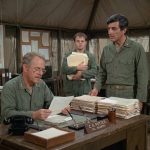
By mid-morning, the desk looked less like an administrative hub and more like a battleground of paper, pencils, and tangled cords.
The green typewriter sat squarely in the center, holding a half-typed requisition form that was already three hours overdue to Seoul.
But Radar couldn’t type a single letter because his hands, his shoulders, and his very sanity were currently occupied by the United States Army communications network.
In his left hand, he gripped a heavy black receiver, pressed tightly to his ear to catch a faint, static-choked voice from the I-Corps supply depot.
In his right hand, another receiver was clamped against his spectacles, listening to a furious quartermaster in Tokyo who claimed they had run out of Type-O negative blood.
Another cord was draped haphazardly over his shoulder, a third receiver dangling like a pendulum near his chest, squawking a string of high-pitched demands from General Hammond’s office.
Radar’s eyes were wide, behind his round lenses, filled with the frantic, deer-in-the-headlights panic that only a nineteen-year-old from Iowa could manage when the fate of an entire mobile army surgical hospital rested on his shoulders.
“Yes, sir! No, sir! I mean, yes, Tokyo, we need the plasma, not the pajamas!” Radar stammered, his voice cracking slightly under the strain. “Wait, hold on, Seoul—don’t hang up! If you click off now, I’ll lose the connection to the front!”
Just then, a shadow fell across the room.
Colonel Sherman T. Potter stepped into the doorway, his hands resting casually on his hips, his posture a stark contrast to the frantic energy vibrating from the desk.
He didn’t shout. He didn’t order everyone to attention.
Instead, the old cavalry officer just stood there, a soft, knowing, almost fatherly smile playing at the corners of his mouth beneath his neat gray mustache.
He looked at the nameplate on the desk—the one that read “CPT. B. PIERCE,” which Hawkeye had jokingly left there after a card game—and then looked at the kid from Ottumwa who was currently playing a one-man orchestra with the U.S. Army’s phone lines.
Potter took a slow breath, his eyes crinkling with a mix of deep affection and weary amusement.
“Son,” Potter said softly, his voice carrying the calm weight of a man who had seen two World Wars and didn’t easily rattle. “You look like a man trying to wrestle an octopus in a dark room.”
Radar didn’t even look up; his eyes were darting between the three different receivers as the static on the I-Corps line suddenly grew deafeningly loud.
“Colonel! It’s the 8063rd, and Tokyo, and the front lines at Outpost Harry!” Radar gasped, his knuckles turning white as he gripped the plastic. “They’re all talking at once, sir, and… and I think one of them is about Hawkeye’s father.”
The room went dead silent, save for the tinny, distant squawking coming from the receivers.
Colonel Potter’s smile vanished, replaced instantly by the sharp, focused gaze of a commander who cared deeply for every soul under his roof.
He took two deliberate steps into the office, his boots clicking softly on the wooden floorboards, his presence instantly anchoring the room.
“Give me Tokyo,” Potter commanded, stretching out a steady hand.
“I… I can’t, sir! If I let go of this one, the whole grid collapses!” Radar cried, his breath catching in his throat. “The operator in Seoul said the lines are failing because of the shelling near the valley. This might be the last connection we get for days.”
Potter stopped. He looked at Radar’s face—the sweat breaking out on the boy’s forehead, the sheer, unadulterated dedication in those young eyes.
Radar wasn’t just handling administrative paperwork; he was keeping the lifeline open for the entire camp, trying to shield his friends from the chaos of the outside world.
“Alright, Walter,” Potter said, using the boy’s real name, his tone dropping into a warm, reassuring gravel. “Take a breath. Iowa boys don’t quit, and neither does the 4077th. Talk to me. What about Pierce’s dad?”
Radar blinked, swallowing hard, trying to separate the voices in his ears.
“It’s… it’s not bad news, sir,” Radar whispered, a sudden wave of relief washing over his face, softening the panic. “Tokyo was trying to relay a message from Crabapple Cove. Hawkeye’s dad… he sent a telegram. He wanted Hawkeye to know the winter storms didn’t break the old pier this year. He said the lobsters will be waiting.”
Potter’s shoulders dropped an inch, a soft sigh escaping his lips. A slow, gentle warmth returned to his eyes.
In the middle of a forgotten war, surrounded by mud, misery, and the constant threat of the operating room, a father thousands of miles away had found a way to reach through the static just to tell his son that home was still there.
“And the 8063rd?” Potter asked quietly.
“They need three vials of penicillin, sir. They’re completely out,” Radar said, his voice stabilizing. “And the front line… they just wanted to know if we had any fresh apples left from the last supply truck.”
Potter let out a dry, chuckling snort. “Apples. The whole world is on fire, and they want apples. God love ’em.”
The Colonel stepped closer to the desk, gently reaching down. With practiced, calm movements, he took one of the receivers from Radar’s cramped fingers, placing it to his own ear.
“This is Colonel Potter,” he said into the mouthpiece, his voice firm and steady. “Seoul, listen to me. Keep this line open. I don’t care if you have to hold the wires together with your bare teeth. We have people down here who need to hear that the world is still turning.”
For the next twenty minutes, the old man and the young corporal worked side by side in the cramped, wood-paneled office.
They sorted through the bureaucratic red tape, redirected the blood plasma, promised the 8063rd their penicillin, and even found a crate of bruised apples to send up to the boys in the trenches.
By the time the static finally cut out and the lines went dead, Radar’s hands were shaking from exhaustion, but the desk was clear.
He slowly lowered the last receiver back onto its cradle, the silence of the tent wrapping around them like a heavy blanket.
Potter stayed by the desk for a moment longer, looking down at the nameplate that read “CPT. B. PIERCE.”
He reached out, his weathered hand gently tapping the wooden sign, a quiet, contemplative look crossing his face.
“You did good, Radar,” Potter said softly, his voice thick with a quiet pride. “You give this camp its heart, you know that?”
Radar looked up, his spectacles sliding slightly down his nose. He offered a small, tired, but deeply grateful smile.
“Just doing my job, Colonel,” Radar whispered.
“No,” Potter replied, turning toward the doorway to head back out into the mud of Korea. “You do a hell of a lot more than that.”
As the afternoon sun filtered through the screen door, casting long shadows across the typewriter and the stacks of paper, the camp outside seemed just a little bit lighter, held together by nothing more than a few frayed wires, a lot of heart, and the family they had built in the middle of nowhere.
Sometimes, the most important lives saved at the 4077th were the ones kept alive by a voice on the other end of the line.