A Little Toledo Sunshine in Post-Op
The hardest hours at the 4077th were never the ones spent in the operating room.
In the O.R., there was noise, motion, and the frantic, bloody rhythm of keeping people alive. The real battle always began afterward, in the quiet, drafty expanse of the Post-Op ward.
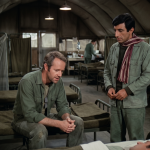
Here, the generators hummed a low, steady drone against the freezing Korean night. The air smelled of damp canvas, iodine, and the stale sweat of nightmares.
Under the dim, muted glow of the overhead bulbs, rows of cots stretched from one end of the tent to the other. Beneath the scratchy army-issue blankets lay boys who had been abruptly forced to become men.
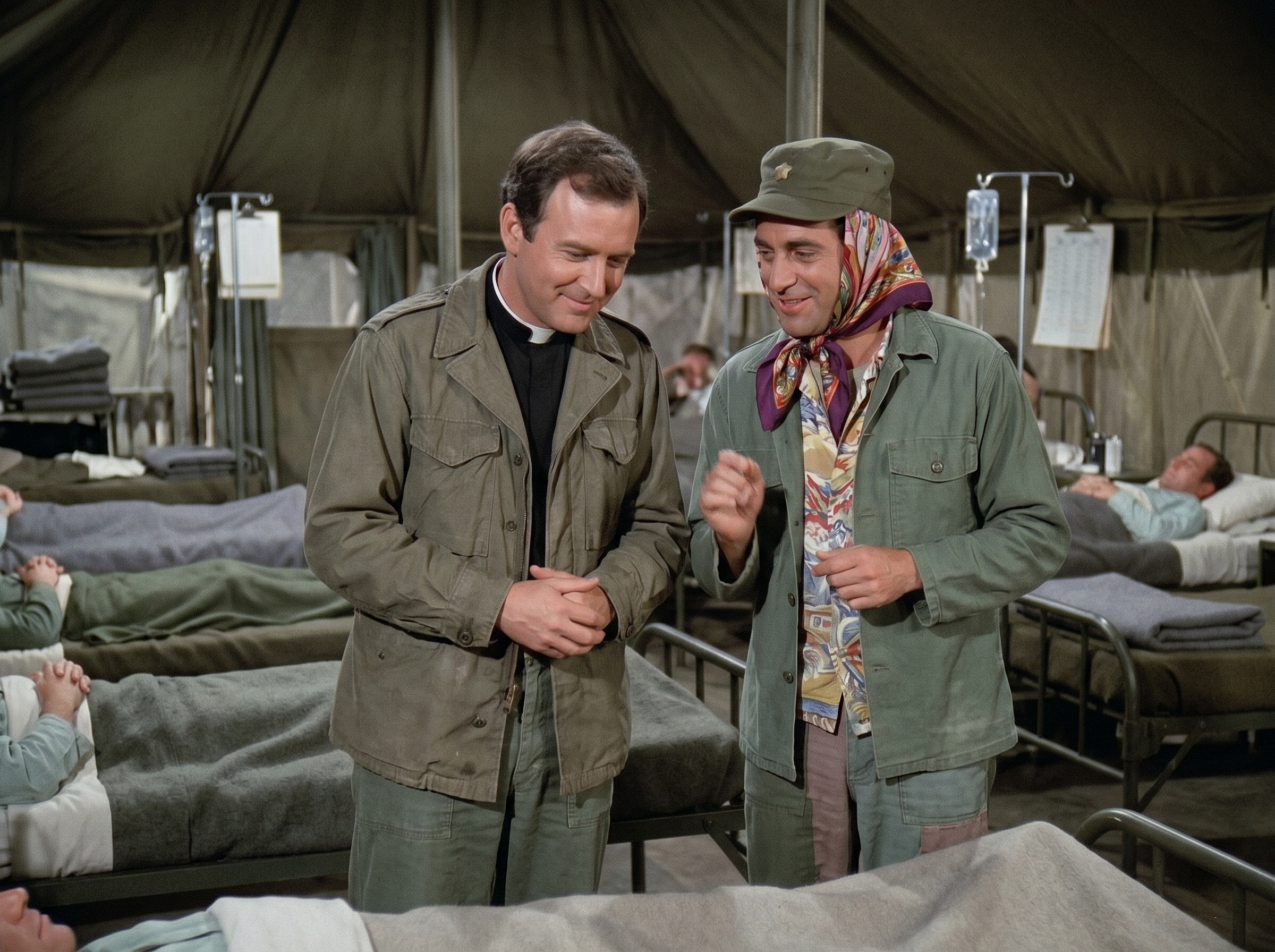
Standing by one of the cots near the center aisle was Father Francis Mulcahy. He looked exactly as he always did—modest, tired, and deeply kind.
His collar was a little frayed, and his shoulders carried the invisible, heavy burden of a thousand confessions. He was leaning in over the bedside, his hands resting gently near the unseen patient, offering a soft, reassuring smile.
Beside the chaplain stood Corporal Maxwell Klinger, a jarring splash of vibrant color against the drab, olive-drab reality of the mobile army surgical hospital.
Klinger was dressed in an eccentric, flowing red-and-gold floral ensemble, completely non-standard and wonderfully ridiculous. He had thrown his arms out wide in a grand, theatrical gesture, his face lit up with a brilliant, exaggerated expression of showmanship.
Usually, Klinger’s wardrobe was a calculated strategy, a loud, desperate plea for a Section 8 discharge and a ticket back to Toledo. But tonight, the dress wasn’t for the brass, and it wasn’t for a psychiatric evaluation.
Tonight, it was medicine.
The boy in the cot was barely nineteen. He had woken up from surgery an hour ago, completely silent, staring up at the canvas ceiling with hollow, terrified eyes.
He hadn’t spoken a word. He hadn’t asked for water, he hadn’t asked where he was, and most worryingly, he hadn’t asked if he was going to be okay.
The nurses had tried taking his vitals, but the kid was locked somewhere deep inside his own shock. The war had reached into his soul and pulled down the shades.
Father Mulcahy had come by to try the gentle approach. He spoke in low, soothing tones, offering words of comfort, telling the boy he was safe now, that the worst was over.
But the words seemed to bounce right off the invisible wall the young soldier had built around himself. The boy just blinked, his breathing shallow and fast, his hands gripping the edges of the wool blanket until his knuckles turned white.
Seeing the chaplain struggling, Klinger had quietly slipped into the tent. He knew a thing or two about wanting to disappear, about the desperate need to escape a reality that was too harsh to bear.
He had stepped right up to the bedside, throwing his arms wide, and launched into a loud, bombastic routine about his fictional Uncle Habib and a runaway camel in downtown Toledo.
He expected a laugh. He expected at least a confused blink.
Instead, the boy’s eyes suddenly filled with absolute panic. The loud noise, the sudden movement—it was too much, too fast.
The young soldier flinched violently, pulling away from Klinger and pressing himself deep into the mattress, gasping for air. The monitors beside the bed began to rattle as the boy’s heart rate spiked, a silent scream building in his throat.
Father Mulcahy immediately reached out, placing a firm, calming hand on Klinger’s brightly draped arm.
The tent fell dead silent, the air thick with sudden, heartbreaking tension. The boy squeezed his eyes shut, shaking like a leaf in the cold, trapped in a terror they couldn’t reach.
Klinger froze, his arms still half-raised in that grand, theatrical pose. The vibrant red and gold fabric of his outfit suddenly felt very heavy.
He looked over at Father Mulcahy, a flash of genuine regret passing over his usually animated features. The corporal realized instantly that his loud, vaudeville routine had been exactly the wrong medicine for a kid whose ears were still ringing from artillery fire.
Father Mulcahy didn’t scold him. The priest just offered Klinger a brief, understanding look—a silent acknowledgment that they were both just trying to help in the best way they knew how.
Mulcahy slowly turned his attention back to the trembling boy. “It’s all right, son,” the priest murmured, his voice softer than the hum of the generators. “You’re safe. We’re right here.”
But it was Klinger who made the next move. Slowly, deliberately, he lowered his arms. The theatrical bravado vanished, replaced by something much quieter, and much more profound.
He didn’t leave the bedside. He didn’t smooth his dress or make a joke about the fashion faux pas.
Instead, Klinger pulled up a small wooden stool and sat down heavily beside the cot. He leaned forward, resting his elbows on his knees, bringing himself right down to the boy’s eye level.
“Hey, kid,” Klinger said. His voice was completely different now. It wasn’t the loud, brassy tone of the camp clown. It was the grounded, weary, gravelly voice of a guy from Ohio who missed his mother.
The boy kept his eyes shut tight, still trembling beneath the thin blanket.
“I know,” Klinger said softly. “It’s loud out there. It’s crazy. And then you wake up in this damp green tent, and you think you’re still in the middle of it.”
Father Mulcahy remained standing exactly where he was, his hands folded neatly in front of him. He watched Klinger with a look of deep, quiet respect. The priest knew that sometimes, salvation didn’t come from a prayer book. Sometimes, it came from a corporal in a floral blouse.
“But look at me,” Klinger pleaded gently. “Just open your eyes for a second. I promise I’m not gonna yell.”
Slowly, hesitantly, the boy’s eyelids fluttered open. He looked sideways at the strange, hairy man wearing an outfit better suited for a Havana nightclub than a Korean combat zone.
“Look at this,” Klinger whispered, gesturing vaguely to his own chest. “Look at what I’m wearing. Does this look like the military to you?”
The boy stared. He took in the bright red fabric, the ridiculous gold pattern, the sheer, undeniable absurdity of it all.
“I’m Corporal Maxwell Q. Klinger,” he said, offering a small, crooked smile. “And I have been trying to get the army to realize I’m crazy for two years. But between you and me? They’re the crazy ones.”
A tiny spark of light flickered in the boy’s hollow eyes. The panic was slowly receding, pushed away by utter confusion.
“You think the war is bad?” Klinger whispered, leaning in closer like he was sharing a top-secret state mystery. “Wait until you see what they serve us for breakfast in the mess tent. It makes this dress look tasteful.”
Father Mulcahy offered a warm, perfectly timed sigh. “He isn’t wrong, son,” the priest added softly, a gentle twinkle in his eye. “I have prayed over the powdered eggs, and I assure you, heaven remains silent.”
The boy’s lip twitched. It was just a millimeter of movement, but in the Post-Op ward, it was a profound victory.
“So you just rest,” Klinger said, reaching out to gently adjust the blanket over the boy’s shoulder. His large, calloused hands were incredibly tender. “Because as long as I’m wearing this gorgeous ensemble, nothing bad is getting past this bed. The North Koreans wouldn’t know what to make of me anyway.”
The young soldier took a deep, shaky breath, and finally, the tension left his body. He let out a tiny, exhausted huff of air that sounded incredibly like a laugh.
He didn’t say anything, but his eyes softened. He looked at Klinger, then at Father Mulcahy, and finally closed his eyes again. This time, he didn’t look terrified. He just looked asleep.
Klinger sat there for a long moment, watching the boy’s chest rise and fall in a steady, peaceful rhythm.
When he was sure the kid was really asleep, Klinger stood up quietly, careful not to let his skirt rustle too loudly against the canvas cots.
Father Mulcahy fell into step beside him as they walked slowly down the center aisle, heading toward the heavy wooden doors of the tent. The cold air seeped in through the cracks, a sharp reminder of where they really were.
“That was a fine piece of medicine, Maxwell,” Father Mulcahy said softly, pulling his coat a little tighter around his shoulders.
Klinger looked down at his bright red dress, brushing a piece of lint off the sleeve. The old bravado began to slip back into place, a necessary armor against the harshness of the camp.
“Well, Father,” Klinger replied, adjusting his shoulders with a hint of dramatic flair. “If laughter is the best medicine, I figure a good taffeta is at least a close second.”
Mulcahy smiled, a genuine, tired expression of affection. “I’ll be sure to mention that in my Sunday sermon.”
They pushed through the doors together, stepping out into the freezing mud of the compound. The war was still waiting for them out there, loud and relentless. But inside that tent, they had won the only battle that mattered tonight.
In a place built on blood and mud, the greatest miracles were often stitched together with terrible jokes, quiet prayers, and mismatched silk.