The Salt of the Earth and the Slop in the Tray
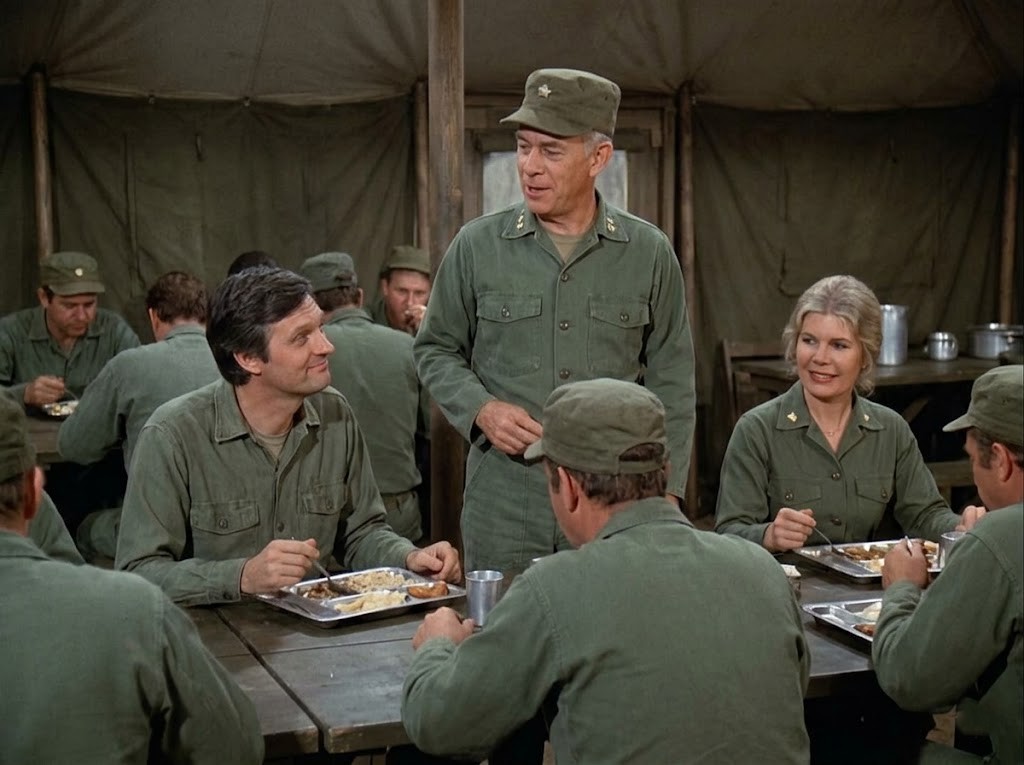
The mess tent at the 4077th always smelled exactly the same, no matter the season. It was a permanent, thick aroma of boiling cabbage, scorched coffee, and the faint, chemical tang of floor disinfectant. Today, it was supplemented by something the cooks were aggressively calling “savory meatloaf,” though nobody in the tent was brave enough to guess the animal of origin.
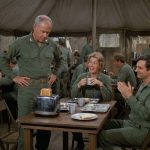
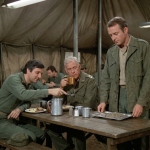
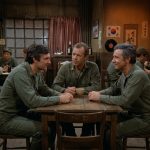
Hawkeye Pierce stared down at his tin tray, idly poking a grey mound of mashed potatoes with his fork. Next to him, BJ Hunnicutt was methodically chewing, his face wearing the stoic, blank expression of a man who had long since accepted his fate. Across the rough wooden table, Margaret Houlihan sat with her posture flawlessly straight, a solitary island of military discipline in a sea of rumpled olive drab.
“I’ve been conducting a silent study,” Hawkeye said, his voice carrying that familiar, gravelly cadence of a man who hadn’t slept a full eight hours since 1950. “I believe the mashed potatoes are actually a structural adhesive. If the artillery ever breaches the perimeter, we could just slap a few scoops of this on the bunker walls and defy the laws of physics.”
BJ didn’t look up from his tray, but a small, tired smile tugged at the corner of his mustache. “Don’t insult the glue supply, Hawk. The glue has more flavor.”
Margaret offered a sharp, brief sigh, the kind she reserved for moments when she felt her professionalism being tested by sheer civilian insolence. “It is sustenance, Captain. It keeps you on your feet in the OR, which is exactly what it is designed to do. We are in a war zone, not the Waldorf-Astoria.”
“Ah, but Margaret, my dear Major,” Hawkeye countered, leaning back and gesturing with his fork, “even the Waldorf doesn’t have our secret ingredient. The unique, earthy seasoning of North Korean dust that settles over everything like a fine, powdered despair.”
Before Margaret could snap back, the heavy canvas flap of the mess tent swung open, letting in a sudden draft of chilly, damp wind. The casual chatter in the room died down to a low hum as Colonel Sherman Potter stepped inside.
He didn’t look angry, but he looked old. The deep lines around his eyes seemed carved a little deeper today, and his shoulders carried the invisible weight of the three straight days of casualties they had just processed. He adjusted his cap, his gaze sweeping over the tables until it landed on the doctors and his head nurse.
Potter walked over slowly, his boots thudding softly against the dirt floor. He stopped right at the head of their table, hands clasped loosely behind his back.
Hawkeye looked up, his easy smile faltering just a fraction. He knew that look. It was the look the Colonel wore when a telegram had arrived from Tokyo, or when the supply lines had been cut again, or when he had to tell them that another batch of helicopters was heading their way.
“Pierce. Hunnicutt. Houlihan,” Potter said, his voice flat, dry, and entirely unreadable.
Margaret immediately shifted, her shoulders squaring even further, her fork coming to a neat rest on the edge of her tray. “Colonel. Is there news from headquarters?”
Potter looked at her, then down at Hawkeye’s tray, and finally into the eyes of each person sitting at the table. The silence stretched out, suddenly heavy, filling the space between them with the quiet anxiety that always haunted the edges of the camp.
“I’ve just come from the clerk’s tent,” Potter said softly, his hand moving to his pocket. He pulled out a crumpled piece of paper.
Hawkeye braced himself, his thumb rubbing the handle of his fork. For all his jokes, the sudden appearance of the old man with an official slip of paper usually meant the fragile peace of the mess hall was about to shatter.
“Colonel?” BJ asked quietly, the humor completely gone from his face now. He thought of Peg, of Erin, of the thousands of miles of ocean between this tent and California. Every piece of paper in this camp carried the potential to break a man’s heart.
Potter let out a long, slow breath that sounded like a deflating tire. “It’s from the registry office in Seoul. Seems we have a serious administrative crisis on our hands, and I’m looking at the chief instigators.”
Margaret blinked, her professional shield cracking just enough to show genuine confusion. “An administrative crisis, sir? My nurses have kept the charts immaculate. If this is about the missing penicillin shipment—”
“It’s not the penicillin, Major,” Potter interrupted, a sudden, sharp glint appearing in his eyes. He unfolded the paper with deliberate slowness. “It seems that three weeks ago, during the chaos of the push near the river, a certain surgeon signed off on a supply manifest using the name ‘Lazarus E. Sausage’.”
BJ covered his mouth with his hand, his shoulders beginning to shake silently.
Hawkeye didn’t even blink. He looked up at the Colonel with an expression of pure, unadulterated innocence. “A fine man, Lazarus. Comes from a long line of smoked meats. His father was a bratwurst in Ohio.”
“And,” Potter continued, ignoring the interruption as he adjusted his glasses, “the witness signature belongs to a ‘Major Gertrude Thunder-Pants’.”
Margaret’s face turned a spectacular shade of crimson. “Captain Pierce! You didn’t.”
“I was under duress, Margaret!” Hawkeye protested, his voice rising in theatrical defense. “The clipboard was cold, the pen was leaking, and the supply sergeant refused to give us the extra sterile towels unless we produced a witness of high military standing. I simply elevated your spiritual essence to the rank you deserve.”
Potter looked down at the paper, then back up at the three of them. The stern, military facade he had worn into the tent began to peel away, revealing the tired, deeply affectionate father figure underneath. He let out a dry, hacking chuckle that turned into a genuine smile.
“They’re rejecting the entire manifest, Pierce,” Potter said, tossing the paper onto the table right into the middle of Hawkeye’s mashed potatoes. “Which means I have to personally explain to a three-star general why the 4077th is operating under the medical authority of a breakfast food and a fictional amazon.”
The tension in the tent dissolved instantly, washed away by the ridiculous, beautiful absurdity of it all. BJ let out a loud, booming laugh that caused a couple of corpsmen at the next table to look over and smile. Even Margaret, despite her best efforts to maintain her outrage, let her lips twitch into a reluctant, fond smile.
“You’re a menace, Pierce,” she muttered, shaking her head as she picked up her coffee mug. “An absolute menace to the United States Army.”
“I do my best, Major. It’s a full-time job keeping us all from becoming too sensible,” Hawkeye said, his eyes softening as he looked up at the Colonel.
Potter stood there for a moment longer, looking at his people. He saw the dark circles under Hawkeye’s eyes, the faint tremor in BJ’s hands from hours of holding clamps, and the stiff, brave set of Margaret’s jaw. He knew why they did it. He knew the jokes were the only thing keeping the mud and the blood from swallowing them whole.
The Colonel reached out, gave Hawkeye a firm, brief pat on the shoulder, and turned to leave. “Fix the paperwork, Lazarus. Before I have you transferred to a sausage factory in Chicago.”
“Yes, sir,” Hawkeye said quietly, his voice losing its manic edge, replaced by a deep, unspoken gratitude.
As the Colonel walked away, his boots clicking against the floorboards near the door, the mess tent settled back into its usual rhythm. The meatloaf was still terrible, the coffee was still burnt, and the war was still waiting just beyond the hills. But inside the canvas walls, under the dim, swinging yellow lightbulbs, they had each other, a bad joke, and enough warmth to last until the next chopper arrived.
In the mud of Korea, it wasn’t the rations that kept them alive, but the family they found in the middle of the mess.