The Color of Home in the Supply Tent
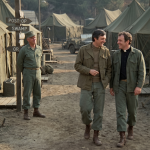
The mud outside the 4077th was deep enough to swallow a jeep, and the chill of the Korean winter was beginning to seep through the seams of every canvas tent. Inside the supply depot, the air smelled of stale canvas, damp wool, and the faint, chemical tang of laundry starch.
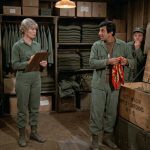
Margaret Houlihan stood with a clipboard clamped tightly in her hand, her posture as rigid as a brass button, though her eyes betrayed the exhaustion of a thirty-six-hour shift in Post-Op. She was conducting a surprise inspection of the winter issue, counting the olive-drab coats and the stacks of identical, coarse green blankets that looked more like concrete blocks than bedding.
Beside her, Maxwell Klinger was doing what Klinger did best—weaving a tapestry of frantic explanations while holding a bright, silk scarf that looked like a stray firecracker in a graveyard of gray and green. His dog tags clinked softly against the collar of his heavy wool sweater as he gestured wildly with the vibrant fabric.
“Major, I swear to you on my grandmother’s immaculate kitchen, this is not a luxury item,” Klinger pleaded, his voice a perfect mix of theatrical desperation and genuine anxiety. “It’s an essential piece of psychological armor, authorized under section four of the ‘keeping-Klinger-sane’ mandate.”
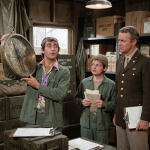
In the background, Radar O’Reilly hovered near a massive wooden crate stenciled with *4077TH M*A*S*H SUPPLY – UNIFORMS*. He bit his knuckle, his oversized cap pushed back on his head, his wide eyes darting between Margaret’s sharpening gaze and the silk scarf in Klinger’s hands. Radar knew exactly what happened when the Major’s patience ran out, and right now, the fuse was burning dangerously short.
“Corporal, this is a military installation, not a Toledo department store,” Margaret said, her voice dropping into that dangerously calm, professional register. “We are short on socks, we are short on penicillin, and we are short on patience. I am checking the manifest for winter gear, and you are waving a piece of civilian contraband in my face.”
“It’s not contraband, Major, it’s a lifeline!” Klinger insisted, taking a step closer, his eyes pleading for a shred of understanding from the formidable head nurse. “Look at the stitching! Look at the pattern! It’s the exact shade of the tablecloth my aunt used to put out for Sunday dinner.”
Margaret didn’t look at the scarf; she looked at her clipboard, her pen poised to write a citation that would likely send Klinger to the latrine digging detail for a month.
Radar took a tentative step forward, his voice barely a squeak. “Uh, Major? Sir—Ma’am? You might want to look at the shipping crate first.”
Margaret paused, her pen hovering over the paper as a heavy, sudden silence fell over the drafty supply room, the tension stretching tight enough to snap.
Margaret slowly lowered the clipboard, her eyes shifting from Radar’s nervous face to the open wooden crate where Klinger had been rummaging before she walked in.
Instead of the neat, uniform bundles of army-issue wool socks she expected to find, the top of the crate was filled with a chaotic assortment of colorful knitted caps, mismatched scarves, and hand-stitched mittens, all smelling faintly of cedar and mothballs from someone’s attic thousands of miles away.
Klinger’s theatrical demeanor dropped away in an instant, replaced by a quiet, protective stillness as he gently folded the red and gold scarf over his forearm.
“They aren’t from the army supply depot, Major,” Klinger said softly, his usual bravado completely gone. “A church group back in Ohio spent the last four months knitting them for the ‘boys in the mud.’ They sent them to my mother’s house, and she boxed them up with some of her old silk scarves and shipped them out here.”
Margaret stood frozen, looking at the bright reds, deep blues, and warm yellows spilling out of the rough olive crate. In a world where everything was camouflage, dust, and blood, the colors were almost blinding.
Radar walked over to the box, reached in, and pulled out a pair of thick, awkwardly knitted green mittens with mismatched yellow thumbs. “My mom sends stuff like this sometimes,” Radar muttered, a wave of homesickness washing over his face as he turned the mittens over in his hands. “They don’t always fit right, but they make your hands feel warm before you even put them on.”
Margaret walked over to the crate, her boots clicking softly against the dirt floor. She put her clipboard down on the edge of the wood, her fingers brushing against a brightly colored wool cap. For a long moment, she didn’t say anything, and Klinger braced himself for the lecture on regulations and unauthorized shipments.
Instead, Margaret reached into the box and pulled out a soft, cream-colored knitted scarf, holding it up to the dim light of the single hanging bulb. She looked at the uneven stitches, seeing the hours of care some stranger had poured into it, imagining a living room somewhere in America where the war felt far away, yet close enough to knit for.
“They’re completely non-regulation,” Margaret said, her voice cracking just a little before she caught herself and regained her professional composure. She looked up at Klinger, her expression softening into something deeply human. “The Colonel will have a fit if he sees the men wearing bright red in the compound.”
“I can tell them to only wear them inside the tents, Major,” Klinger offered quietly, a hopeful glint in his eye. “Under the parkas. No one has to know.”
Margaret looked down at the scarf in her hands, then back at her clipboard. With a deliberate, slow movement, she clicked her pen and scratched a line through the section of the manifest she had been filling out.
“I don’t see any contraband here, Corporal,” Margaret said, looking Klinger dead in the eye with a small, knowing smile. “Just a crate of extra-thick insulation for the winter quarters. Make sure the night shift in the OR gets the first pick. Their hands are always freezing.”
Klinger beamed, a look of pure gratitude replacing his usual scheming grin. “Major, you’re a saint. A beautiful, olive-drab saint.”
“Don’t push your luck, Klinger,” Margaret said, picking up her clipboard and turning toward the exit. “And hide that red silk scarf before Colonel Potter sees it, or you’ll be wearing it while painting the latrines.”
As she walked out into the cold Korean drizzle, Radar and Klinger exchanged a quiet look of relief. Klinger reached into the crate, pulled out a bright blue wool cap, and tossed it to Radar, who caught it with a grin, burying his nose in the wool that smelled like home.
Amidst the endless green of the 4077th, it was the small, colorful threads of home that kept the winter from freezing their hearts.