The Weight of the Glass
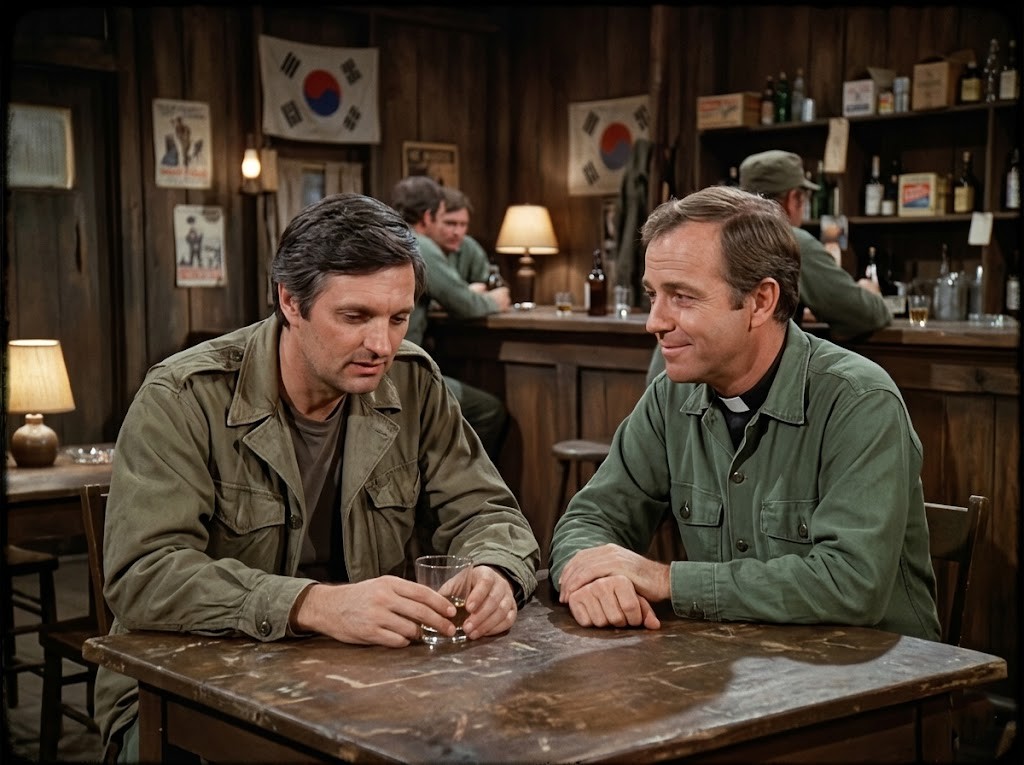
Sometimes, the loudest sound in the Officer’s Club isn’t the laughter, the clinking of glasses, or the off-key singing from the piano. It’s the silence of a man staring into three fingers of cheap local whiskey.
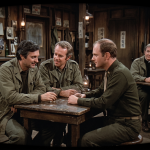
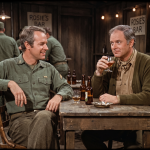
Hawkeye sat at the scarred wooden table, his shoulders slumped beneath the heavy fatigue jacket as if the fabric itself were made of lead. His fingers loosely circled the glass, tracing the rim over and over, though he hadn’t taken a single sip.
Across from him, Father Mulcahy watched quietly, his gentle face etched with the familiar, tired compassion that kept the 4077th from entirely unraveling. The South Korean flags on the wood-paneled walls behind them fluttered slightly in the draft, a constant reminder of where they were, and why they were so exhausted.
“You’ve been staring at that drink for twenty minutes, Pierce,” Mulcahy said softly, his voice cutting through the low murmur of the soldiers at the bar. “I’m beginning to think you’re trying to hypnotize it.”
Hawkeye didn’t look up, his eyes fixed on the amber liquid reflecting the warm, dim light of the table lamp. “I’m just wondering how something so small can feel so heavy, Father. I spent twelve hours in OR today lifting fragments of steel out of kids who should be home studying for midterms. But this? This little glass feels like it weighs a ton.”
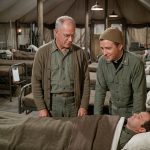
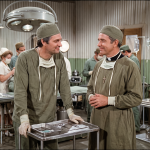
The O.R. had been a meat market that morning—a relentless, assembly-line of human suffering that stripped away the jokes and left nothing but raw nerves. Hawkeye had managed to keep his composure under the bright lights, firing off his usual rapid-fire defense mechanism of puns and banter to keep the nurses moving. But now, in the quiet aftermath, the armor had cracked.
Mulcahy leaned forward, placing his hands flat on the table, offering the steady, unblinking presence he gave to everyone from generals to privates. “It’s not the glass that’s heavy, Hawkeye. It’s everything you brought in here with you.”
“Maybe,” Hawkeye muttered, his voice dropping to a raspy whisper. “Or maybe I’m just tired of fixing things that shouldn’t be broken in the first place. I look at this glass, and all I see is the next helicopter.”
A sudden, sharp burst of laughter erupted from the bar behind them as B.J. Hunnicutt shared a joke with a couple of transit pilots, but at their table, the air remained thick. Hawkeye’s hand began to tremble slightly, a rare sight for a surgeon whose hands were normally as steady as granite under pressure.
He finally raised his eyes to meet the priest’s, and for a fleeting second, the brilliant, defiant Dr. Pierce looked completely lost, utterly defeated by the endless, grinding wheel of the war.
“Father,” Hawkeye whispered, his voice cracking slightly under a weight he could no longer hide. “What happens when the jokes don’t work anymore? What happens when I can’t find a reason to smile?”
Father Mulcahy didn’t answer right away; he knew better than to offer cheap platitudes or easy scripture to a man who had just spent the day looking into the abyss. Instead, he simply let the question hang in the air, validating the pain behind it with his silence.
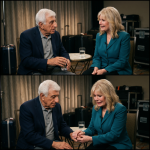
Slowly, Mulcahy reached out and placed his hand near Hawkeye’s on the table, not touching, but offering a bridge if the surgeon chose to take it.
“When the jokes fail, Hawkeye, you let the rest of us carry the smile for a while,” Mulcahy said, his voice a steady anchor in the dim room. “You don’t have to be the life of the party when the party is in the middle of a war zone.”
Hawkeye let out a long, slow breath, his shoulders dropping a fraction of an inch as the tension began to drain from his frame. A small, bittersweet smile tugged at the corner of his mouth, though his eyes remained sad. “Easy for you to say, Padre. You’ve got a direct line to the Boss. Me? I’m just an authorized mechanic for the human body, working without a manual.”
“And you do a magnificent job,” Mulcahy replied, a flash of fierce pride warming his tone. “I see the way you fight for those boys. Heaven knows, I’ve muttered enough prayers over your shoulder to know that the Lord appreciates the assist.”
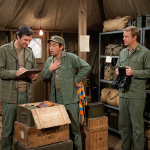
From across the room, Radar O’Reilly crept into the club, his oversized cap pulled low, holding a clipboard like a shield. He caught the somber mood at the table and paused, his innate sensitivity telling him to steer clear. He caught Mulcahy’s eye, received a reassuring nod from the priest, and quietly slipped back out into the compound, leaving the two men to their sanctuary.
Hawkeye finally let go of the glass, leaning back against the rough wooden chair. He looked around the room, taking in the familiar, mismatched environment—the makeshift bar, the tired men trying to drink away the mud, the distant, dull thud of artillery that they had all learned to tune out.
“You know, Father,” Hawkeye said, his usual dry wit filtering back into his voice like sunlight through a storm cloud. “If they ever write a book about this place, they’re going to think we made it all up. The dresses, the still in the tent, the priest who drinks with the heathen surgeons.”
Mulcahy smiled, a warm, genuine expression that crinkled the corners of his eyes. “Well, if they do write it, I hope they mention that the heathen surgeons had the biggest hearts in Korea. Even if they occasionally stole my altar wine.”
Hawkeye let out a genuine laugh then—soft, but real. The invisible, crushing weight that had filled the space between them seemed to lift, replaced by the profound, quiet understanding that only existed among the staff of the 4077th. They were a family forged in fire, held together by nothing more than shared exhaustion and an stubborn refusal to let the darkness win.
Hawkeye picked up the glass, looked at it one last time, and then set it down on the far side of the table, untouched.
“Thanks, Father,” Hawkeye said quietly, sliding his chair back. “I think I’ll skip the whiskey tonight. I’ve got a letter to write to my dad, and I want to make sure he can read the handwriting.”
Mulcahy nodded, watching as the surgeon stood up, adjusted his jacket, and walked out into the cool Korean night. The priest remained at the table for a moment longer, looking at the full glass, grateful for the small victories that didn’t involve a scalpel.
In the shadow of the tents, it wasn’t the medicine that saved them, but the quiet grace of a friend who knew exactly when to listen.